 luckpanda
Quick answer
What is a purchase order, and what should a purchase order format include?
A purchase order (PO) is the buyer's written order to a vendor to supply stated goods or services at an agreed price, by a date, on stated terms. A purchase order format shows the PO number and date, your business and the vendor with GSTINs, bill-to and ship-to addresses, each item with HSN or SAC, quantity, rate and GST, the delivery date, payment terms and the signature of an authorised person. No GST is payable on a PO.
- It binds both sides once the vendor accepts it, or when it accepts the vendor's quotation on the same terms.
- GST follows the vendor's invoice: CGST + SGST if the vendor is in your state, IGST if not.
- No journal entry is made for a PO; the entry comes with the vendor's bill.
- Paying a micro or small vendor late (beyond 45 days) costs interest and, for the buyer, the tax deduction.
Last reviewed:
On this page
- What a purchase order is
- How to fill in this purchase order format
- Purchase order format with GST: what goes where
- Worked example: a purchase order with GST
- The purchase order format, field by field
- GST on a purchase order
- Purchase order vs quotation, proforma, invoice, work order, requisition and GRN
- Three-way matching: PO, goods receipt and bill
- Types of purchase order
- Purchase order terms and conditions: a sample list
- Purchase order in accounting: no entry until the bill
- Buying from an MSME: the 45-day payment rule
- How to number purchase orders
- Amending or cancelling a purchase order
- E-way bill, delivery challan and the PO number
- Purchase order format in Excel or Word, or online
- Common mistakes on purchase orders
- Key terms
- Questions people ask
What a purchase order is
A purchase order (PO, sometimes called an indent or order form) is the document a buyer sends to a vendor to say: supply these items, in these quantities, at these prices, to this address, by this date, on these terms. The buyer issues it; the vendor receives it. It is the buyer's half of the trade, as a quotation and an invoice are the seller's.
In simple words: the quotation is the vendor saying "this is what it will cost", the purchase order is you saying "yes, send it on these terms", and the invoice is the vendor saying "here it is, please pay". The PO number then links the invoice, e-way bill, goods receipt and payment.
| Step | Document | Who issues it |
|---|---|---|
| 1. Need | Purchase requisition (indent) | A department, inside your business |
| 2. Enquiry | Request for quotation (RFQ) | You, to one or more vendors |
| 3. Offer | Quotation | The vendor |
| 4. Order | Purchase order (this page) | You |
| 5. Dispatch | Tax invoice, e-way bill, delivery challan | The vendor (e-way bill: whoever moves the goods) |
| 6. Receipt | Goods receipt note (GRN) | Your stores or site |
| 7. Booking | Vendor bill entered in your books | Your accounts team |
| 8. Payment | Payment advice | You |
When a purchase order becomes binding
Under the Indian Contract Act, 1872 an agreement starts with a proposal (section 2(a)) and becomes a promise when the other side accepts it (section 2(b)); an agreement enforceable by law is a contract (section 2(h)). Acceptance must be absolute and unqualified (section 7). That gives two cases:
- The PO accepts the vendor's quotation. The quotation was the proposal. A PO that repeats its items, price and terms is the acceptance, and the contract is formed when the PO is sent (as against you, acceptance is complete once it is put in course of transmission to the vendor: section 4).
- The PO is the first offer, or it changes the quoted price, quantity, delivery date or terms. Then the PO is a proposal (or a counter-offer), and it binds only when the vendor accepts it: by signing an order acknowledgement, by email, or by conduct such as dispatching the goods (section 8).
Some template sites say a PO is "not enforceable in court". That is not right once it has been accepted: an accepted PO is a contract, and a sale of goods under it is also governed by the Sale of Goods Act, 1930. Until acceptance, you can withdraw your PO (section 5).
How to fill in this purchase order format
- Your businessReplace the sample with your business name, billing address and GSTIN. You are the buyer, so your business heads the purchase order.
- VendorAdd the vendor's name, address and GSTIN. The GSTIN's first two digits against your state decide whether the PO shows CGST + SGST or IGST.
- DetailsSet the PO date and the "Expected by" delivery date. Write the vendor's quotation number in the notes so the PO accepts that offer.
- ItemsAdd one line per item with description, HSN or SAC, quantity, unit, rate and GST rate. Tax and the PO total update as you type.
- Notes and termsAdd the ship-to address, payment terms, delivery terms (ex-works or FOR destination) and your standard terms and conditions.
- Download PDFCheck the live preview and download the PDF free. Free PDFs carry a small LuckPanda footer with a verification code.
- Keep it in PurchasingSign in free to keep the PO as a draft in your business. Recording it in LuckPanda Purchasing gives it a PO number, turns it into a bill when the vendor invoices, and shows what is still open.
Purchase order format with GST: what goes where
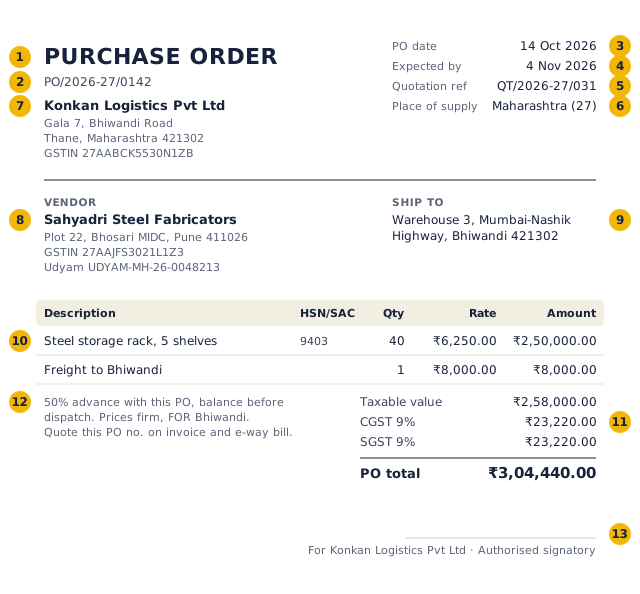
- The words Purchase order, so it is never mistaken for an invoice.
- PO number from your own series, with the financial year.
- PO date: the day you place the order.
- Expected by: the delivery date the vendor commits to.
- Quotation reference: shows this PO accepts that offer.
- Place of supply: the state where the goods are delivered.
- Your business as the letterhead: name, billing address, GSTIN.
- The vendor with GSTIN and Udyam number (if a micro or small enterprise).
- Ship-to address when goods go somewhere other than the billing address.
- HSN or SAC per line, as the vendor will invoice it.
- GST as the vendor will charge it: CGST + SGST here, both parties in Maharashtra.
- Terms: payment, price basis, delivery, documents to quote the PO number.
- Authorised signatory: who may commit the business.
| Section | What to write | Tip |
|---|---|---|
| Heading | "Purchase order", PO number, PO date | One series per financial year, e.g. PO/2026-27/0142 |
| Your business | Legal name, billing address, GSTIN, contact person, phone, email | The name on your GST registration, so the vendor's invoice qualifies for your input tax credit |
| Vendor | Legal name, address, GSTIN, Udyam number, vendor code | Check the GSTIN is active before you order |
| Ship to | Delivery address, receiving contact, working hours | Needed when the warehouse or site is not the billing address |
| References | Quotation number and date, RFQ number, contract number | Makes the PO an acceptance of that quotation |
| Items | Description, HSN/SAC, quantity, unit, rate, discount | Specify size, grade, make and model; vague lines cause disputes at receipt |
| Tax | GST rate per line; CGST + SGST or IGST | Lets you budget the cash out and the input tax credit |
| Totals | Taxable value, GST, PO total, amount in words | State whether freight, loading and installation are included |
| Delivery | Expected-by date, delivery terms (ex-works or FOR destination), part deliveries allowed or not | Imports: an Incoterm such as FOB Shanghai or CIF Nhava Sheva |
| Payment terms | Advance, credit days, mode | Micro and small vendors: no more than 45 days from acceptance of the goods |
| Terms and conditions | Inspection, rejection, warranty, penalties, cancellation, jurisdiction | See the sample list below |
| Signature | Name, designation, signature or digital signature | Only people with purchase authority should sign |
Worked example: a purchase order with GST
Konkan Logistics Pvt Ltd in Thane asked Sahyadri Steel Fabricators in Pune to quote for 40 heavy-duty racks for its Bhiwandi warehouse. Sahyadri quoted ₹6,250 a rack and ₹8,000 freight on quotation QT/2026-27/031, valid until 24 October 2026, with 50% advance and delivery in 21 days. On 14 October Konkan issues PO/2026-27/0142 on the same terms. Freight charged by the vendor with the goods is part of a composite supply, so it takes the racks' 18% rate.
On a purchase order you are the buyer, so the GST split is decided by the vendor's state against the place of supply (where the goods are delivered: your state, here Maharashtra). Both GSTINs start with 27, so the vendor will charge CGST and SGST:
PO/2026-27/0142 to a Pune vendor (intra-state: CGST + SGST)
| Item | HSN/SAC | Qty | Rate | Taxable value | Tax |
|---|---|---|---|---|---|
| Heavy-duty steel storage rack, 5 shelves, 2000 x 900 x 450 mm | 9403 | 40 | ₹6,250.00 | ₹2,50,000.00 | ₹45,000.00 |
| Freight to Bhiwandi warehouse | 1 | ₹8,000.00 | ₹8,000.00 | ₹1,440.00 | |
| Taxable value | ₹2,58,000.00 | ||||
| CGST 9% | ₹23,220.00 | ||||
| SGST 9% | ₹23,220.00 | ||||
| Total | ₹3,04,440.00 | ||||
The 50% advance with the PO is ₹1,52,220 and the balance before dispatch is ₹1,52,220. No GST is charged on the advance, because these are goods (see GST on a purchase order below).
Had Konkan ordered the same racks from a vendor in Ahmedabad (GSTIN starting 24, Gujarat), the goods would move from Gujarat to Maharashtra. The taxable value and the total stay the same, but the tax is IGST at 18%:
The same PO to a Gujarat vendor (inter-state: IGST)
| Item | HSN/SAC | Qty | Rate | Taxable value | Tax |
|---|---|---|---|---|---|
| Heavy-duty steel storage rack, 5 shelves, 2000 x 900 x 450 mm | 9403 | 40 | ₹6,250.00 | ₹2,50,000.00 | ₹45,000.00 |
| Freight to Bhiwandi warehouse | 1 | ₹8,000.00 | ₹8,000.00 | ₹1,440.00 | |
| Taxable value | ₹2,58,000.00 | ||||
| IGST 18% | ₹46,440.00 | ||||
| Total | ₹3,04,440.00 | ||||
For Konkan the cost is the same either way: it claims the CGST and SGST, or the IGST, as input tax credit once it has the vendor's tax invoice and the racks. Check any rate with the HSN code finder before you order.
The purchase order format, field by field
PO number and date
Give every PO a unique number from its own series, with the financial year (PO/2026-27/0142), restarting on 1 April. The PO date is the day you place the order; it starts the vendor's delivery clock. Numbering rules are below.
Your business and the vendor, with GSTINs
Write both legal names as on the GST registrations. Your GSTIN tells the vendor which registration to bill: if your business is registered in several states, the invoice must carry the GSTIN of the one that receives the goods, or that registration cannot claim the credit. Check a new vendor's GSTIN with the GSTIN checker.
Bill-to, ship-to and place of supply
The bill-to address is your registered address for that GSTIN; the ship-to address is where the goods go. For goods that move, the place of supply is where the movement ends (IGST Act section 10(1)(a)). If the vendor delivers to a third party on your instructions (bill-to you, ship-to your customer), the place of supply is your principal place of business (section 10(1)(b)).
Items: HSN or SAC, quantity, unit and rate
Use the code the vendor will invoice under, a unit you both use (unit, kg, metre, box of 100) and a rate per unit. "MS angle 50 x 50 x 5 mm, IS 2062 E250" can be checked at the gate; "angles" cannot. Unsure of a code? Use the HSN code finder.
Delivery and Incoterms
Give a date, not "ASAP", and say whether the price is ex-works (you collect and pay freight) or FOR destination (delivered, freight included), and whether part deliveries are allowed. For imports, use an Incoterms 2020 rule with a named place, such as FOB Shanghai or CIF Nhava Sheva: it fixes where risk passes and who pays freight and insurance.
Payment terms, conditions and signature
Write the advance, the credit period and when it starts ("30 days from receipt of goods and a correct tax invoice"); for micro and small vendors, 45 days at most. Print or attach your standard terms (sample list below). The PO is signed by a person with purchase authority, often within an approval limit; a digitally signed or system-generated PO is as valid as a signed paper one.
GST on a purchase order
- No GST is payable on a purchase order. It is an order, not a supply. The vendor's GST liability arises at the time of supply, normally when it issues the tax invoice or removes the goods (CGST Act sections 12 and 31).
- Your input tax credit comes from the vendor's tax invoice, not the PO. Under section 16(2) you need the tax invoice, the goods or services received, the invoice in GSTR-2B, the vendor's tax paid, and your own return filed. Use the input tax credit checker for a given purchase.
- Advance against a PO for goods: no GST on the advance. Since Notification 66/2017-Central Tax (15 November 2017), registered suppliers (other than composition dealers) pay GST on goods at the time of invoice, not on advances. Konkan's ₹1,52,220 advance attracts no GST until Sahyadri invoices.
- Advance against a PO for services: GST is due on the advance. For services, the time of supply is the earlier of the invoice and the receipt of payment (section 13), so the vendor issues a receipt voucher and pays GST on the advance. Your credit still waits for the tax invoice and the service.
- Rate changes: the invoice uses the rate in force at the time of supply, not the rate on your PO. Write "GST at the rate applicable on the date of invoice" in your terms.
- Reverse charge: for a few supplies (such as goods transport by a GTA that has not opted to charge GST, or legal services from an advocate) you, the buyer, pay the GST. Mark such lines "GST payable by recipient under reverse charge" on the PO so nobody pays it twice.
- Composition vendors cannot charge GST and you cannot claim credit on their bills. Note it on the PO so the price you compare is the full cost.
Purchase order vs quotation, proforma, invoice, work order, requisition and GRN
| Document | Issued by | When | What it does | GST effect |
|---|---|---|---|---|
| Purchase requisition (indent) | A department, internally | Before buying | Asks the purchase team to buy; never sent to a vendor | None |
| Quotation | Vendor | Before the order | Offers a price and terms | None |
| Purchase order | Buyer | To place the order | Accepts the quotation or offers to buy; fixes quantity, price, delivery, terms | None |
| Work order | Buyer (or a contractor to its team) | To start services or works | A PO for services, works or job work: scope, milestones, rates | None |
| Proforma invoice | Vendor | After the order, before supply | Confirms the amount, asks for an advance or supports an import or loan | None |
| Tax invoice | Vendor | At supply | Charges for the supply; basis of your input tax credit | GST charged; in the vendor's GSTR-1 |
| Goods receipt note (GRN) | Buyer's stores | When goods arrive | Records what was received, accepted and rejected | None (but "goods received" is an ITC condition) |
| Vendor bill | Buyer's accounts (from the vendor's invoice) | After the invoice | Books the purchase and the amount payable | Input tax credit claimed |
- Purchase order vs invoice: what is the difference?
- The buyer issues the purchase order before delivery to place the order. The vendor issues the invoice at delivery to charge for it. The invoice should quote the PO number, and it, not the PO, carries the GST you claim as credit.
- Purchase order vs quotation?
- The vendor's quotation is the offer; your purchase order is the acceptance (or your own offer, if it changes the terms). Quote the quotation number on the PO so the two can be matched.
- Purchase order vs work order?
- A work order is a purchase order for services or works: a contractor, a maintenance job, a fit-out, job work. It describes scope, milestones and rates rather than items and quantities. Under GST the same rules apply: no tax on the order, tax on the contractor's invoice.
- Purchase requisition vs purchase order?
- A requisition is internal: a department asks for something to be bought. The purchase team checks budget and vendors and then issues the purchase order, the document the vendor sees.
Three-way matching: PO, goods receipt and bill
Before you pay a vendor, check three documents against each other: what you ordered (the PO), what you received (the GRN) and what you are billed (the vendor's invoice). Pay only what all three agree on.
| Check | PO | GRN | Invoice | Result in the example |
|---|---|---|---|---|
| Item and HSN | Rack, 9403 | Rack | Rack, 9403 | Match |
| Quantity | 40 | 38 accepted, 2 rejected (bent uprights) | 40 | Pay for 38; ask for a credit note for 2, or replacements |
| Rate | ₹6,250 | - | ₹6,250 | Match |
| GST | 18%, CGST + SGST | - | 18%, CGST + SGST | Match; claim credit only on what is accepted |
| Freight | ₹8,000 included | - | ₹8,000 | Match |
A two-way match (PO against invoice) is common for services, where there is nothing to receive into stores; the "receipt" is the user's sign-off that the work was done. A four-way match adds an inspection or quality report. Most businesses allow a small tolerance (for example, 2% or ₹500 on freight) and route anything bigger for approval.
In LuckPanda Purchasing a bill is created from the purchase order with its lines carried over, partial billing is allowed line by line, and billing more than was ordered is refused. The order's due date carries to the bill.
Types of purchase order
| Type | What is fixed | Typical use |
|---|---|---|
| Standard PO | Items, quantity, price, delivery date, terms | One-off purchases: the racks in the example, a laptop, a machine |
| Blanket PO (open PO) | Items, rates, validity and a value ceiling; quantities and dates are called off later by release orders | Repeat consumables: packaging, stationery, spares |
| Contract PO | Terms only (payment, warranty, penalties); each later standard PO refers to it | Long relationships where items vary |
| Planned (scheduled) PO | Items, quantity and price; delivery dates are tentative and confirmed by schedules | Raw material delivered monthly against a production plan |
| Service PO / work order | Scope, milestones, rates per day or per job | Contractors, AMC, consultants, job work |
In India, a rate contract is the vendor's side of a blanket PO: rates fixed for a year, quantities as ordered. A blanket PO should state its ceiling ("not to exceed ₹12,00,000 in FY 2026-27") so releases can be tracked against it.
Purchase order terms and conditions: a sample list
Adapt these to your business and have them checked once by your lawyer. Short, specific terms are enforced; long boilerplate that contradicts the quotation invites a dispute about which terms apply.
| Term | Sample wording |
|---|---|
| Acceptance | Please acknowledge this PO within 2 working days. Dispatch against this PO is acceptance of its terms. |
| Price | Prices are firm until full delivery, inclusive of packing and freight to the ship-to address (FOR destination). |
| Taxes | GST extra at the rate applicable on the date of invoice. Show our GSTIN 27AABCK5530N1ZB and this PO number on every invoice. |
| Delivery | Deliver by 4 November 2026 between 9 am and 5 pm. Part deliveries only with our written approval. |
| Documents | Each consignment with tax invoice, e-way bill where required, delivery challan or packing list and test certificate. |
| Inspection and rejection | Goods are subject to our inspection within 15 days of receipt. Rejected goods will be returned at your cost and must be replaced or credited. |
| Payment | 50% advance with this PO, balance before dispatch. Or: 30 days from receipt of goods and a correct invoice. |
| Late delivery | Liquidated damages of 0.5% of the order value per week of delay, capped at 5%. |
| Warranty | 12 months from the date of delivery against defects in material and workmanship. |
| Cancellation | We may cancel any undelivered quantity if delivery is late by more than 15 days. |
| Jurisdiction | Disputes are subject to the courts at Thane. |
Purchase order in accounting: no entry until the bill
A purchase order is a commitment, not a transaction: no asset, expense or liability exists yet, so no journal entry is passed when you issue it. Entries begin when money moves (an advance) or when the vendor's invoice arrives (the bill). Konkan uses the racks in its own warehouse, so it records them as a fixed asset; a trader would debit Purchases instead.
| Date | Event | Debit | Credit | Amount |
|---|---|---|---|---|
| 14 Oct 2026 | PO/2026-27/0142 issued | No entry | No entry | - |
| 14 Oct 2026 | 50% advance paid | Advance to supplier: Sahyadri | Bank | ₹1,52,220 |
| 2 Nov 2026 | Balance paid before dispatch | Advance to supplier: Sahyadri | Bank | ₹1,52,220 |
| 3 Nov 2026 | Vendor's tax invoice received with the racks | Furniture and fixtures (racks, freight capitalised) | Sahyadri Steel Fabricators | ₹2,58,000 |
| 3 Nov 2026 | GST on that invoice | Input CGST ₹23,220 + Input SGST ₹23,220 | Sahyadri Steel Fabricators | ₹46,440 |
| 3 Nov 2026 | Advances adjusted | Sahyadri Steel Fabricators | Advance to supplier: Sahyadri | ₹3,04,440 |
- If you claim the input tax credit on a capital asset, depreciation is charged on the cost without the GST (CGST Act section 16(3)).
- Open POs for capital items at the year end are disclosed by companies as capital commitments ("estimated amount of contracts remaining to be executed on capital account and not provided for") under Schedule III, even though nothing is booked.
- If the vendor delivers short or rejects are returned, the bill is for what was accepted, and any excess already invoiced is corrected by the vendor's credit note or your debit note, never by editing a posted bill.
Buying from an MSME: the 45-day payment rule
If your vendor is a micro or small enterprise registered on the Udyam portal, the Micro, Small and Medium Enterprises Development Act, 2006 limits how long you can take to pay:
- Section 15: pay by the date agreed in writing, which cannot be more than 45 days from the day you accept the goods or services (or are deemed to accept them). With no written agreement, pay within 15 days.
- Section 16: if you pay late, you owe compound interest with monthly rests at three times the bank rate notified by the RBI, from the agreed date.
- Income tax: under section 43B(h) of the Income-tax Act, 1961 (from FY 2023-24), an amount owed to a micro or small enterprise beyond the section 15 limit is deductible only in the year it is actually paid. From 1 April 2026 the Income-tax Act, 2025 carries the same rule; the Finance Ministry refers to it as section 37(2)(g). Interest paid under section 16 is not deductible at all (section 23 of the MSMED Act).
- Companies that owe micro or small enterprises for more than 45 days file a half-yearly return in MSME Form I with the MCA, and disclose MSE dues in their balance sheet notes.
So for an MSE vendor: write the Udyam number on the PO, keep the payment terms at 45 days or less, and make the clock visible to whoever pays. Medium enterprises are outside sections 15 and 16. As we read the Ministry of MSME's office memorandum of 2 July 2021, retail and wholesale traders registered on Udyam get priority-sector lending only, not the delayed-payment protection; check your vendor's Udyam certificate (it shows the activity) and confirm with your accountant.
How to number purchase orders
- One series per financial year, with the year in the number: PO/2026-27/0142. The counter restarts on 1 April.
- Separate from your sales series. POs are your documents, not the vendor's, so they never share numbers with your invoices or quotations.
- Prefixes for branches or types if you need them: PO/BHW/2026-27/0031 for a Bhiwandi branch, WO/2026-27/0007 for work orders.
- Amendments keep the number: PO/2026-27/0142 Amendment 1, with what changed and the date.
- Cancelled numbers stay used. Mark the PO cancelled with the reason; do not issue the number again.
In LuckPanda the numbering series is set per document type in Workspace settings: the default is PO-2026-0001, and a prefix such as PO/{FY}/ gives PO/2026-27/0001. Numbers are given in order when a PO is recorded, never typed.
Amending or cancelling a purchase order
Before the vendor accepts, you can withdraw or change your PO freely (Contract Act section 5): tell the vendor in writing and issue the corrected version. After acceptance, the PO is a contract and changing it needs the vendor's agreement (section 62: the parties may agree to alter or rescind it).
| Situation | What to issue | Notes |
|---|---|---|
| Quantity, rate or date changes | PO amendment with the same number ("Amendment 1") | Get the vendor's written acceptance; keep the original |
| Order no longer needed, nothing dispatched | Cancellation letter or cancelled PO | Refund of any advance; cancellation charges only if the terms provide for them |
| Part delivered, rest not needed | Short-close the PO | Bill and pay for what was received; close the balance |
| Goods invoiced, then returned | Vendor's credit note, or your debit note to the vendor | Reverses the GST on the returned goods |
E-way bill, delivery challan and the PO number
An e-way bill is needed when goods worth more than ₹50,000 (the consignment value, including GST) move by road (CGST Rules, rule 138). It is generated by the registered person causing the movement: usually the vendor when the price is FOR destination, as in the example (₹3,04,440 of racks); the buyer when it collects ex-works in its own or hired vehicle; or the transporter when authorised. Part A is generated against the tax invoice, bill of supply or delivery challan, not the PO.
The PO has no field on the e-way bill, but buyers ask vendors to quote it on the invoice, the delivery challan and the lorry receipt so the stores can match the delivery to an open order. A delivery challan is used instead of an invoice when goods move without a sale (job work, approval, branch transfer). E-way bills are generated in the Compliance module or on the government portal.
Purchase order format in Excel or Word, or online
"Purchase order format in Excel" and "in Word" are popular because a file is easy to start with. The trouble starts at the tenth PO: numbers typed by hand, GST formulas that differ between copies, and no way to see what is still to be delivered or billed.
| Excel or Word file | This online format | |
|---|---|---|
| GST split | Formulas you maintain; CGST/SGST or IGST chosen by hand | From the vendor's GSTIN and the place of supply, per line |
| Indian number format | Depends on the cell format | ₹3,04,440.00 grouping always |
| PO number | Typed; duplicates and gaps happen | Given in sequence when recorded (signed in) |
| Open quantities | A separate tracker | Each line shows what is billed and what is still open |
| From PO to bill | Retyped by accounts | The bill starts from the PO lines |
| Cost | Free | Free to fill and download as a PDF |
If a customer or a large vendor insists on its own Excel format, fill theirs and attach this PO as the priced order.
Common mistakes on purchase orders
- Raising the PO after the invoice ("post-facto PO"). It defeats the point: the price and terms were never agreed in writing.
- No quotation reference. Without it, the PO may be read as a fresh offer with different terms.
- Changing quoted terms without saying so. A PO that shortens the credit period or adds penalties is a counter-offer; flag the change and get it acknowledged.
- Wrong GSTIN or billing entity, so the vendor's invoice carries a registration that cannot claim the credit.
- Vague items ("racks", "cable") that cannot be checked at the gate.
- Freight, loading and installation unclear: ex-works vs FOR destination changes the total by thousands.
- Credit terms over 45 days for a micro or small vendor, which costs interest and delays your tax deduction.
- Paying on the PO instead of on a matched invoice and goods receipt.
- Reusing numbers of cancelled POs, which breaks the audit trail.
- No expected-by date, so a late delivery cannot be enforced.
Key terms
- Purchase order (PO)
- The buyer's written order to a vendor stating items, quantities, prices, delivery and terms.
- Purchase requisition (indent)
- An internal request from a department asking the purchase team to buy something.
- Work order
- A purchase order for services, works or job work, describing scope, milestones and rates.
- Goods receipt note (GRN)
- The stores' record of what arrived against a PO: received, accepted and rejected quantities.
- Three-way match
- Checking the PO, the GRN and the vendor's invoice against each other before payment.
- Blanket PO
- A PO fixing rates and a value ceiling for a period, with quantities called off by release orders.
- Place of supply
- For goods that move, the place where the movement ends; with the vendor's state it decides CGST + SGST or IGST.
- FOR destination
- Price includes delivery to the buyer's site; the vendor arranges and pays freight.
- Incoterms
- ICC rules (Incoterms 2020) such as FOB or CIF that fix risk and cost between buyer and seller in international trade.
- Udyam registration number
- The MSME registration number (UDYAM-XX-00-0000000) that identifies a vendor as micro, small or medium.
- Short-close
- Closing a PO for the quantity already received when the balance is no longer needed.
Questions people ask
What is a purchase order in simple words?
It is the buyer's written order to a vendor: what to supply, how many, at what price, where, by when and on what terms. The vendor delivers against it and quotes its number on the invoice.
What is the full form of PO?
PO stands for purchase order. A PO number is the unique number a buyer gives each order, such as PO/2026-27/0142.
Who issues a purchase order, the buyer or the seller?
The buyer. The seller (vendor) issues the quotation before it and the tax invoice after it.
Is a purchase order legally binding in India?
Yes, once accepted. A PO that accepts a vendor's quotation on the same terms concludes the contract under the Indian Contract Act, 1872; a PO that is a fresh offer or changes the terms binds when the vendor accepts it, in writing or by dispatching.
Is GST charged on a purchase order?
No. A PO is not a supply, so no GST is payable on it and it does not appear in any GST return. The vendor charges GST on its tax invoice, and that invoice is what you claim input tax credit on.
Do I pay GST on an advance paid against a purchase order?
For goods, no: under Notification 66/2017-Central Tax, GST on goods is paid at the time of invoice, not on advances. For services, the vendor pays GST on the advance and issues a receipt voucher.
Should a purchase order show CGST and SGST or IGST?
It depends on the vendor's state and the place of supply (normally where the goods are delivered). If the vendor is in the same state, CGST + SGST; if it is in another state, IGST. Your own GSTIN alone does not decide it.
Is any journal entry passed for a purchase order?
No. A PO is a commitment, not a transaction. The entries come with an advance payment (advance to supplier) and with the vendor's bill (purchase or asset, input GST, vendor payable).
Can a purchase order be cancelled?
Before the vendor accepts it, yes, by telling the vendor in writing. After acceptance it is a contract, so cancellation needs the vendor's agreement or a cancellation clause in your terms; refund any advance and keep the cancelled number in your series.
How many days do I have to pay an MSME vendor?
Up to 45 days from acceptance of the goods or services if agreed in writing, otherwise 15 days, for micro and small enterprises (MSMED Act section 15). Late payment carries compound interest at three times the RBI bank rate.
Who generates the e-way bill for goods ordered on a PO?
Whoever causes the movement: usually the vendor when it delivers to you, or you when you collect the goods ex-works. It is generated against the invoice or delivery challan, not the PO, for consignments over ₹50,000.
Can I download this purchase order format in Excel or Word?
This is an online format: you fill it in on the page and download it as a PDF free, with a small LuckPanda footer. Signing in keeps the PO so it can be numbered and turned into a bill, which a spreadsheet cannot do.
What is the difference between a purchase order and an invoice?
The buyer issues the purchase order before the supply, to order it. The vendor issues the tax invoice when supplying, with the details CGST Rule 46 requires. Input tax credit is claimed on the vendor's invoice, not on the purchase order.
Should a purchase order show HSN codes and GSTINs?
No GST rule prescribes what a purchase order contains, but showing both GSTINs and the HSN or SAC codes lets the vendor's invoice match the order line by line. Your input tax credit depends on that invoice carrying your GSTIN correctly.
Can I make a purchase order for services?
Yes. Use SAC codes on the lines and describe the scope, milestones and rates; for services this is often called a work order.
Can I use this for an import order?
Fill in the vendor abroad, quote in their currency and state an Incoterm such as FOB or CIF in the terms. Customs duty and IGST on imports are paid at the port, not on the PO.