 luckpanda
Quick answer
How do you write a quotation for civil work?
Write it as a priced bill of quantities (BOQ): number every item, describe the work and its specification, give the unit (cum, sqm, rmt, kg or MT), the estimated quantity, your rate and the amount. Then state the GST on the works contract, and the terms civil work depends on: measurement method, running bills, mobilisation advance, retention, defect liability, price escalation, what the client provides, and validity.
- Quote item rates, not a single figure, unless the drawings are final: you are paid on measured quantities.
- Composite work with material on a building is a works contract: GST at 18% on the full value for private clients.
- Say whether each rate includes material, shuttering, scaffolding, curing and disposal.
- Fix the money terms in the quote: advance, retention, escalation and bill cycle.
Last reviewed:
On this page
- What makes a civil work quotation different
- How to fill in this civil work quotation
- Item-rate, lump-sum or labour-only: choosing the basis
- Example: an item-rate quotation for an RCC frame and masonry
- How to structure the BOQ
- Units of measurement used in civil quotations
- GST on civil work: works contract rules
- Terms a civil work quotation should state
- From quotation to running bills
- Estimate vs BOQ vs quotation vs RA bill
- Mistakes that cost contractors money
- Key terms
- Questions people ask
What makes a civil work quotation different
The general rules for any quotation (numbering, validity, GST shown but not payable, acceptance by purchase order) are on the main quotation format page. Civil work adds four problems a supply quotation does not have:
- The quantity is not known exactly. It is taken off drawings and will change on site. So you quote a rate per unit of work and are paid on what is measured, not on the quoted total.
- Each rate hides a specification. "RCC" means nothing without the grade (M20, M25), what it includes (shuttering, curing, hoisting) and what it excludes (steel). Two quotes with the same rate can be for different work.
- The job runs for months. Steel, cement and labour prices move, so the quote must say what happens to rates over time and how often you bill.
- Money is held back. Clients hold retention against defects and pay advances against guarantees. If those terms are not in the quote, they will be in the client's work order, on the client's terms.
How to fill in this civil work quotation
- Your firm and the clientEnter your firm's name, address and GSTIN, and the client with their GSTIN. Put the site address in the client block: the site decides the state GST is charged in.
- One line per BOQ itemDescribe the work with its specification, set the quantity and the unit (cum, sqm, rmt, MT), and enter your rate. Add the SAC code (9954) to the description if the client wants it.
- GST rateUse 18% for works contracts and construction services for private clients. Use a concessional rate only where the notification covers your work and client, and note the entry in the terms.
- Notes and termsIn notes, state the drawings and enquiry the quote is based on and that quantities are estimated. In terms, write validity, measurement, bill cycle, advance, retention, defect liability and price variation.
- Sign in to issue and trackCreating and editing here is free. Signing in numbers the quotation in your series and, once accepted, carries the same items into running bills; issuing and sending need the Sales module.
Item-rate, lump-sum or labour-only: choosing the basis
| Basis | What you quote | Who carries quantity risk | Use it when |
|---|---|---|---|
| Item-rate (BOQ) | A rate per unit for each item; total is indicative | Client: pays on measured quantities | Drawings may change; most building and public works |
| Lump-sum | One fixed price for a defined scope | Contractor: overruns are yours | Small, fully drawn jobs: a compound wall, a toilet block |
| Percentage or cost-plus | Actual cost plus an agreed percentage | Client | Repairs and urgent work where scope cannot be fixed |
| Labour-only (labour rate) | A rate per unit or per man-day for labour; client supplies material | Client for material, contractor for productivity | Owner buys cement and steel; residential construction |
| Area rate (per sq ft) | One rate per sq ft of built-up area | Contractor, within the stated specification | Individual houses; needs a written specification schedule |
Per sq ft quotes for houses are common and easy to compare, and most disputes come from them: whether the area is carpet or built-up, whether the staircase head room, parapet and sunshades count, and what tiles, fittings and paint the rate assumes. If you quote per sq ft, attach a specification schedule and say how the area is measured.
Example: an item-rate quotation for an RCC frame and masonry
Shivneri Constructions in Pune quotes Acme Warehousing for the structure of a G+1 office block at Acme's Chakan site: excavation, PCC, RCC with shuttering, reinforcement, masonry and internal plaster, all with material. The site and both GSTINs are in Maharashtra, so GST is CGST + SGST. For construction services the place of supply is where the property is, so a contractor from another state working on this site would still charge CGST + SGST of Maharashtra, after registering there.
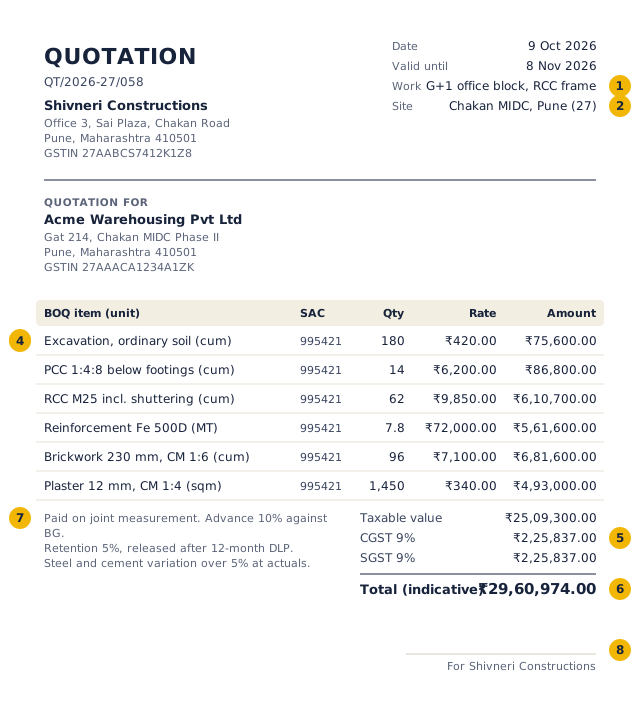
- Scope line: which building and which package of work the rates are for.
- Site location: it fixes the place of supply, and so CGST + SGST of that state.
- BOQ items in the order of construction, each with its unit in brackets.
- SAC 9954 (construction services); 995421 covers general construction of buildings.
- GST on the works contract at 18%, split into CGST and SGST for a site in your own state.
- Indicative total: the contract value moves with measured quantities.
- Money terms: measurement, mobilisation advance, retention, price variation.
- Signature: tenders and work orders usually need it on every page.
The numbers: quotation QT/2026-27/058, with material
| Item | HSN/SAC | Qty | Rate | Taxable value | Tax |
|---|---|---|---|---|---|
| Excavation in ordinary soil up to 1.5 m depth, incl. disposal within 50 m | 995421 | 180 | ₹420.00 | ₹75,600.00 | ₹13,608.00 |
| PCC 1:4:8 below footings, incl. compaction and curing | 995421 | 14 | ₹6,200.00 | ₹86,800.00 | ₹15,624.00 |
| RCC M25 in footings, columns and beams, incl. shuttering, excl. steel | 995421 | 62 | ₹9,850.00 | ₹6,10,700.00 | ₹1,09,926.00 |
| Reinforcement steel Fe 500D, cut, bent, tied and placed | 995421 | 7.8 | ₹72,000.00 | ₹5,61,600.00 | ₹1,01,088.00 |
| Brick masonry 230 mm in CM 1:6, incl. scaffolding | 995421 | 96 | ₹7,100.00 | ₹6,81,600.00 | ₹1,22,688.00 |
| Internal plaster 12 mm in CM 1:4, two coats, incl. curing | 995421 | 1,450 | ₹340.00 | ₹4,93,000.00 | ₹88,740.00 |
| Taxable value | ₹25,09,300.00 | ||||
| CGST 9% | ₹2,25,837.00 | ||||
| SGST 9% | ₹2,25,837.00 | ||||
| Total | ₹29,60,974.00 | ||||
The indicative contract value is ₹25,09,300 before GST and ₹29,60,974 with CGST and SGST of ₹2,25,837 each. If 66 cum of RCC is finally measured instead of 62, the bill rises by 4 x ₹9,850 at the quoted rate; nobody renegotiates the rate.
The same work quoted labour-only
If Acme buys cement, steel, sand and bricks itself, Shivneri quotes labour rates for the same items. The rates are much lower, the quantities are identical, and the quote must say who stores, issues and accounts for the client's material (wastage limits are the usual dispute).
Labour-only rates for the main items
| Item | HSN/SAC | Qty | Rate | Taxable value | Tax |
|---|---|---|---|---|---|
| RCC M25, labour incl. shuttering fixing (client material) | 995421 | 62 | ₹1,450.00 | ₹89,900.00 | ₹16,182.00 |
| Reinforcement, cutting, bending and tying (client steel) | 995421 | 7.8 | ₹9,500.00 | ₹74,100.00 | ₹13,338.00 |
| Brick masonry 230 mm, labour only | 995421 | 96 | ₹1,250.00 | ₹1,20,000.00 | ₹21,600.00 |
| Internal plaster 12 mm, labour only | 995421 | 1,450 | ₹110.00 | ₹1,59,500.00 | ₹28,710.00 |
| Taxable value | ₹4,43,500.00 | ||||
| CGST 9% | ₹39,915.00 | ||||
| SGST 9% | ₹39,915.00 | ||||
| Total | ₹5,23,330.00 | ||||
Labour for these four items comes to ₹4,43,500 before GST and ₹5,23,330 with it. A labour-only contract for a commercial building is taxed at 18% like any construction service; the exemption for pure labour applies only to a single residential unit and to certain housing schemes (see the GST section below).
How to structure the BOQ
Clients compare quotes line by line, so follow the sequence of construction and the client's numbering if they sent a BOQ with the enquiry. Never re-order or merge a client's items: fill their quantities and add your rates.
| Column | What goes in it | Example |
|---|---|---|
| Item no. | Section and item number | 3.02 |
| Description and specification | Material, grade, mix, thickness, finish; what the rate includes and excludes | RCC M25 in columns up to plinth, incl. shuttering, vibration and curing, excl. reinforcement |
| Unit | The unit the item will be measured in | cum |
| Quantity | Taken off the drawings, rounded sensibly | 62.00 |
| Rate | Your rate per unit, before GST | ₹9,850.00 |
| Amount | Quantity x rate | ₹6,10,700.00 |
Group items under section headings (earthwork, concrete, steel, masonry, plaster, flooring, waterproofing, finishes) with a subtotal for each, and finish with a summary of sections. Build each rate from material, labour, equipment, wastage and your overheads and profit; keep that rate analysis on file, because a client who negotiates hard, or asks for an extra item later, will want to see it.
Units of measurement used in civil quotations
| Work | Usual unit | Notes |
|---|---|---|
| Excavation, filling, PCC, RCC | cum (cubic metre) | Measured net to the dimensions on the drawings, not including working space unless stated |
| Reinforcement steel | kg or MT (tonne) | By weight from the bar bending schedule, not including laps you choose to add unless stated |
| Shuttering / formwork | sqm (area in contact with concrete) | Often included in the concrete rate; say which |
| Brick or block masonry | cum for 230 mm and thicker; sqm for 115 mm walls | Openings deducted |
| Plaster, flooring, tiling, waterproofing, painting | sqm | State the deduction rule for openings |
| Skirting, railings, drains, pipes | rmt (running metre) | |
| Doors, windows, fixtures | nos or sqm | Per number when sizes are standard |
| Sand and aggregate (Maharashtra and Gujarat trade) | brass (100 cft, about 2.83 cum) | Convert to cum in a formal BOQ |
Conversions to keep in the quote if the client thinks in feet: 1 sqm = 10.764 sq ft; 1 cum = 35.315 cft; 1 rmt = 3.281 ft. Do not mix units for the same item between quote and bill: if plaster is quoted in sqm it must be measured and billed in sqm.
Public works in India are measured to IS 1200 (Bureau of Indian Standards, method of measurement of building and civil engineering works), which sets out, part by part, how each kind of work is measured and what is deducted. Writing "measurement as per IS 1200" in your terms settles most arguments before they start.
GST on civil work: works contract rules
A contract to build, repair or renovate immovable property in which goods pass to the client as part of the work is a works contract (section 2(119) of the CGST Act). It is treated as a supply of services, taxed on the full value of material and labour together. You do not split the quote into "material at the goods rate" and "labour at 18%".
| Kind of civil work | GST | Notes |
|---|---|---|
| Works contract for a private client: factory, office, shop, warehouse, renovation | 18% | CGST + SGST of the state where the site is |
| Labour-only construction for a commercial or industrial building | 18% | Supply of construction services |
| Pure labour for a single residential unit not part of a residential complex | Exempt | Material supplied by the owner; also certain housing schemes |
| Concessional works contracts for government, local authorities and specified public works | See note | Rates and conditions are in Notification 11/2017-CT(Rate), as amended |
| Supply of material only (cement, steel, sand) without work | Rate of the goods | Not a works contract; cement fell from 28% to 18% on 22 Sep 2025 |
Can the client claim input tax credit?
Usually not, for a building. Section 17(5)(c) of the CGST Act blocks input tax credit on works contract services for construction of immovable property, other than plant and machinery, unless the client is itself a works contractor using the service for its own works contract. Factory owners and developers know this; a client who quotes your price "plus GST" against a competitor's will be comparing the full amount including GST, because for them the GST is a cost.
Tax deducted from your bills
- GST TDS: government departments, local authorities and notified public bodies deduct 2% (1% CGST + 1% SGST, or 2% IGST) from payments under a contract worth more than ₹2,50,000 (section 51). You claim it in your electronic cash ledger.
- Income-tax TDS: payments to contractors are subject to TDS, long at 1% for individuals and HUFs and 2% for others. From 1 April 2026 it is deducted under the Income-tax Act, 2025, so check the current rate table, and give the client your PAN so the higher no-PAN rate does not apply.
Terms a civil work quotation should state
| Term | What to write | Why it matters |
|---|---|---|
| Scope and drawings | Drawing numbers and revision the rates are based on | Changes after the quote are extra items |
| Measurement | Joint measurement, recorded in a measurement book, per IS 1200 | Bills are paid on measured work |
| Running bills | Monthly running account (RA) bills, payable within 15 days | Your cash flow on a long job |
| Mobilisation advance | Usually 5% to 10% of the contract value, against a bank guarantee, recovered pro rata from RA bills | Funds site set-up, labour camp and first material |
| Retention | A percentage of each RA bill (5% is common) held until the end of the defect liability period; may be released against a bank guarantee | The client's security for defects |
| Defect liability period | 12 months from completion is usual | You repair defects at your cost in this period |
| Price variation | Rates firm for a period; steel and cement adjusted beyond a threshold, or a formula linked to price indices | Steel moves enough in a year to wipe out a margin |
| Client's scope | Water, power, storage, approvals, curing water, site access | Unstated items become your cost |
| Time | Completion period from handing over of site and the advance | Delay penalties run from the date you write here |
| Validity | 30 days for material rates; shorter if steel is volatile |
The terms box of the editor above prints these under the totals. Keep them short and numbered; a client's work order will usually repeat them, and anything it changes is a counter-offer you should check before signing.
From quotation to running bills
- Work orderThe client accepts with a work order or letter of acceptance quoting your BOQ rates. Check its quantities, rates and terms against your quotation line by line.
- MeasureAt each billing stage, measure the work done jointly with the client's engineer and record it in the measurement book: item number, location, dimensions and quantity.
- RA billBill cumulative quantity x quoted rate, less the previous bill, less recovery of the advance and retention. GST is charged on the gross value of work in each bill. The construction bill format shows a running bill laid out this way.
- Final billOn completion, the final bill settles all measured quantities and extra items. Retention is released at the end of the defect liability period.
Estimate vs BOQ vs quotation vs RA bill
| Estimate | BOQ | Quotation | RA bill | |
|---|---|---|---|---|
| Prepared by | Engineer, architect or contractor | Client's engineer or quantity surveyor | Contractor | Contractor |
| Contains | Approximate cost | Items, specifications and quantities, no rates | BOQ with rates, amounts and terms | Measured quantities at quoted rates |
| Binding | No | No | Yes once accepted | A demand for payment |
| GST | Shown at most | None | Shown, not payable | Charged on a tax invoice |
For a rough figure before drawings exist, use the estimate format and say it is not an offer. For a US-style construction quote in dollars, see the construction quote template.
Mistakes that cost contractors money
- A per sq ft rate with no specification schedule. The client remembers the rate and forgets the tiles you assumed.
- "Including shuttering" or "excluding steel" left unsaid. Say what every rate includes; the client will read it in their favour.
- Quoting GST at the material rates. A works contract is taxed as one service at 18% (or the concessional rate that applies); splitting it on the invoice does not change the rate.
- No price variation clause on a job longer than six months. Cement and steel can move by more than your margin.
- Retention with no release date. Tie it to the end of the defect liability period, or to a bank guarantee.
- No method for extra items. Agree how they will be rated before they are executed.
- Forgetting TDS in your cash flow. 2% GST TDS on government work and income-tax TDS on every bill come off what reaches your bank.
Key terms
- BOQ (bill of quantities)
- A numbered list of items of work with specifications, units and quantities, priced by the contractor.
- Item-rate contract
- A contract paid at quoted unit rates on the quantities actually measured.
- Works contract
- A contract for building or repairing immovable property in which goods pass to the client; taxed as a service under GST.
- RA bill (running account bill)
- An interim bill for work measured to date, less previous bills and recoveries.
- Mobilisation advance
- An advance at the start of a contract, usually against a bank guarantee, recovered from running bills.
- Retention
- A share of each bill held by the client as security until the defect liability period ends.
- Defect liability period (DLP)
- The period after completion during which the contractor repairs defects at its own cost.
Questions people ask
What is the GST rate on civil construction work?
A works contract (labour and material) or labour-only construction service for a private building is taxed at 18%. Pure labour for a single house not in a residential complex is exempt. Some government and public works contracts have concessional rates; check the current entry in Notification 11/2017-CT(Rate).
Should a civil quotation be item-rate or lump-sum?
Item-rate when quantities can change, which is most building work: the client pays for what is measured at your rates. Lump-sum only when the drawings are final and the scope is small and fully defined.
What is mobilisation advance?
An advance paid at the start of a contract, usually 5% to 10% of its value, so the contractor can set up the site and buy initial material. It is normally given against a bank guarantee and recovered in instalments from the running bills.
What is retention money?
A percentage of each running bill, often 5%, that the client keeps as security for defects. It is paid out at the end of the defect liability period, or earlier against a bank guarantee if the contract allows.
How do I handle price escalation in a construction quotation?
Say how long rates are firm and what happens after: either named materials such as steel and cement adjusted at actuals beyond a threshold, or a formula linked to published price indices. Without a clause, item rates stay fixed for the whole job.
Can my client claim GST input tax credit on construction work?
Generally not when the work builds immovable property for the client's own use: section 17(5)(c) of the CGST Act blocks it, except for plant and machinery and for works contractors using the service in their own works contract.
How is civil work measured for payment?
Jointly by the contractor and the client's engineer, recorded in a measurement book, using the method in the contract. IS 1200 is the Indian standard method of measurement; write it into your terms.
Is TDS deducted from a civil contractor's bills?
Yes. Income-tax TDS applies to payments to contractors, and government bodies also deduct 2% GST TDS on contracts above ₹2,50,000. Both are credited to you and can be claimed, but they reduce the cash you receive.