 luckpanda
Quick answer
What should an export proforma invoice include?
Everything the commercial invoice will carry, fixed before shipment: the exporter with IEC and GSTIN, the buyer and destination country, goods with HS codes, quantities, unit prices and currency, the Incoterms 2020 rule with a named place, ports of loading and discharge, country of origin, packing and weights, payment terms and bank, and a validity date. The buyer uses it for an import licence, an advance payment or a letter of credit.
- Price, currency, Incoterm and HS codes on the proforma must carry into the commercial invoice unchanged.
- Exports are zero-rated: show IGST as nil under LUT, or the IGST you will pay and claim back.
- Export proceeds must be realised within nine months of export; goods against an advance shipped within three years.
- At shipment the commercial invoice, packing list and shipping bill take over; the proforma does not clear customs for a sale.
Last reviewed:
On this page
- What an export proforma adds
- How to fill in this export proforma
- Example: a garment export from Tiruppur to Dubai
- Export fields, and where each one goes next
- Choosing the Incoterms rule
- Payment terms and the RBI rules behind them
- GST on exports: LUT or IGST paid
- From proforma to shipment: the documents that follow
- United States: proforma invoices at customs
- Mistakes to avoid on an export proforma
- Key terms
- Questions people ask
What an export proforma adds
What a proforma invoice is, how advances against it are taxed and how it converts into the final invoice are on the main proforma invoice page. For an export, the proforma does more work, because the buyer's government and bank rely on it before you ship:
- The importer's licence or foreign-exchange approval may be issued on the proforma's value, HS codes and quantities.
- The importer's bank remits the advance, or opens a letter of credit, on the proforma's amount, currency, goods description and Incoterm.
- Your freight forwarder and customs broker plan the shipment from its ports, weights and packages.
So whatever you write on the export proforma has to survive unchanged into the commercial invoice, the packing list, the shipping bill and, if there is one, the letter of credit.
How to fill in this export proforma
- Exporter and buyerEnter your business with its GSTIN and put the IEC in the notes. Add the buyer with the full overseas address and country.
- Goods with HS codesOne line per product with the HS code in the description, quantity, unit and price. The editor drafts in rupees for an Indian seller; quote dollar prices in the notes if the order is in USD.
- Supply type and IGSTIn the details, set Supply type to "Export under LUT (zero-rated)" and the IGST stays at nil. For "Export with IGST paid", set each line to the goods' GST rate.
- Shipping and payment termsIn the terms, write the Incoterms 2020 rule and named place, payment terms, shipment period and validity. In the notes, add origin, ports, packages and weights, and "not a commercial invoice".
- Sign in to issue and convertCreating here is free. Signing in numbers the proforma in its own series, lets you send it and later convert it into the tax invoice at shipment; issuing and sending need the Sales module.
Example: a garment export from Tiruppur to Dubai
Noyyal Knit Exports in Tiruppur has agreed to sell 2,400 T-shirts and 1,200 polo shirts to a Dubai wholesaler. The buyer pays 30% in advance and the balance against shipping documents through the banks (D/P at sight). The goods go by sea from Chennai, FOB, and Noyyal exports under a letter of undertaking (LUT), so no IGST is charged.
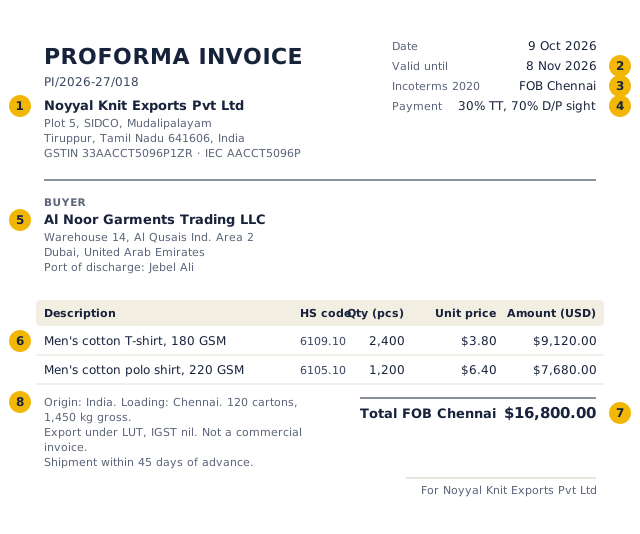
- Exporter with GSTIN and IEC (the 10-character Importer-Exporter Code, the same as the PAN).
- Validity: prices and exchange risk hold until this date.
- Incoterms 2020 rule and named place: it fixes what the price includes.
- Payment terms: share in advance and how the balance is collected.
- Buyer, country and port of discharge, exactly as the importer's bank and customs will show them.
- HS code per line; the shipping bill uses the 8-digit Indian code under the same 6-digit heading.
- Total and currency, labelled with the Incoterm, so nobody adds freight twice.
- Origin, ports, packages and weights, the LUT status and "not a commercial invoice".
The numbers: PI/2026-27/018 in US dollars
| Item | Qty | Rate | Amount | Tax |
|---|---|---|---|---|
| Men's cotton knitted T-shirt, 180 GSM, crew neck | 2,400 | $3.80 | $9,120.00 | $0.00 |
| Men's cotton knitted polo shirt, 220 GSM | 1,200 | $6.40 | $7,680.00 | $0.00 |
| Subtotal | $16,800.00 | $0.00 | ||
| Total | $16,800.00 | |||
The buyer remits the 30% advance of $5,040.00 against this proforma. The balance of $11,760.00 is collected through the banks when Noyyal presents the commercial invoice, packing list and bill of lading after shipment.
The same order in rupees, as the editor drafts it
Indian exporters may also invoice in rupees. The editor above drafts the proforma as an Indian document, so the two routes for GST on an export show as they will on the tax invoice. Under an LUT the IGST line is zero:
Export under LUT: IGST nil
| Item | HSN/SAC | Qty | Rate | Taxable value | Tax |
|---|---|---|---|---|---|
| Men's cotton knitted T-shirt, 180 GSM | 6109 | 2,400 | ₹310.00 | ₹7,44,000.00 | ₹0.00 |
| Men's cotton knitted polo shirt, 220 GSM | 6105 | 1,200 | ₹520.00 | ₹6,24,000.00 | ₹0.00 |
| Taxable value | ₹13,68,000.00 | ||||
| IGST 0% | ₹0.00 | ||||
| Total | ₹13,68,000.00 | ||||
If Noyyal exported on payment of IGST instead, at the 5% rate for apparel priced up to ₹2,500 a piece, it would charge and pay the tax and then claim it back as a refund once the shipping bill is filed:
Export on payment of IGST at 5%, refunded later
| Item | HSN/SAC | Qty | Rate | Taxable value | Tax |
|---|---|---|---|---|---|
| Men's cotton knitted T-shirt, 180 GSM | 6109 | 2,400 | ₹310.00 | ₹7,44,000.00 | ₹37,200.00 |
| Men's cotton knitted polo shirt, 220 GSM | 6105 | 1,200 | ₹520.00 | ₹6,24,000.00 | ₹31,200.00 |
| Taxable value | ₹13,68,000.00 | ||||
| IGST 5% | ₹68,400.00 | ||||
| Total | ₹14,36,400.00 | ||||
IGST of ₹68,400 is paid with the month's return and refunded after export. The buyer never pays it: the overseas price is ₹13,68,000 either way. Most regular exporters use an LUT so that no cash is locked up waiting for the refund.
Export fields, and where each one goes next
| Field on the proforma | What to write | Carried into |
|---|---|---|
| Exporter | Legal name, address, GSTIN, IEC | Commercial invoice, shipping bill, bank documents |
| Buyer (consignee) | Name, full address, country; notify party if different | Commercial invoice, bill of lading |
| Goods | Description the buyer's customs will recognise; HS code; quantity and unit | Commercial invoice, packing list, shipping bill, LC |
| Unit price and total | In the contract currency | Commercial invoice, LC amount, bank realisation |
| Incoterms 2020 and named place | For example FOB Chennai, CIF Jebel Ali, FCA Tiruppur ICD | Commercial invoice, freight and insurance arrangements |
| Ports and route | Port of loading, port of discharge, final destination, mode | Shipping bill, bill of lading |
| Country of origin | India, or as the rules of origin decide | Certificate of origin, commercial invoice |
| Packing | Number and type of packages, net and gross weight, dimensions or CBM | Packing list, bill of lading |
| Payment terms | Advance, LC, D/P, D/A or open account; tenor; bank | LC application, bank collection |
| Validity and shipment date | Valid until; latest shipment date | LC expiry and latest shipment date |
| GST status | Under LUT, IGST nil; or on payment of IGST | Tax invoice endorsement |
India classifies goods in 8-digit ITC(HS) codes, aligned with the international Harmonized System at 6 digits. The first six digits are what the buyer's customs will recognise; the shipping bill needs the full 8-digit Indian code. Use the same heading on every document.
Choosing the Incoterms rule
The Incoterms rule decides what your price includes and where the risk passes to the buyer. Incoterms 2020, in force since 1 January 2020, is the current edition. Always write the rule, the named place and the edition: "FOB Chennai, Incoterms 2020".
| Rule | You deliver and risk passes | You also pay | Mode |
|---|---|---|---|
| EXW | At your premises, not loaded | Nothing more; buyer does export clearance | Any |
| FCA | To the buyer's carrier at a named place (your factory or an ICD) | Export clearance | Any |
| FAS | Alongside the ship at the port | Export clearance | Sea |
| FOB | On board the ship at the port of loading | Inland haulage, export clearance, loading | Sea |
| CFR | On board at loading; risk passes there | Sea freight to the destination port | Sea |
| CIF | On board at loading | Freight and minimum insurance, Institute Cargo Clauses (C) | Sea |
| CPT | To the first carrier | Carriage to the named destination | Any |
| CIP | To the first carrier | Carriage and insurance at Institute Cargo Clauses (A) | Any |
| DAP | At the named destination, ready for unloading | All transport to that place | Any |
| DPU | At the destination, unloaded | Transport and unloading | Any |
| DDP | At the destination, import-cleared | Transport, import duties and taxes | Any |
- FOB, CFR and CIF are sea rules. For goods in containers handed over at an inland container depot or a terminal, FCA, CPT or CIP fit better, because your risk otherwise runs until the container is loaded on the ship, after you have lost control of it.
- DDP makes you the importer. You pay the buyer's import duties and taxes and may need to register in their country; avoid it unless you have done that.
- The price follows the rule. A CIF quote is the FOB price plus freight and insurance; label the total "Total CIF Jebel Ali" so the buyer's bank and customs read it correctly.
Payment terms and the RBI rules behind them
| Term | How it works | Risk for you |
|---|---|---|
| Advance (TT) | Buyer remits before shipment against the proforma | Lowest |
| Letter of credit (LC) | Buyer's bank undertakes to pay against documents that comply with the credit (UCP 600) | Low if the documents comply and the bank is sound |
| D/P (documents against payment) | Your bank sends documents; the buyer gets them only by paying (URC 522) | Buyer may refuse the goods |
| D/A (documents against acceptance) | Buyer gets documents by accepting a bill payable later | Credit risk until maturity |
| Open account | Goods and documents go direct; buyer pays on terms | Highest |
- Realisation period. Under the RBI's Master Direction on export of goods and services, the full value of goods exported must be realised and repatriated within nine months from the date of export. The limit was raised to fifteen months in November 2025 and brought back to nine months in June 2026.
- Advance payments. If you receive an advance against an export, the goods must be shipped within three years of receiving it (one year before November 2025).
- Currency. Export contracts and invoices may be in any freely convertible currency or in Indian rupees; rupee invoicing and settlement through special rupee vostro accounts has been allowed since July 2022.
- Tracking. Your authorised dealer bank reports shipping bills and inward remittances in the RBI's Export Data Processing and Monitoring System (EDPMS); each shipping bill stays open until the proceeds are matched to it. Give the bank the proforma or contract when the advance arrives so it can be tagged to your export.
- Credit insurance. For D/P, D/A and open account sales, ECGC (Export Credit Guarantee Corporation of India) insures against the buyer's default and country risk.
For a letter of credit, the importer's bank copies the proforma's amount, goods description, Incoterm, shipment date and document list into the credit. Read the credit against your proforma as soon as it arrives and ask for amendments before you ship; the main proforma invoice page explains why the final presentation must use the commercial invoice, not the proforma.
GST on exports: LUT or IGST paid
Exports are zero-rated under section 16 of the IGST Act. The proforma has no GST effect of its own, but it should show which route you will use, so the buyer is not surprised by a tax line on the invoice.
- Under LUT: file a letter of undertaking in form GST RFD-11 before exporting (it covers a financial year), export without IGST, and claim refund of unused input tax credit if you want it.
- On payment of IGST: charge IGST on the tax invoice, pay it, and receive it back as a refund once the shipping bill and export are confirmed. A short list of notified goods cannot use this route.
- The tax invoice endorsement (rule 46 of the CGST Rules) reads "SUPPLY MEANT FOR EXPORT/SUPPLY TO SEZ UNIT OR SEZ DEVELOPER FOR AUTHORISED OPERATIONS UNDER BOND OR LETTER OF UNDERTAKING WITHOUT PAYMENT OF INTEGRATED TAX", or "ON PAYMENT OF INTEGRATED TAX" for the second route. It goes on the tax invoice, not the proforma.
- Time limit under LUT (rule 96A): if the goods are not exported within three months of the tax invoice date, or a further period the Commissioner allows, IGST becomes payable with interest within fifteen days. Date the tax invoice at shipment, not when the proforma is accepted.
- Advance for goods: an advance received against an export proforma creates no GST liability for goods; the tax point is the invoice at supply.
From proforma to shipment: the documents that follow
| Step | Document | Issued by |
|---|---|---|
| 1. Order | Proforma invoice accepted; purchase order or contract | You and the buyer |
| 2. Payment set-up | Advance remittance, or letter of credit opened on the proforma's terms | Buyer's bank |
| 3. Shipment | Commercial invoice and packing list (separate, or combined as invoice cum packing list), and the GST tax invoice | You |
| 4. Customs | Shipping bill filed electronically on ICEGATE; let export order | Your customs broker; Indian Customs |
| 5. Transport | Bill of lading (sea) or airway bill (air) | Carrier or forwarder |
| 6. Origin | Certificate of origin: preferential under a trade agreement, through the DGFT platform, or non-preferential from an authorised agency | Issuing agency |
| 7. Payment | Documents through the banks (LC, D/P, D/A) or direct; proceeds realised and matched in EDPMS | Banks |
The Foreign Trade Policy lists three mandatory export documents: the bill of lading or airway bill (or lorry, railway or postal receipt), the commercial invoice cum packing list, and the shipping bill or bill of export. The commercial invoice template and the export invoice format show those documents; each should repeat the proforma's description, HS code and Incoterm exactly.
United States: proforma invoices at customs
Searches for "proforma invoice for customs" come mostly from the US. US Customs enters goods on the commercial invoice, which under 19 CFR 141.86 must show, among other things, the port of entry, the seller and buyer, the time and place of sale, a detailed description with marks and numbers, quantities, the purchase price in the currency of the sale, and the charges included (freight, insurance, commissions, packing). When the commercial invoice is not available at entry, a pro forma invoice may be filed in its place under 19 CFR 141.85, with a bond to produce the commercial invoice later.
For small parcels, note that the $800 de minimis exemption has been suspended, so low-value shipments to the US now need a formal or informal entry with proper invoice values. Courier shipments of free samples still travel with a proforma invoice stating a realistic value for customs.
Mistakes to avoid on an export proforma
- An Incoterm without a named place or edition. "FOB" alone does not say which port.
- A different description or HS code on the commercial invoice. The LC, licence and customs entry were based on the proforma.
- FOB or CIF for containers handed over inland. Your risk runs until loading on the ship; use FCA, CPT or CIP.
- No validity date in a volatile currency. A 90-day-old dollar price can be a loss.
- Forgetting the LUT. Without one filed for the year, the export must go on payment of IGST.
- Leaving the advance unlinked. Ask your bank to tag the advance to the export so it can be matched in EDPMS.
- Shipping late under LUT. Goods not exported within three months of the tax invoice attract IGST with interest.
Key terms
- IEC (Importer-Exporter Code)
- The 10-character code DGFT issues to exporters and importers; it is the same as the PAN.
- Incoterms 2020
- The ICC rules that define delivery, costs and the transfer of risk between seller and buyer.
- LUT (letter of undertaking)
- The GST RFD-11 filing that lets an exporter ship without paying IGST.
- D/P and D/A
- Documents against payment and documents against acceptance: collections through banks under URC 522.
- Shipping bill
- The export declaration filed with Indian Customs on ICEGATE.
- EDPMS
- The RBI system in which banks match export shipping bills with the payments received.
Questions people ask
What is the difference between an export proforma invoice and a commercial invoice?
The proforma comes before shipment and sets the terms the buyer uses for a licence, an advance or a letter of credit. The commercial invoice is issued at shipment, bills the buyer, and is the document customs and the banks act on.
Which Incoterm should I use on an export proforma?
The one you have agreed with the buyer, with the named place and edition, such as "FCA Tiruppur ICD, Incoterms 2020". For containers handed over inland, FCA, CPT or CIP fit better than FOB, CFR or CIF.
Is GST charged on an export proforma invoice?
No GST arises on a proforma. Exports are zero-rated: under an LUT the tax invoice carries no IGST; on the other route you pay IGST and claim a refund. Show which route on the proforma.
Can I receive an advance against an export proforma invoice?
Yes. The goods must then be shipped within three years of the advance, and your bank should link the remittance to the export. For goods, the advance does not create a GST liability.
How long do I have to receive export payment?
Nine months from the date of export under the RBI's current Master Direction, for goods exported normally. The period was briefly fifteen months between November 2025 and June 2026.
Can an export proforma invoice be in Indian rupees?
Yes. Export contracts and invoices may be in any freely convertible currency or in rupees; rupee settlement uses special rupee vostro accounts.
Do I need an IEC to send an export proforma invoice?
You need an IEC to export, and buyers and banks expect it on the proforma. It is the same as your PAN and must be updated on the DGFT portal every year between April and June.
Can a proforma invoice be used for customs clearance?
Not for a normal sale: Indian export customs and the buyer's import customs use the commercial invoice. A proforma travels with goods that are not sold, such as free samples, and in the US may stand in temporarily when the commercial invoice is not yet available.
How long should an export proforma invoice be valid?
Thirty days is common. Shorten it when freight rates or exchange rates are moving, and give a latest shipment date that the letter of credit can match.