 luckpanda
Quick answer
Can you give a discount after the invoice under GST?
Yes. A discount given after the sale reduces GST only if it was agreed before or at the time of supply, is linked to specific invoices, and the buyer reverses the matching input tax credit; you then issue a GST credit note under section 34. Any other post-sale discount can still be passed on through a commercial (financial) credit note, which reduces what the buyer owes but leaves both sides' GST unchanged.
- Agreed in advance, linked to invoices, credit reversed by the buyer: a tax credit note that reduces GST.
- Decided after the sale: a commercial credit note with no GST on it.
- An overcharge or wrong price is not a discount: correct it with an ordinary credit note.
- Keep the scheme letter and proof the buyer reversed its credit.
Last reviewed:
On this page
- When the discount was agreed decides the GST
- How to make a credit note for a discount
- Example: a quarterly volume discount to a distributor
- Proving the buyer reversed its input tax credit
- Rate difference and price protection credit notes
- Cash discounts for early payment
- Commercial (financial) credit notes
- Journal entries for discount credit notes
- United Kingdom: VAT on discounts after the sale
- Mistakes to avoid with discount credit notes
- Key terms
- Questions people ask
When the discount was agreed decides the GST
GST is charged on the transaction value, and section 15(3) of the CGST Act lets discounts come off that value in two cases only. A discount given before or at the time of supply comes off if it is shown on the invoice. A discount given after the supply comes off only if all three of these hold:
- it is established in an agreement entered into at or before the time of supply;
- it is specifically linked to the relevant invoices; and
- the input tax credit attributable to it has been reversed by the recipient.
| Discount | Typical example | Document | GST effect |
|---|---|---|---|
| Trade discount on the invoice | 10% off list price, shown on the invoice | None: it is in the invoice | GST on the discounted price |
| Volume or target discount, scheme agreed in advance | 3% if quarterly purchases exceed ₹15 lakh | GST credit note at quarter end | Reduces GST, if the buyer reverses its credit |
| Price protection, agreed in the distributor agreement | Credit for a list price cut on stock the dealer holds | GST credit note | Reduces GST, on the same conditions |
| Cash discount in the payment terms | 2% if paid within 10 days | GST or commercial credit note when paid early | Reduces GST only if all three conditions hold |
| Discount decided after the sale | A goodwill or festive discount offered later | Commercial credit note | None: GST stays as invoiced |
| Wrong price charged (rate difference) | Invoiced at ₹3,200, agreed price ₹3,050 | GST credit note for the excess | Reduces GST: an overcharge under section 34(1), not a discount |
The general rules for any credit note (fields, numbering, GSTR-1 tables, the 30 November time limit) are on the credit note page; this page covers only what changes for discounts.
How to make a credit note for a discount
- Seller and buyerEnter both businesses with their GSTINs exactly as on the invoices being discounted; they decide IGST or CGST + SGST.
- One line for the discountDescribe the discount (rate, period, scheme) and enter its taxable amount as the price. For price protection or a cash discount, put the units or the invoice in the description.
- Tax or no taxFor a discount agreed before the sale and reversed by the buyer, use the invoices' GST rate. For a commercial credit note, set the rate to 0% and say "without GST" in the notes.
- Invoices and agreementIn the notes, list the invoices the discount relates to and the date of the scheme letter or agreement. In the terms, ask the buyer to accept the credit note in IMS.
- Sign in to issueSigning in numbers the credit note in your CN series, posts the discount and any tax reversal, and lines it up for GSTR-1. Issuing and sending need the Sales module.
Example: a quarterly volume discount to a distributor
Cauvery Kitchen Appliances in Coimbatore gives its Bengaluru distributor, Malnad Distributors, 3% off a quarter's purchases once they exceed ₹15 lakh. The scheme letter was signed on 1 April 2026, before any of the supplies. In July to September Malnad bought ₹18,40,000 of mixer grinders (before GST) on 14 invoices, so at quarter end Cauvery issues one credit note for ₹55,200 plus IGST, with an annexure listing each invoice and its share of the discount.
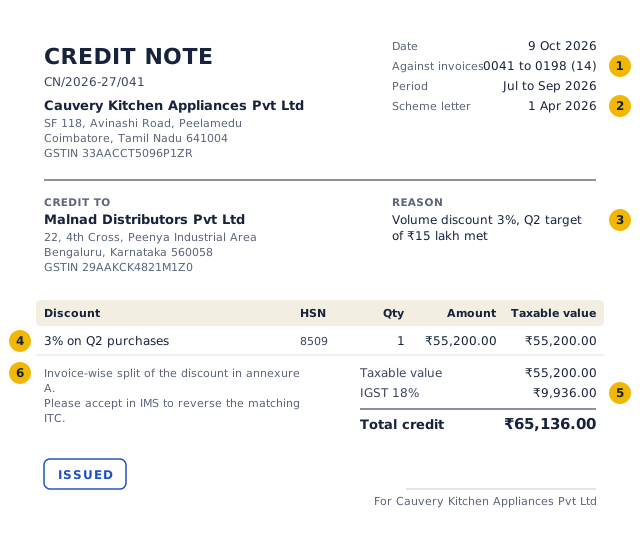
- The invoices the discount relates to: section 15(3)(b) needs the discount linked to specific invoices.
- The agreement made before the supplies: the scheme letter and its date.
- How the discount was earned: rate, target and period.
- HSN of the goods discounted, so the tax rate can be checked against the invoices.
- IGST at the invoice rate (18%), because the original sales were inter-state.
- Annexure and IMS: the invoice-wise split, and the request to accept the credit note.
The numbers: credit note CN/2026-27/041
| Item | HSN/SAC | Qty | Rate | Taxable value | Tax |
|---|---|---|---|---|---|
| Volume discount 3% on Q2 purchases of ₹18,40,000 | 8509 | 1 | ₹55,200.00 | ₹55,200.00 | ₹9,936.00 |
| Taxable value | ₹55,200.00 | ||||
| IGST 18% | ₹9,936.00 | ||||
| Total credit | ₹65,136.00 | ||||
Malnad's balance falls by ₹65,136. Cauvery's IGST for October falls by ₹9,936 once Malnad accepts the credit note in the Invoice Management System, which reverses ₹9,936 of Malnad's input tax credit. If the discount had been worked out and offered only after the quarter, with no scheme in place before the sales, the same ₹55,200 would go on a commercial credit note and no IGST would move.
One credit note may cover several invoices of the same financial year, so a quarterly or annual scheme does not need one credit note per invoice. If the period crosses 31 March, issue one credit note per financial year.
Proving the buyer reversed its input tax credit
A tax credit note for a discount is two-sided: your output tax falls only if the buyer's input tax credit falls by the same amount. Two rules require this, and you need evidence for both.
- Section 15(3)(b)(ii): the discount is excluded from value only if the recipient has reversed the attributable credit. CBIC Circular 212/6/2024-GST (26 June 2024) accepts as evidence a certificate from the recipient's chartered accountant or cost accountant, with UDIN, listing the credit notes, the invoices they relate to and how the credit was reversed. Where the tax on such credit notes to one recipient in a financial year is ₹5,00,000 or less, an undertaking or certificate from the recipient itself is enough.
- Section 34(2), from 1 October 2025: the proviso substituted by the Finance Act 2025 bars any reduction in your output tax unless a registered recipient has reversed the credit attributable to the credit note. On the portal this happens when the buyer accepts the credit note in the Invoice Management System (IMS); a rejected credit note does not reduce your liability.
The Finance Act 2026 change
The Finance Act 2026 amends section 15(3)(b) to tie post-sale discounts to a section 34 credit note and the recipient's reversal of input tax credit. Amendments to the CGST Act made by a Finance Act apply only from the date the government notifies, and we could not confirm a notification as of 9 October 2026. Until the new wording is in force, apply the three conditions above, and check the current text before changing your schemes.
Rate difference and price protection credit notes
"Rate difference" covers two different things, and the difference matters:
- A wrong price on the invoice. The purchase order said ₹3,050 a unit and you invoiced ₹3,200. That is an overcharge: the taxable value charged exceeds the correct value, a ground for a credit note under section 34(1) in its own right. Section 15(3) does not apply, because nothing was discounted.
- A price reduction after the sale. You cut your list price and compensate dealers for stock they already bought at the old price ("price protection"). That is a discount after supply. It reduces GST only if the price protection was agreed in the dealer agreement before the supplies, is linked to the invoices for the stock, and the dealer reverses the credit.
Cauvery's distributor agreement promises price protection on unsold stock for 60 days. On 1 October Cauvery cuts the price of its 750 W model from ₹3,200 to ₹2,950; Malnad holds 120 units bought in September.
Price protection: ₹250 on 120 units in the distributor's stock
| Item | HSN/SAC | Qty | Rate | Taxable value | Tax |
|---|---|---|---|---|---|
| Price protection, 750 W model, ₹3,200 to ₹2,950 | 8509 | 120 | ₹250.00 | ₹30,000.00 | ₹5,400.00 |
| Taxable value | ₹30,000.00 | ||||
| IGST 18% | ₹5,400.00 | ||||
| Total credit | ₹35,400.00 | ||||
The credit is ₹30,000 of taxable value and ₹5,400 of IGST, ₹35,400 in all. Quote the September invoices for those 120 units and the clause of the agreement on the credit note.
Cash discounts for early payment
A cash (prompt payment) discount is written into the payment terms at the time of supply, but nobody knows at invoicing whether it will be earned. If the buyer pays early, you have two options:
| GST credit note | Commercial credit note | |
|---|---|---|
| When it fits | Terms on the invoice or contract before supply; buyer reverses its credit | Conditions not met, or buyer will not reverse its credit |
| On a ₹4,00,000 + 18% IGST invoice, 2% discount | ₹8,000 + ₹1,440 IGST = ₹9,440 | ₹9,440, no GST |
| Supplier's output IGST | Falls by ₹1,440 | Unchanged at ₹72,000 |
| Buyer's input credit | Falls by ₹1,440 | Unchanged |
| Supplier keeps, net of GST | ₹3,92,000 | ₹3,90,560 |
Tax credit note for a 2% cash discount on a ₹4,00,000 invoice
| Item | HSN/SAC | Qty | Rate | Taxable value | Tax |
|---|---|---|---|---|---|
| Cash discount 2%, paid within 10 days | 8509 | 1 | ₹8,000.00 | ₹8,000.00 | ₹1,440.00 |
| Taxable value | ₹8,000.00 | ||||
| IGST 18% | ₹1,440.00 | ||||
| Total credit | ₹9,440.00 | ||||
The buyer receives the same ₹9,440 either way. With a tax credit note, ₹1,440 of it is tax that comes back to the supplier, paid for by the buyer's reversal of input credit; with a commercial credit note, the supplier bears the whole ₹9,440 and the buyer keeps its full credit.
Commercial (financial) credit notes
CBIC Circular 92/11/2019-GST says a supplier may issue a financial or commercial credit note even when the conditions of section 15(3)(b) are not met. Such a credit note does not reduce the value of the supply or the supplier's tax, and it does not affect the supplier's own input tax credit.
- Do not show GST on it, and do not report it in GSTR-1.
- Title it so nobody mistakes it for a tax document: "Credit note (commercial, without GST)".
- The buyer keeps the input tax credit on the original invoice, because the supplier's tax has not been reduced.
- CBIC Circular 251/08/2025-GST (September 2025) addressed post-sale discounts again. As we read it, it confirms that the recipient need not reverse credit on a commercial credit note, and that a discount a manufacturer gives its dealer after the sale is not, by itself, payment for a promotional service by the dealer; a separate agreement for promotion would be. Read the circular for the exact cases before you rely on it.
Journal entries for discount credit notes
For Cauvery's ₹55,200 volume discount as a tax credit note:
| Account | Debit | Credit |
|---|---|---|
| Discount allowed (or sales) | ₹55,200.00 | |
| Output IGST | ₹9,936.00 | |
| Malnad Distributors (customer) | ₹65,136.00 |
| Account | Debit | Credit |
|---|---|---|
| Cauvery Kitchen Appliances (supplier) | ₹65,136.00 | |
| Discount received (or purchases) | ₹55,200.00 | |
| Input IGST | ₹9,936.00 |
As a commercial credit note, the whole amount goes through discount allowed and discount received, with no tax lines: Cauvery debits discount allowed and credits Malnad; Malnad debits Cauvery and credits discount received. If the buyer still holds the goods, its accountant may reduce the stock cost instead of booking discount income.
United Kingdom: VAT on discounts after the sale
HMRC charges VAT on the amount actually paid when a prompt payment discount is taken (VAT Notice 700, section 7.3.2). You can handle it in two ways (section 18.2.2): issue a credit note for the discount and VAT when the customer pays early, or put the discount terms on the original invoice, with the deadline and a statement that the customer may only recover the VAT actually paid. With the second method no credit note is needed. Volume rebates and other reductions agreed after the sale are made with a VAT credit note under section 18.2.
UK: £5,000 of services with a 2.5% prompt payment discount, taken
| Item | Qty | Rate | Amount | Tax |
|---|---|---|---|---|
| Consultancy, September (2.5% discount for payment in 14 days) | 1 | £5,000.00 | £4,875.00 | £975.00 |
| Subtotal | £4,875.00 | |||
| VAT 20% | £975.00 | |||
| Total | £5,850.00 | |||
Paid within 14 days, the customer pays £5,850.00 and the VAT is £975.00 on the discounted £4,875.00. Paid late, it pays the full £6,000.00, and VAT of £1,000.00 is due on the full price.
Mistakes to avoid with discount credit notes
- No written scheme before the sales. A volume or target discount without a prior agreement can only be a commercial credit note.
- A lump-sum discount with no invoice link. List the invoices, and the discount on each, in an annexure.
- Reducing GST without the buyer's reversal. From 1 October 2025 your tax falls only when the buyer accepts the credit note in IMS.
- Treating an overcharge as a discount. A wrong price is corrected under section 34(1); the section 15(3) conditions do not apply.
- Showing GST on a commercial credit note. It confuses the buyer into reversing credit it should keep.
Key terms
- Trade discount
- A discount shown on the invoice; GST is charged on the discounted price.
- Post-sale discount
- A discount given after the supply, by a tax or commercial credit note.
- Volume (target) discount
- A discount earned when purchases over a period exceed an agreed amount.
- Price protection
- A credit to a dealer for a price cut on stock it already bought.
- Commercial credit note
- A credit note without GST, reducing the amount owed but not the taxable value.
- Prompt payment discount
- A discount for paying within a set time; in the UK, VAT is on the amount actually paid.
Questions people ask
What is a commercial or financial credit note?
A credit note issued without GST. It reduces the amount the buyer owes but not the value of the supply, so the supplier's tax and the buyer's input tax credit stay as invoiced (CBIC Circular 92/11/2019-GST).
What is a credit note for rate difference?
A credit note for the difference between the price invoiced and the price that should have been charged. If the invoice was simply wrong, it is an overcharge under section 34(1); if the price was cut after the sale, it is a discount and the section 15(3) conditions apply.
How do I issue a credit note for a volume discount?
At the end of the period, issue one credit note for the discount earned, list the invoices it relates to with the discount on each, quote the scheme letter, and charge GST at the invoices' rate if the scheme was agreed before the sales.
Does a cash discount for early payment reduce GST?
Only if the discount terms were agreed at or before the supply, the credit note is linked to the invoice, and the buyer reverses the attributable credit. Otherwise pass it on with a commercial credit note.
Does the buyer have to reverse input tax credit on a discount credit note?
On a tax credit note, yes: the supplier's tax falls only when the buyer reverses the credit, normally by accepting the credit note in IMS. On a commercial credit note, no.
What proof do I need that the buyer reversed its credit?
IMS acceptance on the portal, plus, under Circular 212/6/2024-GST, a CA or CMA certificate from the buyer, or the buyer's own undertaking where the tax involved is ₹5,00,000 or less in a financial year.
Is a discount from a manufacturer to a dealer a payment for promotion?
Not by itself: a price discount is a reduction in what the dealer pays, not payment for a service, unless the dealer is paid under a separate agreement to promote the products. Circular 251/08/2025-GST deals with these cases; read it for the exact facts it covers.
How does VAT work on a prompt payment discount in the UK?
VAT is due on the amount actually paid. Either issue a credit note when the discount is taken, or state the discount terms on the invoice with a note that the customer may only recover the VAT actually paid.