 luckpanda
Quick answer
How do you issue a credit note for a sales return?
When goods come back, the seller issues a credit note against the original invoice for the returned quantity, at the original price and GST rate. It reduces the sale, the output GST and the customer's balance; the money is then refunded or set off against the next invoice. Under GST it must be issued by 30 November after the end of the financial year of the sale, and a registered buyer must reverse the matching input tax credit.
- The seller records a sales return with a credit note; the buyer records the same goods as a purchase return.
- Credit only what came back, with the same tax type (IGST or CGST + SGST) as the invoice.
- On a marketplace, the seller issues the credit note, not the marketplace.
- After the GST deadline, use a commercial credit note or have the buyer invoice the goods back.
Last reviewed:
On this page
- Sales return: credit note or debit note?
- How to make a credit note for returned goods
- Example: a partial return between two states
- Refund, store credit or replacement
- E-commerce and marketplace returns
- Getting the goods back into stock
- Journal entries on both sides
- Returns after the GST time limit
- Returns from consumers and returned exports
- United Kingdom and United States: returns in short
- Mistakes to avoid with returns
- Key terms
- Questions people ask
Sales return: credit note or debit note?
Both, depending on which side you are on. The seller records a sales return with a credit note: it credits the customer's account and reduces sales. The buyer records the same goods as a purchase return, and many buyers send the supplier a debit note to claim the amount back, because it debits the supplier's account in their books.
| Seller | Buyer | |
|---|---|---|
| Event | Sales return (returns inward) | Purchase return (returns outward) |
| Document | Credit note to the customer | Debit note to the supplier (a claim), optional |
| Ledger effect | Customer's balance falls; sales returns increase | Supplier's balance falls; purchases fall |
| GST effect | Output tax falls, once the buyer reverses its credit | Input tax credit is reversed |
| Which one GST recognises | The supplier's credit note under section 34 | None: the buyer's debit note has no GST effect |
How to make a credit note for returned goods
- Business and customerEnter your business and the customer exactly as on the original invoice, with both GSTINs; they decide IGST or CGST + SGST, as they did on the invoice.
- Returned goods onlyAdd one line per returned item with the quantity that came back and the rate per unit from the invoice. Put the HSN code in the description.
- Same GST rateKeep the GST rate of the original invoice line, even if the rate has changed since; the credit reverses the tax actually charged.
- Invoice, return and settlementIn the notes, give the original invoice number and date, the date the goods arrived and your GRN number. In the terms, say whether you will refund or adjust against the next invoice.
- Sign in to issueSigning in numbers the credit note in your CN series, posts the sales return and the tax reversal, and lines it up for GSTR-1. Issuing and sending need the Sales module.
Example: a partial return between two states
Patel Seating Systems in Ahmedabad sold 40 mesh chairs to Nimbus Interiors, a Delhi furniture retailer, on invoice INV/2026-27/0342 at ₹7,450 a chair plus 18% IGST (Gujarat to Delhi is inter-state). Six chairs had faulty gas lifts and came back. Patel inspects them, records a goods received note, and credits the six chairs only. The invoice for the other 34 stands.
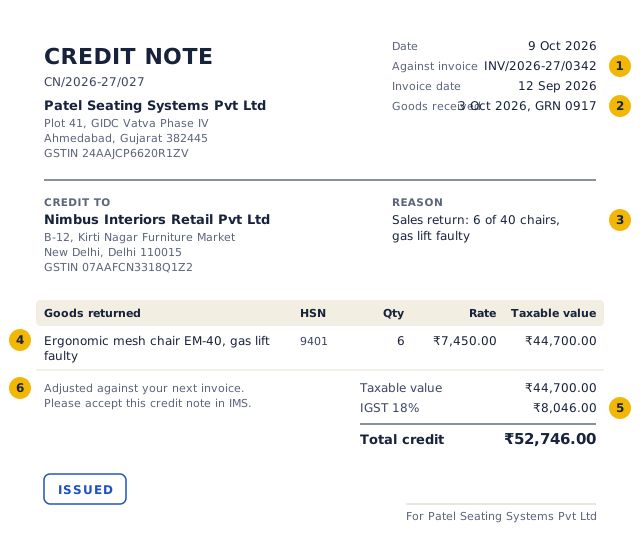
- Original invoice number and date: the credit note reduces this invoice and no other.
- Proof of return: the date the goods arrived and your goods received note (GRN) number.
- Reason: sales return, with the quantity returned out of the quantity invoiced.
- Only the returned goods, at the invoice rate per unit, not the whole invoice again.
- IGST at 18%, as on the invoice: the tax type follows the original sale.
- Settlement and IMS: say whether you refund or adjust, and ask the buyer to accept it.
The numbers: credit note CN/2026-27/027
| Item | HSN/SAC | Qty | Rate | Taxable value | Tax |
|---|---|---|---|---|---|
| Ergonomic mesh chair EM-40, gas lift faulty | 9401 | 6 | ₹7,450.00 | ₹44,700.00 | ₹8,046.00 |
| Taxable value | ₹44,700.00 | ||||
| IGST 18% | ₹8,046.00 | ||||
| Total credit | ₹52,746.00 | ||||
Nimbus's balance falls by ₹52,746. Patel reports the credit note in its October 2026 GSTR-1 (table 9B, registered recipient). Its IGST falls by ₹8,046 once Nimbus accepts the credit note in the Invoice Management System, which reverses the same ₹8,046 of Nimbus's input tax credit.
A full return
If all 40 chairs had come back, the credit note would credit all 40 lines, plus any freight or packing charged on the invoice if you refund it. Do not cancel or delete the invoice: once it is issued and reported, a full credit note is the only clean way to reverse it. If you refund the goods but keep the freight, credit the goods only.
Refund, store credit or replacement
The credit note settles what is owed; it does not move money. What happens next is a separate choice, and each choice has its own paperwork:
| Outcome | Documents | Notes |
|---|---|---|
| Cash or bank refund | Credit note, then a refund payment | Record the refund against the credit note so it shows as settled |
| Set off against the next invoice | Credit note; the next invoice shows the credit applied | Usual between businesses that trade regularly |
| Store credit (retail) | Credit note given to the customer as a credit slip | Under GST it is still a sales return; track the unused balance as a liability |
| Exchange for a different item | Credit note for the return, new invoice for the new item | Two documents, even if no money changes hands |
| Free replacement under warranty | Delivery challan for the replacement; no credit note | CBIC Circular 195/07/2023-GST: no GST on a warranty replacement supplied without consideration |
Restocking fees. If you keep part of the price (a 10% restocking fee, say), credit only the amount you are giving back. The part you keep stays as the value of the original sale, taxed as invoiced. Say so on the credit note: "Credited ₹X; restocking charge of ₹Y retained as per terms of sale."
E-commerce and marketplace returns
On a marketplace the seller is the supplier of the goods. So the seller issues the credit note, under its own GSTIN, against its own invoice, even though the customer clicked "return" on the marketplace and the marketplace arranged the pickup and the refund. Most marketplaces generate the credit note for you in the seller panel; it is still your document, in your series, and it goes in your GSTR-1.
- TCS is on net sales. The operator collects tax at source under section 52 on the net value of taxable supplies made through it, which means supplies minus returns in the same month. Since 10 July 2024 the rate is 0.5% in total (0.25% CGST + 0.25% SGST, or 0.5% IGST).
- Returns in a later month are deducted in the operator's GSTR-8 for the month the goods come back, so the TCS credited to you is adjusted then, not in the month of the sale.
- Reconcile monthly: your credit notes, the marketplace's return report and the TCS in your GST account should agree.
Here is a typical consumer return, by a buyer in Karnataka from a Bengaluru seller (intra-state, so CGST + SGST). Apparel priced up to ₹2,500 a piece is taxed at 5% from 22 September 2025.
B2C marketplace return: one cotton kurta at ₹1,239 including GST
| Item | HSN/SAC | Qty | Rate | Taxable value | Tax |
|---|---|---|---|---|---|
| Cotton kurta, size M, returned (wrong size) | 6211 | 1 | ₹1,180.00 | ₹1,180.00 | ₹59.00 |
| Taxable value | ₹1,180.00 | ||||
| CGST 2.5% | ₹29.50 | ||||
| SGST 2.5% | ₹29.50 | ||||
| Total credit | ₹1,239.00 | ||||
The credit note reverses ₹1,180 of taxable value and ₹59 of tax. Because the customer is unregistered, it is netted against the month's B2C sales in GSTR-1 table 7 rather than listed on its own.
Getting the goods back into stock
- Receive and countRecord a goods received note for the return: date, quantity, condition, and the invoice it came from. This is your evidence the goods actually came back.
- InspectSort the goods into resaleable, repairable and scrap. The credit note can be issued once the return is accepted; inspection decides what happens to the stock, not what the customer is owed.
- Restock at costResaleable goods go back into inventory at the cost they left at, not at the selling price.
- Write off the restGoods scrapped or written off leave stock as a loss. Under section 17(5)(h) of the CGST Act, input tax credit on goods written off or destroyed is not available, so reverse any credit taken on their inputs.
Journal entries on both sides
For the six chairs above. Patel's entry reverses the sale and the output IGST:
| Patel Seating (seller) | Debit | Credit |
|---|---|---|
| Sales returns | ₹44,700.00 | |
| Output IGST | ₹8,046.00 | |
| Nimbus Interiors Retail (customer) | ₹52,746.00 |
If Patel keeps perpetual inventory and the chairs cost ₹4,900 each to make, it also brings the six chairs back into stock: debit inventory ₹29,400, credit cost of goods sold ₹29,400. If it refunds instead of adjusting, it later debits Nimbus and credits the bank with ₹52,746.
| Nimbus Interiors (buyer) | Debit | Credit |
|---|---|---|
| Patel Seating Systems (supplier) | ₹52,746.00 | |
| Purchase returns | ₹44,700.00 | |
| Input IGST | ₹8,046.00 |
The buyer's credit to input IGST is the reversal that lets the supplier's output tax fall. In TallyPrime these are a Credit Note voucher (seller) and a Debit Note voucher (buyer) against the original bill.
Returns after the GST time limit
A credit note reduces GST only if it is declared by 30 November following the end of the financial year of the original sale, or by the date the annual return for that year is filed, if earlier. For Patel's invoice of 12 September 2026, that is 30 November 2027 at the latest. For goods that come back later, two routes remain:
- Commercial credit note. Issue a credit note without GST: it reduces what the customer owes, but your output tax and the buyer's input credit stay as originally reported.
- The buyer sells the goods back. A registered buyer can treat the return as a fresh supply to you, issue its own tax invoice with GST, and you claim input tax credit on it in the normal way. This keeps the tax neutral without a section 34 credit note.
Returns from consumers and returned exports
Unregistered customers (B2C)
A consumer has no input tax credit to reverse, so the condition in section 34(2) works differently: your output tax may be reduced unless the tax has been passed on to someone else. For a refund to the consumer who paid it, that test is met. Report the credit note in GSTR-1 table 7, netted against the month's B2C sales, unless the original invoice was an inter-state B2C invoice above ₹1 lakh, in which case it goes in table 9B as an unregistered credit note (CDNUR). Shops often give a credit slip instead of cash: that slip is the credit note, and its unused balance is money you owe.
Returned exports
Goods exported and sent back by the overseas buyer come back through customs as a re-import. Customs Notification 45/2017-Customs allows re-import of exported goods, generally within three years, subject to conditions that usually include paying back export benefits taken on them, such as duty drawback or an IGST refund. On the GST side, issue a credit note against the export invoice for the goods returned; it is reported as a credit note to an unregistered (overseas) recipient. Tell your bank too, so the export entry it tracks for realisation of the proceeds can be closed against the re-import rather than left as unpaid.
United Kingdom and United States: returns in short
- UK, consumers buying online or by phone: they can cancel within 14 days of receiving the goods and then have 14 more days to send them back; you must refund within 14 days of getting the goods back. For faulty goods, the Consumer Rights Act 2015 gives a 30-day short-term right to reject for a full refund.
- UK VAT: a VAT credit note must be issued within 14 days of the refund and show the original invoice number and date and the VAT credited (VAT Notice 700, section 18). A shop that never issued a VAT invoice to a consumer simply records the refund and reduces its sales.
- US: the document is a credit memo. Most states let you deduct returned sales on your sales tax return when you refund the full price including the tax; California, for example, excludes returned goods when the full sale price including sales tax is refunded in cash or credit, and limits any restocking charge to the actual cost of handling the return (Regulation 1655).
Mistakes to avoid with returns
- Crediting the whole invoice for a partial return. Credit the returned quantity and re-invoice nothing.
- Relying on the buyer's debit note. It has no GST effect; the supplier's credit note is what reduces tax.
- No proof the goods came back. Keep the goods received note and quote it on the credit note.
- Letting the marketplace's return and your credit note drift apart. Reconcile each month with the TCS statement.
- Waiting past 30 November of the following year. After that, the credit note no longer reduces GST.
Key terms
- Sales return (returns inward)
- Goods sent back by a customer; the seller records it with a credit note.
- Purchase return (returns outward)
- Goods sent back to a supplier; the buyer records it, often with a debit note.
- Goods received note (GRN)
- The record that returned goods arrived, with date, quantity and condition.
- Commercial credit note
- A credit note issued without GST, reducing the amount owed but not the tax.
- TCS (e-commerce)
- Tax collected by a marketplace operator under section 52 on a seller's net sales through it.
- Re-import
- Bringing exported goods back into India, for example when an overseas buyer returns them.
Questions people ask
Is sales return a debit note or credit note?
For the seller, a sales return is recorded with a credit note, because it credits the customer's account. The buyer records the same goods as a purchase return and may send a debit note as a claim. For GST, only the seller's credit note reduces the tax.
Is purchase return a debit note or credit note?
A purchase return is recorded by the buyer, often with a debit note to the supplier, because it debits the supplier's account. The supplier then issues a credit note for the same goods, and the buyer reverses the matching input tax credit.
Who issues the credit note when a customer returns an order bought on a marketplace?
The seller, under its own GSTIN, against its own invoice. The marketplace handles the pickup and refund and adjusts its TCS on your net sales, but it does not issue your credit note.
Should I refund the customer or give store credit?
Either. The credit note records the return; a refund is a separate payment, and store credit is a balance you owe the customer until it is used. Consumer law may require a refund, for example in the UK for distance sales and faulty goods.
What if the goods come back after the GST time limit?
Issue a commercial credit note without GST, which leaves both sides' tax as reported, or ask a registered buyer to invoice the goods back to you with GST so you can claim the credit.
Do I need a credit note for a replacement under warranty?
No, if the replacement is free. Send it on a delivery challan; CBIC has clarified that no GST is payable on a warranty replacement given without consideration.
How do I show a sales return in GSTR-1?
In the return for the month the credit note is issued: table 9B for registered customers and for large inter-state B2C or export invoices, or netted in table 7 for other consumer sales.