 luckpanda
TDS on Partners Remuneration: Section 194T and Section 393(3) Explained
Firms deduct 10% TDS on partners' salary, commission, bonus and interest once a partner's yearly total crosses ₹20,000. Rules, a worked example, Section 40(b) and the 2026 renumbering.
On this page
- What does Section 194T say, and why was it added?
- Is TDS deductible on partner remuneration from 1 April 2025?
- What is the threshold and rate under Section 194T?
- Does 194T apply to profit share or capital withdrawal?
- When must TDS be deducted on credited but unpaid remuneration?
- How does it work: a worked example with real numbers
- How does 194T interact with Section 40(b) limits?
- What changed on 1 April 2026: the Income-tax Act, 2025
- Pitfalls and penalties
- How 194T differs from TDS on employee salary (Section 192)
TDS on partners remuneration is 10%, deducted by the firm on salary, remuneration, commission, bonus and interest paid or credited to a partner once the year's total crosses ₹20,000. It started on 1 April 2025 under Section 194T and, from 1 April 2026, sits in Section 393(3) (Table Sl. No. 7, payment code 1067) of the Income-tax Act, 2025. Profit share and capital withdrawals are not covered.
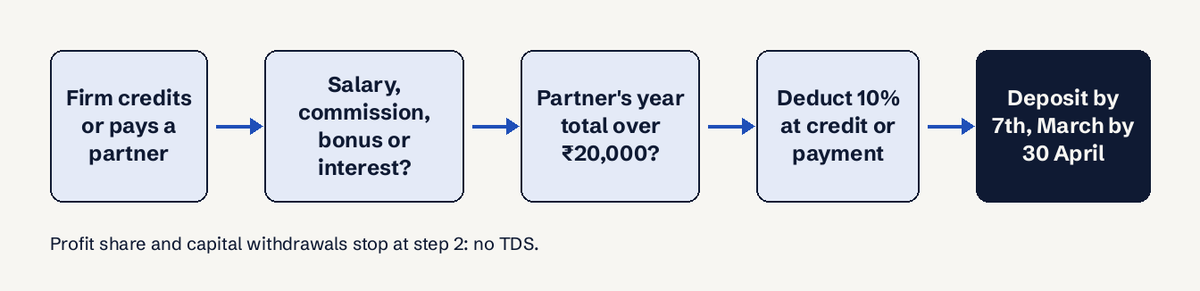
Section 194T is the TDS provision, inserted by the Finance (No. 2) Act, 2024, that makes a partnership firm or LLP deduct tax on what it pays its own partners. Before 1 April 2025 a firm deducted nothing on a partner's salary or interest on capital. Now it deducts 10% when it credits the amount to the partner's account (including the capital account) or pays it, whichever comes first, once the partner's total for the year exceeds ₹20,000 (20% without a PAN). The tax is deposited by the 7th of the following month, or 30 April for March credits, and the partner claims it as a credit in their own return.
What does Section 194T say, and why was it added?
Sub-section (1) applies to "any person, being a firm, responsible for paying any sum in the nature of salary, remuneration, commission, bonus or interest to a partner of the firm" and fixes the rate at ten per cent. Sub-section (2) excludes cases where the sum, or the aggregate "credited or paid or likely to be credited or paid" to the partner, does not exceed ₹20,000 in the financial year. The text is on the Income Tax Department's Section 194T page. LLPs count as firms, and there is no turnover, audit or partner-count exemption.
The reason is reporting. Partners' salaries and interest are deductible for the firm under Section 40(b), within limits, and taxable for the partner under Section 28(v). Until 2025 nothing linked the two at source: the firm claimed the deduction and the department relied on each partner to report the income. Now the firm reports every partner's remuneration and interest each quarter under its TAN. The same Finance Act raised the Section 40(b) limits, so firms got more deductible room and a reporting duty together.
Is TDS deductible on partner remuneration from 1 April 2025?
Yes. Any salary, remuneration, commission, bonus or interest a firm credits or pays to a partner on or after 1 April 2025 falls under Section 194T, and from 1 April 2026 under Section 393(3) of the Income-tax Act, 2025. Amounts credited before 1 April 2025 (for example, a year-end credit on 31 March 2025) were outside it.
What is the threshold and rate under Section 194T?
The rate is 10% and the threshold is ₹20,000 per partner per financial year.
| Item | Section 194T (1961 Act) | Section 393(3), Sl. No. 7 (2025 Act) |
|---|---|---|
| Applies to | Credits or payments from 1 Apr 2025 to 31 Mar 2026 | Credits or payments from 1 Apr 2026 |
| Payer | Firm, including LLP | Firm, including LLP |
| Covered payments | Salary, remuneration, commission, bonus, interest | Same |
| Rate | 10% | 10% |
| Rate without PAN | 20% | 20% |
| Threshold | ₹20,000 per partner per financial year | ₹20,000 per partner per tax year |
| When to deduct | Earlier of credit (including capital account) or payment | Same |
| Quarterly return | Form 26Q | Form 140 (replaces Form 26Q) |
| Payment code | Section 194T | 1067 |
| Lower or nil deduction certificate | Not available (Section 197 did not list 194T) | Check with your tax adviser |
Three things about the threshold catch firms out:
- It is per partner, not per firm. A partner who receives ₹18,000 of interest in the year is below the limit even if another partner receives ₹10 lakh.
- It counts every covered head together. Salary, commission, bonus and interest are added up. Interest on a partner's loan to the firm counts as well as interest on capital.
- "Likely to be credited" means you deduct from the first credit. If a partner's monthly salary is ₹50,000, the year's total will obviously cross ₹20,000, so the firm deducts 10% from April's credit itself. Once the limit is crossed, TDS applies to the whole amount, not only to the part above ₹20,000.
Does 194T apply to profit share or capital withdrawal?
No. Section 194T lists five kinds of payment: salary, remuneration, commission, bonus and interest. A partner's share of the firm's profit is not one of them, and it is exempt in the partner's hands under Section 10(2A) because the firm has already paid tax on it. Capital withdrawals and repayment of a partner's capital balance are a return of the partner's own money, not income, so they are also outside the section. For how drawings are recorded in the books, see our guide to drawings in accounting.
| Payment from firm to partner | TDS under 194T? | Why |
|---|---|---|
| Monthly salary to a working partner | Yes, 10% | Salary is listed |
| Commission or bonus | Yes, 10% | Listed |
| Interest on capital | Yes, 10% | Interest on any account is covered |
| Interest on a partner's loan to the firm | Yes, 10% | Interest is covered whatever the account |
| Share of profit | No | Not listed; exempt under Section 10(2A) |
| Drawings or capital withdrawal | No | Return of capital, not income |
| Repayment of a partner's loan principal | No | Principal is not income |
When must TDS be deducted on credited but unpaid remuneration?
TDS is deducted when the amount is credited to the partner's account, including the capital account, even if no money leaves the firm's bank. This is the point most firms get wrong. Many firms credit salary and interest to the partner's capital account on 31 March when they close the books, and pay nothing in cash. Under Section 194T, that book entry is the trigger: the firm deducts 10% on 31 March and deposits it by 30 April.
The practical consequence is that the firm must decide the year's partner remuneration and interest by 31 March, or at least credit it by then. Remuneration worked out after the year closes, during the audit, still has to be credited and taxed in the books of the year it relates to; the later the entry, the more likely the deposit is late and attracts interest.
How does it work: a worked example with real numbers
Take a two-partner trading firm (an illustration, not a real business) for the financial year 2026-27. Its partnership deed authorises salary to the working partner and 12% interest on capital.
- Partner A (working partner): salary ₹50,000 a month credited on the last day of each month; capital ₹10,00,000; a year-end commission of ₹40,000.
- Partner B (sleeping partner): capital ₹1,50,000; no salary.
- Book profit after interest but before partner salary and commission: ₹20,00,000.
Partner A. Salary for the year is ₹6,00,000, interest on capital is ₹10,00,000 × 12% = ₹1,20,000, and commission is ₹40,000. The total is ₹7,60,000, far above ₹20,000, so the firm deducts 10% from the first salary credit. From April to February it deducts ₹5,000 a month and deposits each by the 7th of the next month. On 31 March it credits the March salary (₹50,000), the interest (₹1,20,000) and the commission (₹40,000), deducts ₹21,000 and deposits it by 30 April 2027. Total TDS for Partner A: ₹76,000.
Partner B. Interest on capital is ₹1,50,000 × 12% = ₹18,000. That is the only covered payment and it is below ₹20,000, so no TDS. If B also lent the firm ₹50,000 at 12%, the extra ₹6,000 of interest would take B's total to ₹24,000 and TDS of ₹2,400 would apply to the whole amount.
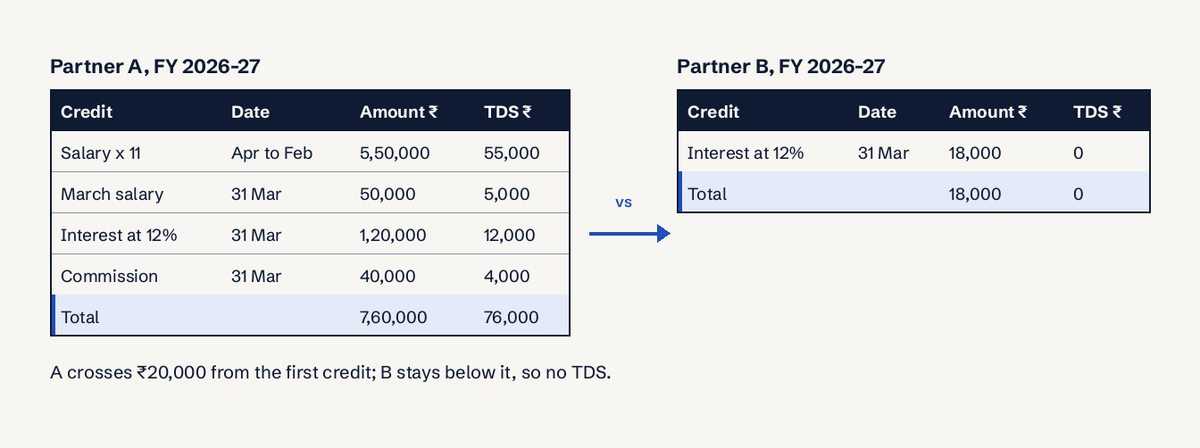
The firm reports both partners in its quarterly return (Form 140 from 2026-27), issues Partner A a TDS certificate after each quarter, and Partner A claims the ₹76,000 as a credit in their own return. The partner arithmetic is a flat 10%, so a spreadsheet is enough. Once a firm has a TAN for partner payments, it usually owes TDS on other payments too (contractors, professional fees, commission, rent); LuckPanda's free TDS calculator gives the Section 393 rate, threshold and amount for those.
How does 194T interact with Section 40(b) limits?
Section 40(b) decides how much of a partner's remuneration and interest the firm can deduct; Section 194T decides how much tax the firm withholds. They are separate tests, and TDS applies to the full amount credited, not only to the deductible part.
The Section 40(b) limits, as raised by the Finance (No. 2) Act, 2024 from assessment year 2025-26:
| Book profit | Maximum deductible remuneration to working partners |
|---|---|
| First ₹6,00,000 (or a loss) | ₹3,00,000 or 90% of book profit, whichever is higher |
| Balance above ₹6,00,000 | 60% of the balance |
| Interest on capital | Up to 12% simple interest a year |
Before that amendment, the first slab was ₹3,00,000 of book profit with a minimum of ₹1,50,000.
Book profit here is the net profit from the profit and loss account, adjusted as the Act requires, before deducting partners' remuneration. For the example firm, book profit is ₹20,00,000. The limit is 90% of ₹6,00,000 = ₹5,40,000, plus 60% of ₹14,00,000 = ₹8,40,000, so ₹13,80,000 in total. Partner A's salary and commission of ₹6,40,000 sit well inside it, so the whole amount is deductible for the firm.
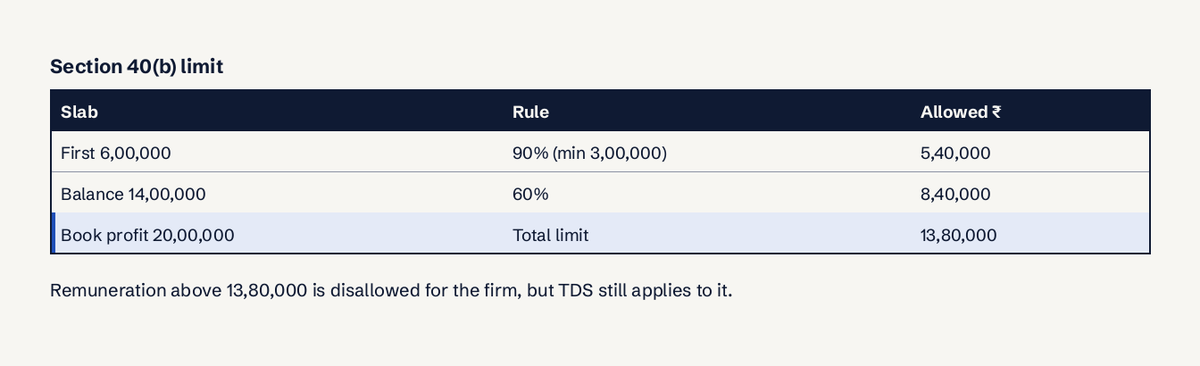
Now suppose the firm credited Partner A ₹15,00,000 of salary instead. The firm can deduct only ₹13,80,000; ₹1,20,000 is disallowed. TDS is still 10% of ₹15,00,000 = ₹1,50,000, because Section 194T looks at what was credited, not at what is allowable. On the partner's side, Section 28(v) taxes remuneration "to the extent to which it is allowed as deduction" under Section 40(b), and the partner claims the full ₹1,50,000 as a credit. Where the deed is silent or vague on remuneration, discuss the treatment of any excess with your chartered accountant.
There is a second link. Under Section 40(a)(ia), if the firm fails to deduct or deposit TDS on an amount, 30% of that expense is disallowed in the firm's computation, on top of the Section 40(b) test.
What changed on 1 April 2026: the Income-tax Act, 2025
The Income-tax Act, 2025 received the President's assent on 21 August 2025 and came into force on 1 April 2026, replacing the 1961 Act. It folds most TDS sections into tables under Section 393, and it replaces "previous year" and "assessment year" with a single "tax year". For partner payments:
- Credits and payments up to 31 March 2026 stay under Section 194T, including corrections to those quarters.
- Credits and payments from 1 April 2026 fall under Section 393(3), Table Sl. No. 7, payment code 1067. The rate (10%), threshold (₹20,000) and timing (earlier of credit or payment) are unchanged.
- The quarterly statement is Form 140, which replaces Form 26Q for TDS on payments to residents. Our Form 26Q guide covers the quarters filed under the old form.
Most top-ranking explanations of Section 194T were written in 2024 and 2025 and still cite only the old section and Form 26Q. If your accounting software or deductor still asks for "194T" for a 2026-27 credit, it is using the old mapping.
Pitfalls and penalties
- No TAN. A firm must hold a TAN to deduct and deposit TDS. Many small firms had never needed one before 194T; apply before the first credit, not after.
- Year-end credits deposited late. TDS on 31 March credits is due by 30 April. Interest under Section 201(1A) is 1% a month for not deducting and 1.5% a month for deducting but not depositing.
- Treating the threshold as an exemption on the first ₹20,000. Once a partner crosses ₹20,000, TDS is on the whole amount.
- Ignoring interest on partner loans. Interest on any account counts towards the ₹20,000.
- Disallowance. Missed TDS can cost 30% of the expense under Section 40(a)(ia), and Section 271C allows a penalty equal to the tax not deducted.
- No 15G or 15H. Under the 1961 Act, partners cannot give Form 15G or 15H to stop deduction, and Section 197 did not cover 194T.
How 194T differs from TDS on employee salary (Section 192)
A partner is not an employee of the firm, so a partner's "salary" is business income under Section 28(v), not income under the head "Salaries". That is why Section 192, with its slab-rate calculation, does not apply. Section 194T instead uses a flat 10%, with no standard deduction and no projection of the partner's total income.
| Point | Section 192 (employee salary) | Section 194T (partner payments) |
|---|---|---|
| Recipient | Employee | Partner of the firm or LLP |
| Rate | Slab rates on estimated income | Flat 10% |
| Threshold | Basic exemption limit | ₹20,000 per year |
| Head of income | Salaries | Profits and gains of business (Section 28(v)) |
| Covers interest | No | Yes |
Questions
Is TDS applicable on interest on capital paid to partners?
Yes. Interest on capital, and interest on a partner's loan to the firm, are both covered by Section 194T and Section 393(3). The firm deducts 10% once the partner's total covered payments for the year cross ₹20,000.
Is the ₹20,000 limit per partner or for the whole firm?
Per partner. Each partner's salary, commission, bonus and interest for the financial year are added together and compared with ₹20,000. Payments to other partners do not count towards that partner's limit.
Does TDS apply to LLPs?
Yes. An LLP is treated as a firm under the Income-tax Act, so payments by an LLP to its designated partners or partners are covered on the same terms as a partnership firm.
Is TDS deducted on partner remuneration credited on 31 March?
Yes. Credit to the partner's account, including the capital account, triggers the deduction even if no cash is paid. The tax on a 31 March credit is due by 30 April.
What is the new section for 194T under the Income-tax Act, 2025?
From 1 April 2026, TDS on payments to partners is under Section 393(3), Table Sl. No. 7, with payment code 1067. The rate and threshold are the same and the quarterly return is Form 140.
Can a partner avoid TDS by submitting Form 15G or 15H?
No. Under the 1961 Act, Form 15G and 15H do not apply to Section 194T and a Section 197 lower deduction certificate was not available for it. For 2026-27 onwards, ask your tax adviser whether a lower deduction certificate can be obtained under the new Act.
Is TDS deducted on the part of remuneration disallowed under Section 40(b)?
Yes. TDS is on the full amount credited or paid. Section 40(b) only limits what the firm can deduct; it does not reduce the amount on which tax is withheld.
This guide is information, not tax advice. Sources: Section 194T on the Income Tax Department website, the Finance (No. 2) Act, 2024, the Income-tax Act, 2025 and Form 140 under the Income-tax Rules, 2026.