 luckpanda
40 Voice of Customer Survey Questions, by Goal
Voice of customer survey questions ask why people buy, hesitate, leave and what they miss. Copy 40 questions grouped by goal, with when to ask each.
On this page
- What are voice of customer survey questions?
- Where do unprompted buyer questions come from?
- 1. Why customers bought (ask within 7 days of purchase)
- 2. Objections and hesitation (ask after a trial or a quote that did not convert)
- 3. Product fit (ask after 30 days of active use)
- 4. Missing features and what to build next (ask every 90 days)
- 5. Support and effort (ask within 1 hour of a support conversation)
- 6. Journey friction (ask 3 days and 14 days after signup)
- 7. Loyalty and relationship health (ask every 6 months)
- 8. Churn and win-back (ask at cancellation)
- Which set should you use?
- What are good open-ended VoC questions?
- How many questions should a VoC survey have, and how do you write them?
TL;DR: Voice of customer (VoC) survey questions ask customers, in their own words, why they bought, what nearly stopped them, what they miss and why they would leave. Below are 40 questions in 8 sets, each tied to one decision and one moment to ask. Surveys only reach people who already bought; LuckPanda Chatbot fills the other half by saving every website visitor's question word for word and ranking what they asked for that you do not offer.
Hear buyers before they buy. LuckPanda Chatbot answers website visitors from your own pages, hands you qualified leads and keeps every question they asked. Setting up and testing are free. Try LuckPanda Chatbot.
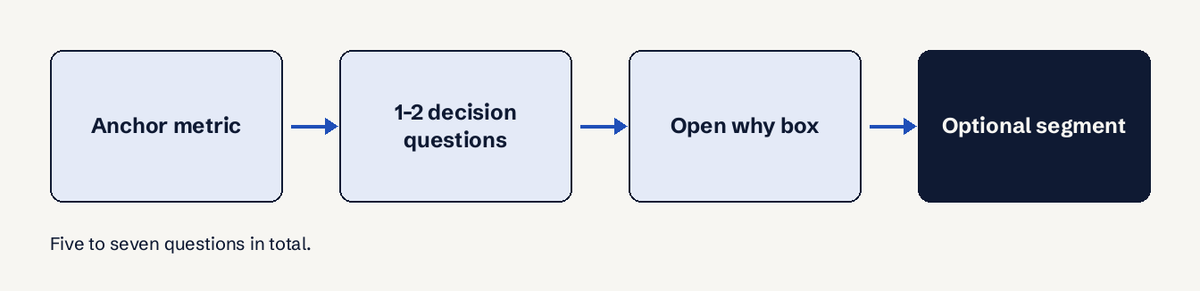
Voice of customer survey questions are questions built to capture the customer's expectation, reason or doubt in a sentence of their own, not just a score. A good VoC survey pairs one scored anchor question (NPS, satisfaction or effort) with one or two decision questions and one open "why" box, about five or six questions in total. Pick the set below that matches the decision you face this quarter, copy it, and send it at the moment listed.
What are voice of customer survey questions?
A voice of customer survey question is one whose answer changes a decision you have not made yet: what to build, how to price, what to say on the website, who to win back. A CSAT question ("How satisfied were you with your delivery?") scores a moment that is over. A VoC question ("What did you expect from us that you did not get?") hands you the expectation itself. Retently draws the same line in its VoC question guide and sorts questions by the decision they feed rather than by topic, which is the approach used here.
Three question types do the work:
- Anchor metric: one number you can trend, such as NPS ("How likely are you to recommend us to a friend or colleague?", 0 to 10, from Bain's Net Promoter System).
- Decision question: a forced choice or ranking that maps to one decision.
- Open question: a free text box. This is the actual "voice".
Where do unprompted buyer questions come from?
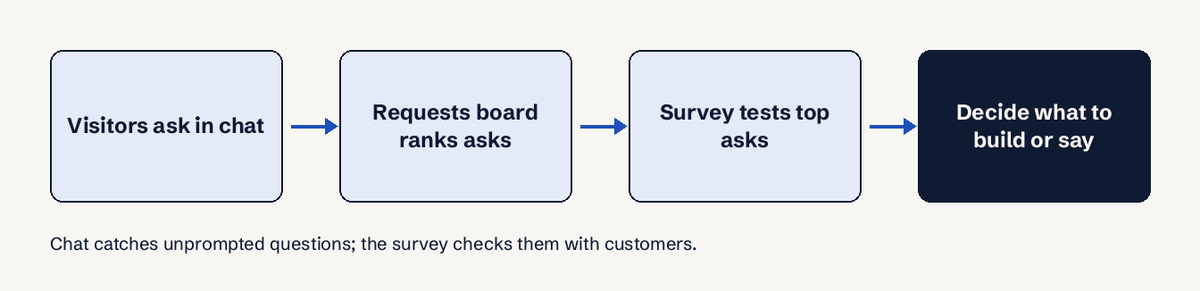
You also collect voice of customer data without a survey by reading what people already write to you: website chat transcripts, support tickets, sales call notes, reviews and cancellation emails. Website chat is the richest source for buying questions, because the visitor has not decided yet. The live chat metrics guide covers what to measure in those chats.
Surveys have a blind spot: they reach customers, not the people who looked and left. LuckPanda Chatbot sits on your website and answers visitors from your own pages and documents, so the questions arrive unprompted, at the moment of doubt, in the visitor's own words. From the live Chatbot page:
- Every chat is saved word for word with the page it started on.
- With request logging on, things visitors ask for that you do not offer yet are grouped on a Requests board, ranked by how many different people asked, with a weekly digest.
- Leads come with a summary of the need, timeline and size.
- It replies in the language the visitor writes in.
- You can try it without an account: the preview reads up to 30 pages, answers up to 20 questions and is kept for 7 days. Once you keep it, it reads up to 50 pages per website plus documents (PDF, DOCX, TXT, MD, CSV) of up to 5 MB each. Putting it on a website costs $4.99 a month or $44.91 a year (₹199 or ₹1,791 in India), tax included, for up to 10 websites.
The limit: chat data tells you what people ask, not how many customers would pay for it. Use the chat log to decide which survey questions to ask. If the Requests board shows 14 people asking about a feature you lack, set 4 below tells you whether paying customers would trade anything for it.
1. Why customers bought (ask within 7 days of purchase)
Scenario: you need to know which message to put on your home page and ads.
- What problem were you trying to solve when you started looking?
- What other options did you consider before choosing us?
- What made you choose us over those options?
- What almost stopped you from buying?
- How would you describe us to a colleague in one sentence?
What it shows: question 5 gives you copy in the buyer's words; question 4 lists objections your page has to answer. Adapt it by naming your real competitors in a follow-up to question 2.
2. Objections and hesitation (ask after a trial or a quote that did not convert)
Scenario: people request a quote or start a trial, then go quiet.
- What were you hoping to find that you did not?
- Which question did you not get a clear answer to?
- How did our price compare with what you expected to pay? (Lower / About the same / Higher)
- What would have to change for you to try us again?
- Who else was involved in the decision?
What it shows: questions 6 and 7 are the same doubts a website chatbot hears live. Compare the answers with your chat transcripts; if they match, fix the page, not just the sales script.
3. Product fit (ask after 30 days of active use)
Scenario: deciding whether the product solves a real need for a segment.
- How would you feel if you could no longer use this product? (Very disappointed / Somewhat disappointed / Not disappointed)
- What is the main benefit you get from it?
- What type of person do you think would benefit most?
- What would you use instead if it went away?
- How can we improve it for you?
What it shows: the share answering "very disappointed" tracks fit by segment. Cut the results by customer type before reading them.
4. Missing features and what to build next (ask every 90 days)
Scenario: roadmap planning.
- Rank these five planned improvements from most to least useful to you.
- If we could add one thing, what should it be?
- What do you do outside our product today that you wish you could do inside it?
- Which feature do you never use, and why?
- Would you pay more for [feature]? (Yes / Maybe / No)
What it shows: ranking (16) forces a trade-off, so you do not get "all of the above". Seed the list with the top items from your Requests board.
5. Support and effort (ask within 1 hour of a support conversation)
Scenario: finding where help breaks down.
- How easy was it to get your issue resolved? (1 Very difficult to 7 Very easy)
- Did you have to contact us more than once about this?
- Was the answer you got correct and complete?
- What could we have done to make this easier?
- Would you have preferred to find the answer yourself?
What it shows: repeat contact (22) and effort (21) point at missing documentation. Add those answers to the pages your chatbot answers from, and the same question stops reaching a person.
6. Journey friction (ask 3 days and 14 days after signup)
Scenario: new customers stall before they get value.
- What was the hardest part of getting started?
- How long did it take before you got your first useful result?
- Where did you get stuck or confused?
- What did you expect to happen that did not?
- What one thing should we explain better on our website?
What it shows: question 30 is the bridge between marketing and product. Map each answer to the page it concerns.
7. Loyalty and relationship health (ask every 6 months)
Scenario: forecasting renewals and referrals.
- How likely are you to recommend us to a friend or colleague? (0 to 10)
- What is the main reason for your score?
- What would make you more likely to recommend us?
- How do you feel our value compares with the price you pay?
- Is there anything we should stop doing?
What it shows: Bain counts 9 and 10 as promoters, 7 and 8 as passives and 0 to 6 as detractors, and NPS is the percentage of promoters minus the percentage of detractors. Bain also notes detractors account for more than 80% of negative word of mouth. Worked example: 200 replies, 110 scores of 9 or 10 (55%), 40 scores of 7 or 8 (20%), 50 scores of 0 to 6 (25%), so NPS = 55 - 25 = 30. Work it out with the free NPS calculator. Question 32 matters more than the number.
8. Churn and win-back (ask at cancellation)
Scenario: understanding why customers leave.
- What is the main reason you are leaving? (Price / Missing feature / Switched to another tool / No longer needed / Other)
- Which tool are you moving to, if any?
- What could we have done to keep you?
- Was there a moment you decided to leave?
- Can we contact you if we fix the reason you left?
What it shows: question 39 gives you a date to look for in the account history. Question 40 builds a win-back list.
Which set should you use?
| Decision | Set | When to ask | Anchor question |
|---|---|---|---|
| Website message | 1. Why customers bought | 7 days after purchase | Q5 |
| Lost deals | 2. Objections | 1 day after a trial or quote ends | Q8 |
| Product fit | 3. Product fit | 30 days after signup | Q11 |
| Roadmap | 4. Missing features | Every 90 days | Q16 |
| Support quality | 5. Support and effort | Within 1 hour of a support chat | Q21 |
| Onboarding | 6. Journey friction | 3 days and 14 days after signup | Q27 |
| Renewals | 7. Loyalty | Every 180 days | Q31 (NPS) |
| Retention | 8. Churn | Within 1 day of cancelling | Q36 |
What are good open-ended VoC questions?
Good open-ended VoC questions ask about a specific moment or a gap, not general feelings:
- What almost stopped you from buying?
- What did you expect from us that you did not get?
- What would you use instead if we went away?
- What is the main reason for your score?
- What one thing should we explain better on our website?
Avoid "Any other comments?". It gets few answers and fewer usable ones.
How many questions should a VoC survey have, and how do you write them?
A VoC survey should have five to seven questions: one anchor metric, one or two decision questions, one open "why" box and, if you need it, one segmentation question (plan, company size, role). Retently recommends five or six with a single open box and the verbatim question near the end; completion and answer quality drop as the survey grows. Pull five from one set above rather than one from each.
- One idea per question. "How fast and helpful was support?" mixes two answers.
- Neutral wording. "How easy was it" is better than "How easy and quick was it".
- Ask at the moment. Send set 1 within a week of purchase, set 5 straight after the chat. Late surveys measure memory.
- Close the loop. Tell customers what changed because of their answers; it raises the next response rate.
- Tag the answers. Group open answers into a few categories before counting them; see customer feedback categories for a scheme.
- Combine with unprompted data. Chat transcripts, support tickets and sales call notes show what people say when nobody asked. Our guide to customer pain points examples shows how to read them.
Questions
What are voice of customer survey questions?
They are survey questions designed to capture why customers buy, hesitate, stay or leave, in their own words, so the answers feed a specific decision. They usually combine one scored metric with open questions.
How many questions should a VoC survey have?
Five to seven: one anchor metric, one or two decision questions, one open question and an optional segmentation question.
What is the difference between VoC and CSAT questions?
CSAT scores a moment that already happened, such as a delivery or a support chat. VoC questions surface expectations, priorities and reasons, so you can act before the next experience.
Is NPS a voice of customer question?
NPS is a common anchor metric inside a VoC survey. On its own it is a number; the follow-up "What is the main reason for your score?" is where the voice is.
How do you collect voice of customer data without a survey?
Read website chat transcripts, support tickets, sales notes, reviews and cancellation reasons. LuckPanda Chatbot saves every website chat word for word and ranks what visitors asked for that you do not offer.
When should you send a VoC survey?
Right after the moment it is about: within a week of purchase, straight after a support chat, at onboarding milestones, at cancellation, and every six months for loyalty.
Want to hear what buyers ask before they buy? Paste your website address and build a LuckPanda Chatbot for free, no account needed to try it.