 luckpanda
Written Down Value Depreciation Formula: How to Calculate
WDV depreciation = opening WDV x rate. How to find the rate from useful life, a 5-year rupee schedule, the 180-day half-rate rule and WDV vs SLM.
On this page
- What you need before you start
- How to calculate WDV depreciation: 5 steps
- How do you calculate the WDV rate from useful life?
- Worked example: a 5-year WDV schedule at 15%
- What happens if an asset is used for less than 180 days?
- How the block of assets changes the tax calculation
- Is WDV or SLM better?
- Common mistakes
- Where to keep the schedule
TL;DR: Under the written down value (WDV) method, depreciation for a year = opening WDV x rate, and the closing WDV is the opening WDV minus that depreciation. If you only know cost, residual value and useful life, the rate is 1 - (residual / cost)^(1/n). For Indian tax, you use the fixed block rates (15% for general plant and machinery, 40% for computers, 10% for furniture) and only half the rate when an asset is used for less than 180 days in its first year.
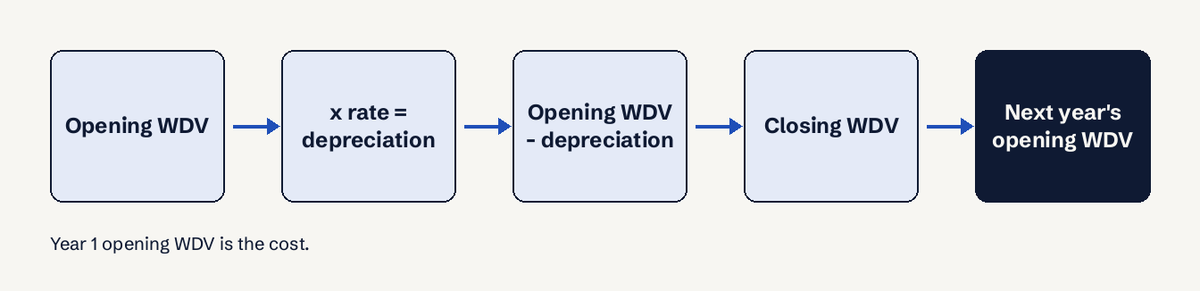
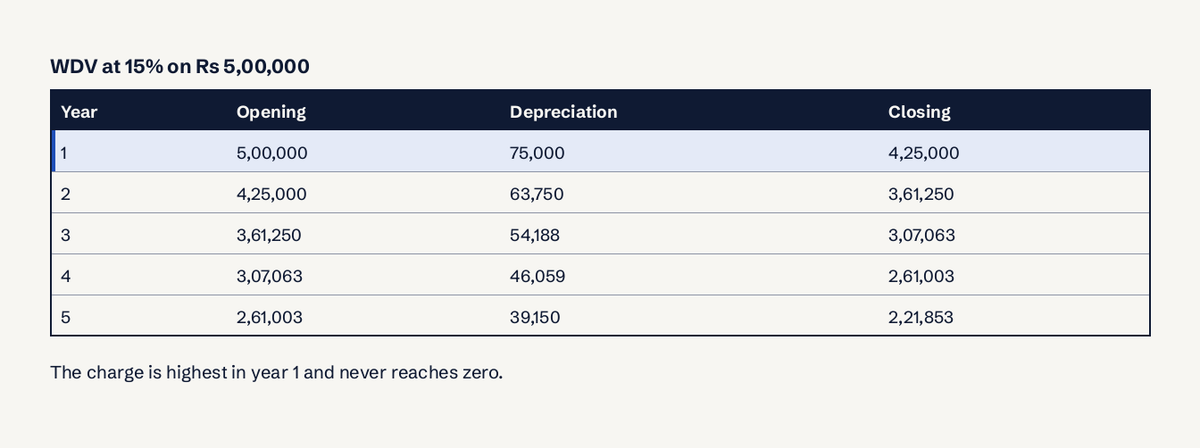
The written down value depreciation formula has two parts. The yearly charge is Depreciation = Opening WDV x Rate %, and Closing WDV = Opening WDV - Depreciation, which becomes next year's opening WDV. A machine bought for ₹5,00,000 at 15% is depreciated by ₹75,000 in year 1 (WDV ₹4,25,000) and by ₹63,750 in year 2 (WDV ₹3,61,250). Because the rate applies to a falling balance, the charge is highest in year 1 and shrinks every year, and the value never quite reaches zero. This is also called the reducing balance or diminishing balance method.
What you need before you start
- Cost of the asset: purchase price plus costs to bring it into use (freight, installation). GST you claim as input tax credit is not part of the cost.
- The date it was put to use, not just the purchase date. The 180-day rule depends on it.
- The rate, from one of two places:
- for your income-tax computation: the block rate in the depreciation table under section 33 of the Income-tax Act, 2025 (section 32 of the 1961 Act before Tax Year 2026-27);
- for your books under the Companies Act, 2013: the useful life in Schedule II and a residual value (normally up to 5% of cost), from which you work out the rate.
How to calculate WDV depreciation: 5 steps
- Find the rate. For tax, read it from the block table (general plant and machinery 15%). For books, compute it with the rate formula in the next section.
- Check the 180-day rule in the year of purchase. If the asset was put to use for less than 180 days in that financial year, use half the rate for that year only (15% becomes 7.5%).
- Compute the year's depreciation: opening WDV x rate. In year 1 the opening WDV is the cost.
- Compute the closing WDV: opening WDV - depreciation. Post the depreciation as an expense (Depreciation A/c Dr, To Asset A/c or Accumulated Depreciation A/c).
- Carry the closing WDV forward as next year's opening WDV and repeat steps 3 and 4 with the full rate.
How do you calculate the WDV rate from useful life?
Use Rate = 1 - (Residual value / Cost)^(1/n), where n is the useful life in years. This is the rate that, applied to the falling balance every year, brings the cost down to the residual value at the end of the life. It is the formula you need under Schedule II of the Companies Act, 2013, which gives useful lives, not rates.
With the usual 5% residual value, residual / cost = 0.05:
| Asset (Schedule II) | Useful life | WDV rate at 5% residual |
|---|---|---|
| Computers, end-user devices (laptops, desktops) | 3 years | 63.16% |
| Servers and networks | 6 years | 39.30% |
| General furniture and fittings | 10 years | 25.89% |
| General plant and machinery | 15 years | 18.10% |
For a 15-year machine: 0.05^(1/15) = 0.8190, so the rate is 1 - 0.8190 = 18.10%. In Excel, the formula =1-(25000/500000)^(1/15) returns 0.1810.
Worked example: a 5-year WDV schedule at 15%
A manufacturer buys a machine for ₹5,00,000 and puts it to use on 1 April 2026, so the full year applies. Income-tax rate for general plant and machinery: 15%.
| Year | Opening WDV (₹) | Depreciation at 15% (₹) | Closing WDV (₹) |
|---|---|---|---|
| 2026-27 | 5,00,000.00 | 75,000.00 | 4,25,000.00 |
| 2027-28 | 4,25,000.00 | 63,750.00 | 3,61,250.00 |
| 2028-29 | 3,61,250.00 | 54,187.50 | 3,07,062.50 |
| 2029-30 | 3,07,062.50 | 46,059.38 | 2,61,003.12 |
| 2030-31 | 2,61,003.12 | 39,150.47 | 2,21,852.65 |
Check: the closing WDV after n years is Cost x (1 - rate)^n. Here 5,00,000 x 0.85^5 = ₹2,21,852.66 (the one paisa difference is rounding each year). Total depreciation over five years: ₹2,78,147.35, of which 27% falls in the first year.
What happens if an asset is used for less than 180 days?
If an asset is put to use for less than 180 days in the financial year it was acquired, the income-tax depreciation for that year is 50% of the block rate. From the next year the full rate applies to the reduced WDV.
Example: a laptop costing ₹1,20,000 is put to use on 10 November 2026. From 10 November to 31 March is 142 days, under 180.
- 2026-27: 1,20,000 x 20% (half of 40%) = ₹24,000. Closing WDV ₹96,000.
- 2027-28: 96,000 x 40% = ₹38,400. Closing WDV ₹57,600.
The rule turns on the date the asset is put to use, not the invoice date. A machine bought in September but installed in December counts from December. Your books under Schedule II work differently: there you charge depreciation pro rata for the period the asset was in use, not a flat half.
How the block of assets changes the tax calculation
For income tax you do not run one schedule per asset. Assets with the same rate form a block, and the formula runs on the block's WDV:
- Opening WDV of the block
- plus cost of assets added during the year
- minus money received for assets sold or scrapped in the block during the year
- = WDV on which depreciation is charged (half rate on additions used under 180 days)
If the money received from a sale is more than the block's value, the block does not go negative: the excess is taxed as a short-term capital gain, and when every asset in a block is sold the remaining balance is a short-term capital loss or gain. The Income-tax Act, 2025 kept this block method and the old rates when it replaced the 1961 Act from 1 April 2026.
Is WDV or SLM better?
Neither is better in general; they suit different assets and purposes. The straight line method (SLM) charges the same amount every year: (Cost - Residual) / Life. For the ₹5,00,000 machine with a 15-year life and 5% residual, that is ₹31,666.67 a year.
| Point | WDV (reducing balance) | SLM (straight line) |
|---|---|---|
| Formula | Opening WDV x rate | (Cost - residual) / life |
| Year 1 charge, ₹5,00,000 machine | ₹75,000 (15% tax rate) or ₹90,500 (18.10% book rate) | ₹31,666.67 |
| Pattern | High early, falls every year | Same every year |
| Reaches residual | Only at the computed rate; never zero | Exactly at end of life |
| Income-tax (most businesses) | Required, by block | Only for specific cases such as power generation units that opt for it |
| Companies Act books | Allowed | Allowed |
| Suits | Machines, vehicles, computers that lose value fast | Buildings, leases, assets used evenly |
Pick WDV when an asset loses most of its value early and repair costs rise later: the falling depreciation balances the rising repairs. Pick SLM in your books when the asset gives similar service every year, and stay consistent: a change of method is a change in accounting estimate you must disclose.
Common mistakes
- Using the tax rate in Companies Act books. 15% is the income-tax rate; Schedule II needs a rate from the useful life (18.10% for 15 years). Most companies keep two sets of figures and the difference creates deferred tax.
- Taking full depreciation on a February purchase. Under 180 days means half the rate for tax.
- Applying the rate to cost every year. That is SLM at a WDV rate and over-depreciates the asset.
- Including claimed GST in cost. If you took input tax credit on the GST, depreciation is on the value excluding GST.
- Depreciating land. Land is not depreciated; split the land and building cost of a property.
Where to keep the schedule
A schedule like the one above lives in your fixed asset register, and its yearly figure becomes a journal entry in your ledger and a line in the profit and loss account. If you already keep your invoices and payments in LuckPanda, the Finance module's ledger holds those depreciation journals next to the rest of your books, so the balance sheet shows assets at their WDV.
For the concept itself and the other methods, see what depreciation means; for where the charge appears, see the profit and loss account format; and for why the method must stay consistent, see accounting principles.
Sources: Income Tax Department, section 33 of the Income-tax Act, 2025; Companies Act, 2013, Schedule II. This guide is information, not tax advice; check rates for your asset class with your accountant.
Questions
What is the formula for WDV depreciation?
Depreciation = Opening WDV x Rate. Closing WDV = Opening WDV - Depreciation. After n years, WDV = Cost x (1 - Rate)^n.
How do you calculate the WDV rate?
Rate = 1 - (Residual value / Cost)^(1/n), with n the useful life in years. With a 5% residual value, a 10-year life gives 25.89% and a 3-year life gives 63.16%.
What is the WDV depreciation rate for computers?
40% under the Income-tax Act for computers including software. Under Schedule II, laptops and desktops have a 3-year life, which is 63.16% WDV at a 5% residual value.
Is depreciation charged on cost or WDV?
Under WDV it is charged on the opening written down value each year; only in the first year is that equal to cost. Under SLM it is charged on cost less residual value.
What happens to depreciation when an asset is sold?
For tax, the sale money is deducted from the block's WDV and depreciation continues on what remains. If the sale money exceeds the block, the excess is a short-term capital gain.
Can I switch from WDV to SLM?
In Companies Act books, yes, if the change better reflects how the asset is used; it is treated as a change in accounting estimate and disclosed. For income tax, most businesses must use the block WDV method.