 luckpanda
AP Aging Report: How to Read the Buckets, With a Worked Example
An AP aging report lists unpaid vendor bills by days past due. Buckets, a worked rupee example, summary vs detail, and the India MSME 45-day rule.
On this page
- Which columns does the report have?
- What are the aging buckets?
- How do you read an accounts payable aging report?
- A worked AP aging report example
- The India rule a standard aging report misses: MSME 45 days
- What is the difference between AP aging summary and detail?
- How to create an AP aging report
- Common mistakes
- Keeping the report right without a spreadsheet
TL;DR: An AP aging report (accounts payable aging report) lists every unpaid vendor bill and sorts it into buckets by how many days past its due date it is: current, 1-30, 31-60, 61-90 and over 90 days. Read it bucket by bucket, oldest first, and give each bucket an action. In India, add one more column: days since acceptance for micro and small suppliers, because the MSMED Act caps their payment at 45 days.
An AP aging report is a snapshot, on a chosen date, of what your business owes its suppliers and how late each amount is. Each row is a vendor (summary) or a bill (detail), each column is an aging bucket, and the totals tell you how much cash you need this week, which vendors are at risk of stopping supply, and where late fees or interest are building up. It is the payables mirror of the accounts receivable aging report: AR aging shows who owes you, AP aging shows who you owe.
Which columns does the report have?
The report is a list of open payables grouped by age, measured from the due date (or, in some systems, from the bill date) to the report date. Accounting tools generate it from the bills you have entered; you can also build one in a spreadsheet from a list of unpaid bills.
The columns most reports carry are:
- Vendor name: the supplier you owe.
- Bill number and bill date: the vendor's invoice reference and its date.
- Due date: bill date plus the payment terms (net 30, net 45 and so on).
- Amount open: the unpaid balance after part payments and debit notes.
- Aging buckets: the amount placed in the one bucket its age falls into.
What are the aging buckets?
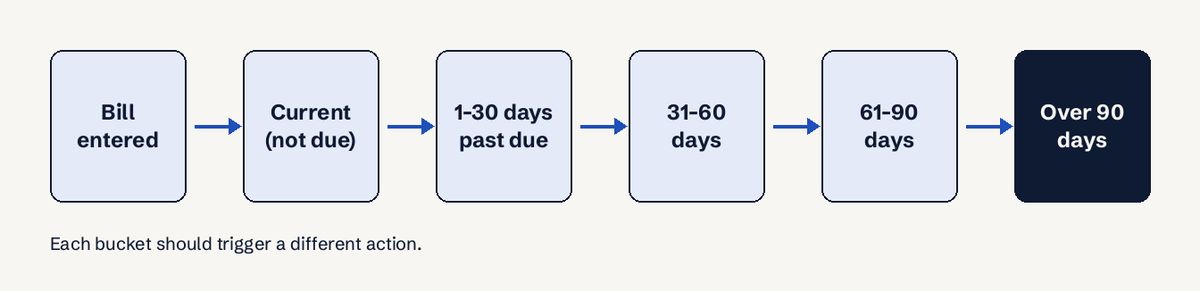
The standard buckets are 30-day steps, counted as days past the due date:
| Bucket | Meaning | Typical action |
|---|---|---|
| Current | Not yet due | Schedule on the due date; check for early-payment discounts |
| 1-30 days | Slightly overdue | Pay this cycle; confirm the bill is approved and matched |
| 31-60 days | Overdue | Find the reason (dispute, missing GRN, cash); agree a date with the vendor |
| 61-90 days | Seriously overdue | Escalate to the owner; expect late fees or a credit hold |
| Over 90 days | Very old | Resolve or write down: dispute, duplicate, or a real cash problem |
Some businesses use 15-day buckets for fast-moving suppliers, or add a 120+ column. The buckets are a reporting choice; the due date is the fact underneath them. Receivables aging uses the same buckets, but there you chase the oldest balance first; on payables you pay by due date, legal limit and how much you depend on the supplier.
How do you read an accounts payable aging report?
Read it in this order: total, oldest bucket, biggest vendor, then the current column.
- Check the total against your balance sheet. The report total should equal the accounts payable (sundry creditors) balance in your ledger on the same date. A gap means unposted bills, payments recorded without the bill, or a bill entered twice.
- Start with the oldest bucket. Anything over 60 days needs a reason written next to it. Old balances are often not cash problems at all: a disputed bill, a credit note the vendor never sent, or a duplicate.
- Look at concentration. One vendor holding most of the overdue amount is a supply risk; many small overdue bills usually point to a slow approval process.
- Then plan the current column. That is next week's cash requirement, plus any discount you can take by paying early.
- Compare with last month. If the 31-60 bucket grows month after month while the current bucket shrinks, bills are getting stuck in approval, not just paid late.
A quick health check: work out each bucket as a share of the total. Most of the balance should sit in Current and 1-30.
A worked AP aging report example
Here is an AP aging report for a small Pune manufacturer, run on 6 November 2026. All amounts are in rupees.
| Vendor | Bill date | Terms | Due date | Days past due | Amount (₹) | Bucket |
|---|---|---|---|---|---|---|
| Kaveri Logistics | 20 Oct 2026 | Net 30 | 19 Nov 2026 | 0 | 36,500 | Current |
| Shree Packaging (micro) | 5 Oct 2026 | Net 30 | 4 Nov 2026 | 2 | 48,000 | 1-30 |
| Apex Steel (small) | 15 Sep 2026 | Net 45 | 30 Oct 2026 | 7 | 2,10,000 | 1-30 |
| Om Electricals (micro, no written terms) | 10 Oct 2026 | 15 days | 25 Oct 2026 | 12 | 22,400 | 1-30 |
| Mehta Traders | 20 Aug 2026 | Net 30 | 19 Sep 2026 | 48 | 64,000 | 31-60 |
| CloudNine Software | 1 Aug 2026 | Net 30 | 31 Aug 2026 | 67 | 18,000 | 61-90 |
| Delta Office Supplies | 1 Jul 2026 | Net 30 | 31 Jul 2026 | 98 | 9,600 | Over 90 |
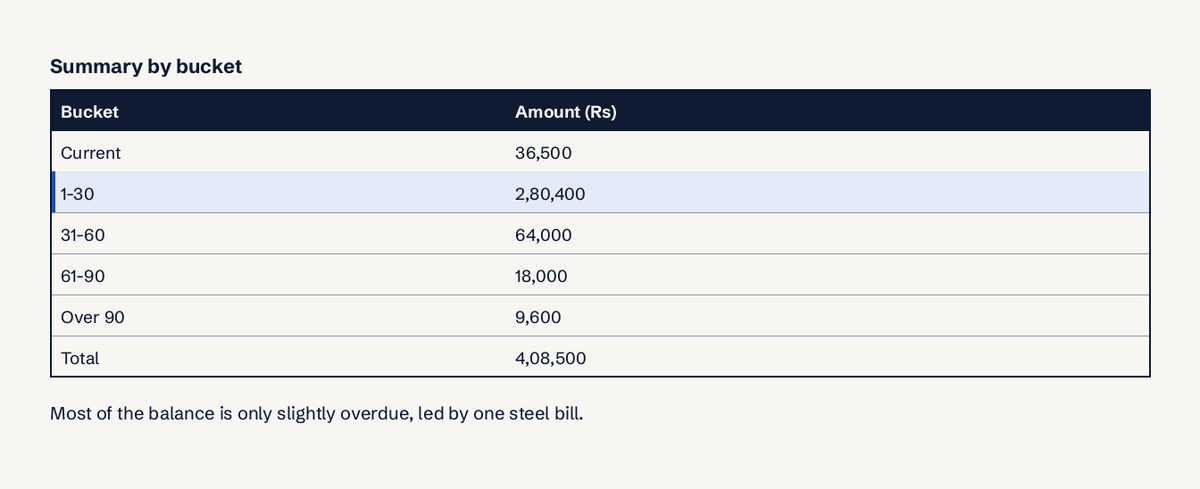
The summary view of the same data:
| Bucket | Amount (₹) | Share of total |
|---|---|---|
| Current | 36,500 | 8.9% |
| 1-30 days | 2,80,400 | 68.6% |
| 31-60 days | 64,000 | 15.7% |
| 61-90 days | 18,000 | 4.4% |
| Over 90 days | 9,600 | 2.4% |
| Total | 4,08,500 | 100% |
What this report says:
- Cash this week: ₹2,80,400 is already overdue but under 30 days. Apex Steel alone is ₹2,10,000 of it, so that one payment decides the week.
- The 31-60 and older bills are probably not cash problems. Mehta Traders at 48 days, CloudNine at 67 and Delta at 98 each need a written reason: a disputed quantity, a missing goods received note, a subscription that should have been cancelled.
- Two suppliers carry legal deadlines, which a plain aging report does not show. That is the next section.
The India rule a standard aging report misses: MSME 45 days
If a supplier is a micro or small enterprise registered under the MSMED Act, 2006, your due date is not only what the bill says. Section 15 requires the buyer to pay on the date agreed in writing, and that agreed period cannot exceed 45 days from the day you accept the goods or services. With no written agreement, payment is due before the "appointed day", which section 2(b) defines as the day after 15 days from acceptance (MSMED Act text, quoted by ITATonline).
Three consequences follow, and each one maps to a column you should add to your AP aging report:
- Interest: under section 16, a buyer who pays late owes the supplier compound interest with monthly rests at three times the bank rate notified by the RBI (MSME Samadhaan). Suppliers can file a case with the MSE Facilitation Council.
- Income tax: section 43B(h) of the Income-tax Act, added by the Finance Act 2023 and applicable from assessment year 2024-25, allows the expense only in the year you actually pay when payment to a micro or small enterprise is later than the section 15 limit. It does not apply to medium enterprises. An unpaid MSE bill at 31 March can be added back to taxable profit.
- Company filing: companies with dues to micro and small suppliers outstanding beyond 45 days file Form MSME-1 half-yearly with the MCA, by 30 April for October to March and by 31 October for April to September (ClearTax on MSME-1).
In the example above:
| Vendor | MSME status | Days since acceptance | Legal limit | Status on 6 Nov |
|---|---|---|---|---|
| Apex Steel | Small, written 45-day terms | 52 | 45 days, ended 30 Oct | Breached: interest running, 43B(h) exposure |
| Om Electricals | Micro, no written terms | 27 | 15 days | Breached: interest running |
| Shree Packaging | Micro, net 30 | 32 | 30 days agreed, max 45 | Overdue on contract; 45-day limit on 19 Nov |
So the payment order changes. By bucket, every 1-30 bill looks the same. By law, Apex Steel and Om Electricals come first, Shree Packaging must clear by 19 November, and Mehta Traders (not an MSE) can wait for its dispute to be settled. Ask each supplier for its Udyam registration number when you add it as a vendor, and record the acceptance date (often the GRN date) on every bill, so the report can count from the right day.
This is general information, not tax or legal advice. Check the supplier's Udyam certificate and your contract terms, and confirm the 43B(h) treatment with your accountant before year end.
What is the difference between AP aging summary and detail?
The AP aging summary shows one row per vendor with its total in each bucket; the AP aging detail (A/P aging detail) shows one row per open bill, with bill number, date, due date and days past due.
| AP aging summary | AP aging detail | |
|---|---|---|
| One row per | Vendor | Bill |
| Best for | Weekly cash planning, owner review | Deciding which bill to pay, disputes, audit |
| Shows bill numbers | No | Yes |
| Shows due dates | No | Yes |
| Size | Short | Long |
Use the summary to see the shape of the problem and the detail to act on it. The first table in the worked example is a detail report; the second is its summary.
How to create an AP aging report
- List every unpaid bill with vendor, bill number, bill date, terms and open amount. Include part-paid bills at their balance.
- Work out the due date: bill date plus terms. For MSE suppliers, also note the acceptance date and the legal limit (15 or up to 45 days).
- Calculate days past due: report date minus due date. Zero or negative means current.
- Put each amount in its bucket and total the columns.
- Reconcile the total with the accounts payable balance in your ledger.
In a spreadsheet, days past due is MAX(0, report date minus due date), and the bucket can be set with nested IF formulas on that number. The spreadsheet works until bills, payments and debit notes live in three places; then the report is only as right as the last manual update.
Common mistakes
- Aging from the bill date instead of the due date. A net 60 bill is not "overdue" at day 35. Say which convention the report uses.
- Leaving out unapproved bills. A bill waiting in someone's inbox is still a liability.
- Ignoring debit notes and advances. An advance paid to the vendor reduces what you owe; a debit note for short supply does too.
- Treating MSME suppliers like everyone else. The bucket says 1-30; the law may say interest is already running.
- Running it once a quarter. Weekly in a tight cash month, monthly at minimum, and always before 31 March and before an MSME-1 due date.
Keeping the report right without a spreadsheet
The report is only as accurate as the bills behind it. LuckPanda's Purchasing module keeps vendors, purchase orders, bills and payouts on one record, so a payment against a bill updates what is open, and you can see what is due before it ages. Drafting and recording are free; you pay ₹249 a month for the module only when you issue and send documents.
Related reading: the accounts payable process, purchase price variance, the free purchase order format and vendor bills in LuckPanda.
Questions
What is an AP aging report?
An AP aging report lists all unpaid vendor bills on a given date, grouped by how many days past due they are, usually in current, 1-30, 31-60, 61-90 and over 90 day buckets. It shows how much you owe, to whom and how late.
What are the aging buckets in accounts payable?
The usual buckets are current (not yet due), 1-30, 31-60, 61-90 and over 90 days past due. Some businesses use 15-day steps or add a 120+ bucket.
How often should you run an AP aging report?
At least monthly, before closing the books, and weekly when cash is tight. Indian companies should also run one before 31 March for section 43B(h) and before the 30 April and 31 October Form MSME-1 dates.
What is the difference between AP aging summary and detail?
The summary shows one row per vendor with totals per bucket. The detail shows each open bill with its number, dates and days past due. Plan with the summary, pay and resolve disputes with the detail.
Is the AP aging calculated from the bill date or the due date?
Most reports age from the due date, so "1-30" means 1 to 30 days past due. Some tools let you age from the bill date instead; check the report setting before comparing two reports.
What happens if I pay an MSME supplier after 45 days?
Under section 16 of the MSMED Act you owe compound interest with monthly rests at three times the RBI bank rate, and under section 43B(h) of the Income-tax Act the expense is deductible only in the year you actually pay. This applies to micro and small enterprises, not medium ones.