 luckpanda
ASMT-13 in GST: How to Get a Best Judgement Order Withdrawn
ASMT-13 is the GST best judgement order for unfiled returns. File a valid return within 60 days, or 120 with Rs 100 a day extra, and it is deemed withdrawn.
On this page
- What is ASMT-13 in GST?
- What LuckPanda does for an ASMT-13
- How do you get ASMT-13 withdrawn? Step by step
- What is the 60 day plus 60 day rule?
- Does the order lapse automatically after filing?
- What if the 120 day deadline is missed?
- Common errors and how to fix them
- How to stop the next ASMT-13
- Prepare the missing return today
TL;DR: ASMT-13 is the best judgement assessment order a GST officer issues under Section 62 when you have not filed a return even after a GSTR-3A notice. File a valid return (with the tax paid) within 60 days of the order and it is deemed withdrawn; between day 61 and day 120 you can still do it by paying an extra late fee of Rs 100 a day. After 120 days your only route is an appeal. LuckPanda's Compliance module prepares GSTR-1 and GSTR-3B from your own books, so the missing return can be ready the same day.
Prepare your GSTR-1 and GSTR-3B free on LuckPanda
ASMT-13 in GST is an order, not a notice: the officer has already worked out your tax "to the best of his judgement" from whatever material is available, and a summary of the demand sits in FORM GST DRC-07, which works as a recovery notice. The fix most businesses need is not a reply. It is the return itself. Under Section 62(2) of the CGST Act, as amended from 1 October 2023, a valid return filed within 60 days of the order being served makes the order deemed withdrawn, and a further 60 days are allowed with an additional late fee of Rs 100 per day beyond day 60. Interest under Section 50(1) and the normal late fee under Section 47 still apply.
What is ASMT-13 in GST?
ASMT-13 is the assessment order for non-filers under Section 62(1), issued in the form prescribed by Rule 100(1) of the CGST Rules, with its summary uploaded as DRC-07. It comes at the end of this chain:
| Step | Form | What it means |
|---|---|---|
| 1 | GSTR-3B or GSTR-1 not filed | Return under Section 39 missed |
| 2 | GSTR-3A | Notice under Section 46: file within 15 days |
| 3 | ASMT-13 + DRC-07 | Best judgement order and demand summary |
| 4 | Return filed in 60 / 120 days | Order deemed withdrawn |
| 5 | Nothing done | Recovery under Section 79, appeal only |
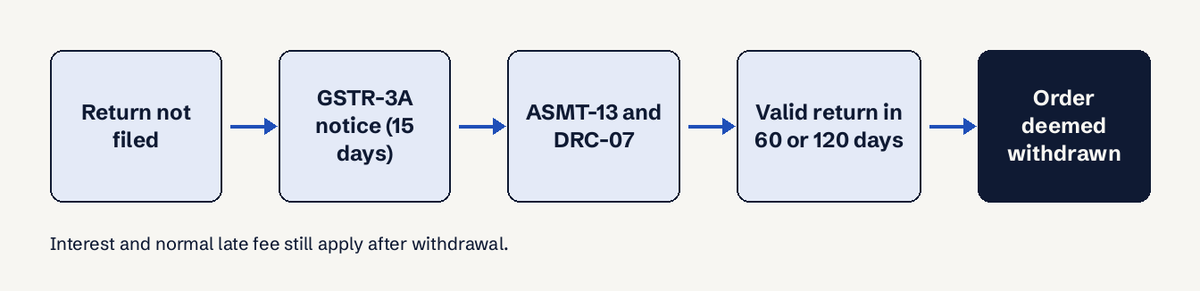
Three points make ASMT-13 different from other GST notices:
- No show cause notice is needed. Section 62 opens with "notwithstanding anything to the contrary contained in section 73 or section 74", so the officer can assess without the full SCN and hearing route.
- The time limit is long. The order can be issued within five years from the due date of the annual return (Section 44) for the year in question.
- It is undone by compliance. No other GST demand order lapses just because you file. This one does.
What LuckPanda does for an ASMT-13
LuckPanda is a business operating system for small businesses, and its GST return module works out returns from your own books for any month or quarter:
- GSTR-1 tables from issued invoices and notes: B2B, B2C large and others, exports, credit and debit notes, nil-rated, the HSN summary and documents issued.
- GSTR-3B from the same records: outward tax and input tax credit by head, with ineligible credit reversed (Table 4), and an estimate of tax payable.
- GSTR-1 JSON in the GSTN offline-tool format, ready to upload.
It prepares the return; it does not file it. You or your accountant upload and file on the GST portal, then record the filing date and ARN in LuckPanda. Drafting is free; the Compliance module is ₹199 a month for a business in India (live on pricing).
How do you get ASMT-13 withdrawn? Step by step
- Find the order and its service date. On the GST portal go to Services > User Services > View Notices and Orders. Note the reference number, the tax period and the date of the order. Day 1 of your 60 days counts from service of the order.
- Work out which returns are missing. The order names the period. Check Returns Dashboard for that period and any later ones: GSTR-3B is usually the return that matters, but file GSTR-1 for the same period too.
- Prepare the return from your books. Total outward supplies, tax on them, and eligible ITC. Do not copy the officer's figure: the assessed amount is an estimate and is often higher than your real liability.
- Pay the tax, interest and late fee. A "valid return" is one filed with the self-assessed tax paid in full (Section 2(117) read with Section 39). Interest is 18% a year under Section 50(1) from the due date. The GSTR-3B late fee under Section 47 is charged automatically in the return.
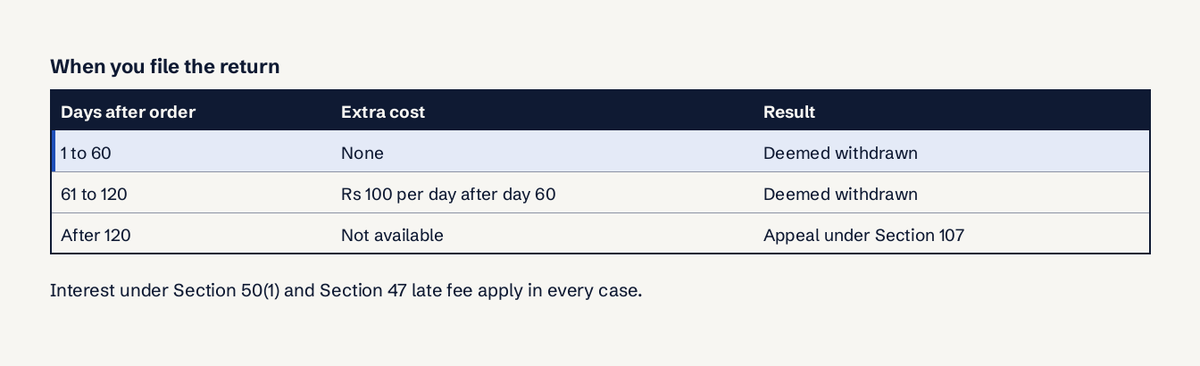
- If you are past day 60, pay the additional late fee. Days 61 to 120 cost Rs 100 per day beyond day 60, on top of the normal late fee. Example: filing on day 75 means 15 days x Rs 100 = Rs 1,500 extra.
- File the return and save the ARN. Download the filed return and the payment challans.
- Check that the demand is dropped. The order is "deemed to have been withdrawn" by law; the portal usually updates the DRC-07 demand. If it still shows in the Electronic Liability Register, write to the proper officer with the ARN, filing date and payment proof, and ask for the demand to be closed.
What is the 60 day plus 60 day rule?
The 60 plus 60 rule is the Section 62(2) window as amended by the Finance Act 2023 (in force from 1 October 2023). Before that date the window was 30 days, extendable by the officer. Now the first 60 days are free of extra charges, and the second 60 days need the additional late fee of Rs 100 per day. The window is counted from service of the assessment order, not from the date on the order if it was served later.
Does the order lapse automatically after filing?
Yes, by law. Section 62(2) says the order "shall be deemed to have been withdrawn" once a valid return is furnished in time; no separate application is required. Courts have backed this: in Goodwill Insulations, the Andhra Pradesh High Court held that a Section 62 assessment is deemed withdrawn once the return is filed and the late fee paid (Taxscan report). In practice, keep the ARN and write to the officer if the portal still shows the demand.
What if the 120 day deadline is missed?
After 120 days the order can no longer be withdrawn by filing. It becomes a normal demand:
- Appeal under Section 107 within 3 months of the order being communicated (the appellate authority can allow one more month for sufficient cause), with a pre-deposit of 10% of the tax in dispute. See our grounds of appeal format for GST.
- Recovery can start under Section 79 if the demand stays unpaid, including a DRC-13 notice to your bank or customers. Section 83 provisional attachment is also possible.
- Registration risk: continued non-filing can lead to cancellation under Section 29(2)(c).
A one-time amnesty under Notification 06/2023-Central Tax let older ASMT-13 orders (issued up to 28 February 2023) be withdrawn if the returns were filed in 2023. That window has closed.
Common errors and how to fix them
| Problem | Why it happens | Fix |
|---|---|---|
| Return filed but demand still in the ledger | Portal did not auto-close DRC-07 | Write to the officer with ARN and challans |
| Return filed as nil to close the order | A nil return that hides supplies is not a valid return | File true figures; a false return invites Section 74 |
| GSTR-3B blocked | Earlier period still unfiled | File returns in date order, oldest first |
| Paid the assessed amount instead of filing | Payment alone does not withdraw the order | File the return; adjust the payment against it |
How to stop the next ASMT-13
Every ASMT-13 starts with a missed GSTR-3B. Keep invoices and purchase bills in one place so the return is a download, not a project, and check that GSTR-1 and GSTR-3B agree before filing. LuckPanda builds both from the same records and shows the tax payable estimate before the due date.
Prepare the missing return today
Find the period in your ASMT-13, then let LuckPanda work out GSTR-1 and GSTR-3B from your invoices and bills and download the GSTR-1 JSON for the portal. Start free on LuckPanda.
Sources: CGST Act and Rules, CBIC; West Bengal Commercial Taxes: assessment and adjudication functionality. This guide is information, not tax advice.
Questions
What is ASMT-13 in GST?
ASMT-13 is the best judgement assessment order under Section 62(1) of the CGST Act, issued under Rule 100(1) to a registered person who has not filed a return even after a GSTR-3A notice. Its demand summary is uploaded as DRC-07.
How do you get ASMT-13 withdrawn?
File a valid return for the period, with the tax, interest and late fee paid, within 60 days of the order being served. Between day 61 and day 120 you can still do it by paying an additional late fee of Rs 100 for each day beyond day 60. The order is then deemed withdrawn.
Can I reply to ASMT-13 instead of filing the return?
There is no reply form for ASMT-13, because it is already an order. The law withdraws it only when the return is filed. If you disagree with the order and cannot file in time, the remedy is an appeal under Section 107.
Is interest payable even if the order is withdrawn?
Yes. Section 62(2) keeps the liability for interest under Section 50(1) and the late fee under Section 47 alive after withdrawal.
Is ASMT-13 the same as ASMT-10?
No. ASMT-10 is a scrutiny notice under Section 61 for a return you have filed, answered in ASMT-11. ASMT-13 is a final order for a return you have not filed.