 luckpanda
GST on GTA Service: 8 Worked Examples (RCM, 5%, 18%)
GST on GTA service is 5% under reverse charge by default, or 5% or 18% under forward charge if the GTA opts in. 8 worked freight bill examples.
On this page
- What are the GST rates for GTA in 2025-26?
- How LuckPanda handles GST on GTA bills
- Who pays GST on GTA services: the GTA or the recipient?
- 1. Reverse charge: GTA bills a private limited company
- 2. Forward charge at 18%: GTA with heavy truck purchases
- 3. Forward charge at 5%: GTA with few taxable costs
- 4. Unregistered customer: exempt
- 5. Small consignment: exempt under ₹1,500
- 6. Exempt goods: food grain and agricultural produce
- 7. The forward charge declaration on the invoice
- 8. GTA to GTA: a subcontracted load
- When is RCM applicable on GTA?
- What is the Annexure V declaration?
- Which example matches your case?
- Common mistakes on GTA bills
- Start your next GTA bill
TL;DR: GST on GTA service is 5% paid by the business customer under reverse charge (RCM) by default. A goods transport agency can instead opt, through Annexure V, to charge GST itself at 5% without input tax credit or 18% with full credit (the 18% rate replaced 12% from 22 September 2025). LuckPanda's free transport bill format builds the freight bill for either case, with the reverse charge statement already worded.
Make a GTA freight bill now with the free transport bill format: consignment note lines, RCM or forward charge, the right note. No account needed.
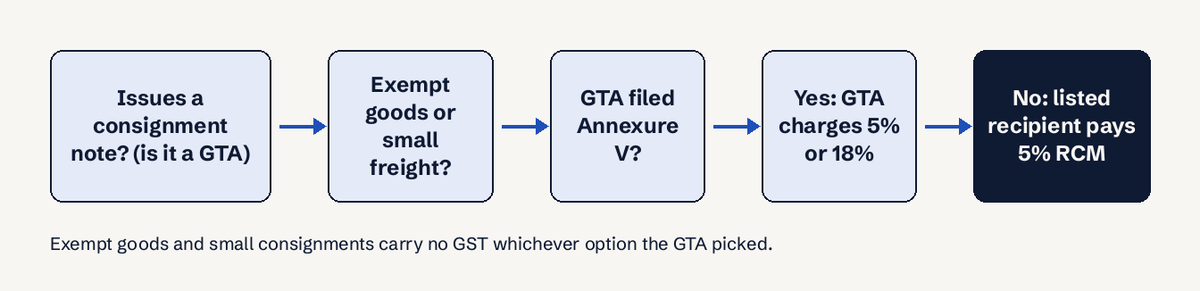
GST on a goods transport agency (GTA) service depends on two things: who pays the freight and which option the GTA has chosen for the year. If the person paying freight is a registered business, a factory, a society, a co-operative, a body corporate, a partnership firm or a casual taxable person, that customer pays 5% under reverse charge under Notification 13/2017-Central Tax (Rate), and the GTA bills without tax. If the GTA has filed Annexure V for the year, it charges the tax itself on its invoice: 5% with no input tax credit, or 18% with credit. Freight of ₹1,500 or less per consignment, freight of ₹750 or less for one consignee, and transport of agricultural produce, milk, salt, food grain, organic manure, newspapers, relief material and defence equipment are exempt under Notification 12/2017-Central Tax (Rate). This page is information, not tax advice; the notifications on the CBIC GST rates page are the authority.
What are the GST rates for GTA in 2025-26?
From 22 September 2025, after the 56th GST Council meeting of 3 September 2025, a GTA has three positions (Lakshmikumaran and Sridharan summary):
- 5% under reverse charge, the default, paid by the recipient;
- 5% under forward charge, paid by the GTA, without input tax credit;
- 18% under forward charge, paid by the GTA, with full input tax credit. Before 22 September 2025 this option was 12%.
The 12% rate no longer exists for GTA services. A GTA still quoting 12% on a bill dated after 21 September 2025 is wrong on the bill.
The whole picture in one table:
| Situation | Who pays | Rate | Credit |
|---|---|---|---|
| Default, freight paid by a registered business or other listed recipient | Recipient, reverse charge | 5% | Recipient can claim the RCM tax it paid |
| GTA opted forward charge at 5% | GTA | 5% | GTA takes no input tax credit; recipient can claim the 5% |
| GTA opted forward charge at 18% (from 22 Sep 2025) | GTA | 18% | GTA claims full ITC; recipient can claim the 18% |
| Freight paid by an unregistered person not in the listed categories | Nobody | Exempt | Not applicable |
| Freight up to ₹1,500 per consignment, or up to ₹750 for one consignee | Nobody | Exempt | Not applicable |
| Agricultural produce, milk, salt, food grain, organic manure, newspapers, relief material, defence equipment | Nobody | Exempt | Not applicable |
How LuckPanda handles GST on GTA bills
LuckPanda is a business operating system for small businesses. For a transporter or a business that pays freight, the parts that matter here are:
- The free transport bill format has a line per consignment note (LR number, route, vehicle, weight) and separate lines for loading, unloading and detention. Under reverse charge you set the tax to 0% and the note reads "GST payable by recipient under reverse charge at 5%". If you have opted for forward charge you set 5% or 18%.
- The GST invoice generator splits tax into CGST and SGST or IGST from the place of supply, and the free GST calculator adds or removes GST at any rate.
- The Compliance module works out GST returns from your books: "GSTR-1 tables from issued invoices and notes, GSTR-3B with output tax and input tax credit from recorded bills, and the HSN summary" (GST returns). It prepares the GSTR-1 JSON for you to upload; it does not file on the portal, because LuckPanda has no GSP connection.
- Drafts and branded PDFs are free. Issuing, sending and clean PDFs cost $4.99 per module per month, or ₹199 for a business in India, tax included (pricing).
What it does not do: it does not decide your Annexure V option or file the declaration. That is done on the GST portal.
Who pays GST on GTA services: the GTA or the recipient?
The recipient pays when the GTA has not opted for forward charge and the person paying freight is one of the categories in Notification 13/2017-Central Tax (Rate), entry 1:
- a factory registered under the Factories Act, 1948;
- a society registered under the Societies Registration Act, 1860 or any other law;
- a co-operative society;
- a person registered under GST;
- a body corporate;
- a partnership firm, registered or not, including an association of persons;
- a casual taxable person.
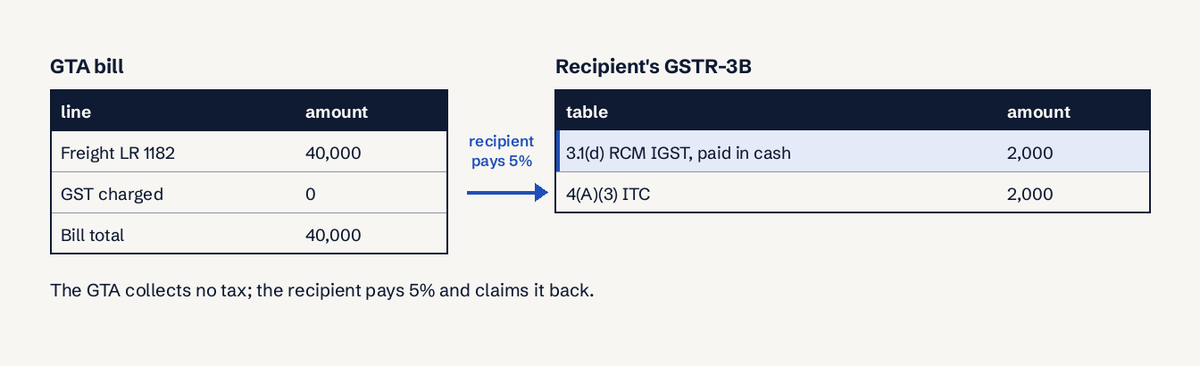
The GTA pays when it has exercised the forward charge option. Since the change of 18 July 2022, reverse charge does not apply to a GTA that has opted for forward charge, so one option covers all its customers for the year. Liability under reverse charge is paid in cash (Section 49(4) of the CGST Act bars using credit for it), reported in GSTR-3B Table 3.1(d), and claimed back as credit in Table 4(A)(3) in the same return when the freight is used for business.
All examples below use freight of ₹40,000 unless stated, and Indian number formatting. Where the GTA and the place of supply are in the same state the tax splits into CGST and SGST; otherwise it is IGST.
1. Reverse charge: GTA bills a private limited company
Scenario: Malwa Roadlines (Indore, Madhya Pradesh, registered, no Annexure V) carries a load for Deccan Pumps Pvt Ltd (Pune, Maharashtra, registered). Freight ₹40,000.
The bill:
| Field | Value |
|---|---|
| Freight, LR 1182, Indore to Pune, 9 t | ₹40,000.00 |
| GST on bill | ₹0.00 |
| Note | GST payable by recipient under reverse charge at 5% |
| Bill total | ₹40,000.00 |
What it shows: Deccan Pumps pays IGST of ₹2,000 (5% of ₹40,000) in cash. The place of supply for a registered recipient is the recipient's location (Section 12(8) of the IGST Act), Maharashtra, and the GTA is in Madhya Pradesh, so it is IGST. Deccan Pumps reports ₹2,000 in GSTR-3B Table 3.1(d) and claims ₹2,000 as ITC in Table 4(A)(3).
How to adapt it: change the recipient's state. If Deccan Pumps were in Madhya Pradesh, the ₹2,000 would split into ₹1,000 CGST and ₹1,000 SGST.
2. Forward charge at 18%: GTA with heavy truck purchases
Scenario: Sahyadri Cargo (Nashik, Maharashtra) filed Annexure V and opted for 18%. It bills a registered customer in Maharashtra ₹40,000.
| Field | Value |
|---|---|
| Freight | ₹40,000.00 |
| CGST 9% | ₹3,600.00 |
| SGST 9% | ₹3,600.00 |
| Bill total | ₹47,200.00 |
What it shows: the customer pays ₹47,200 and claims ₹7,200 as ITC. Sahyadri Cargo pays ₹7,200 as output tax but can set off ITC on trucks, tyres, spares and repairs, subject to Section 17(5), which does not block goods carriages. The bill carries the forward charge declaration (example 7).
How to adapt it: this option pays when the GTA buys trucks or spends heavily on taxable inputs, and its customers are registered and can take the credit.
3. Forward charge at 5%: GTA with few taxable costs
Scenario: the same bill, but the GTA opted for 5% under forward charge.
| Field | Value |
|---|---|
| Freight | ₹40,000.00 |
| CGST 2.5% | ₹1,000.00 |
| SGST 2.5% | ₹1,000.00 |
| Bill total | ₹42,000.00 |
What it shows: the GTA collects and pays ₹2,000 and takes no ITC on its own purchases. The customer can claim the ₹2,000. Compared with reverse charge, the tax is the same; what changes is who deposits it and the GTA's registration and return work.
4. Unregistered customer: exempt
Scenario: a GTA on the default (reverse charge) carries goods for an unregistered sole trader who pays the freight of ₹12,000. The trader is not a factory, society, co-operative, body corporate or firm.
What it shows: GTA services to an unregistered person, including an unregistered casual taxable person, other than the listed categories, are exempt under Notification 12/2017-Central Tax (Rate). The GTA issues a bill of supply with no tax, and nobody pays reverse charge. If the same sole trader were registered, example 1 would apply.
How to adapt it: check the payer's status, not the consignor's. If the consignee pays freight ("to pay"), the consignee's status decides.
5. Small consignment: exempt under ₹1,500
Scenario: a GTA carries one carton for a registered retailer in a single carriage. Freight ₹1,200.
What it shows: freight of ₹1,500 or less for the goods in one consignment in a single carriage is exempt, so no reverse charge arises. A second exemption covers freight of ₹750 or less for goods meant for a single consignee. Above the limits, the full freight is taxable, not just the excess.
6. Exempt goods: food grain and agricultural produce
Scenario: a GTA carries 15 t of wheat for a registered flour mill. Freight ₹60,000.
What it shows: transport of food grain, including flour, pulses and rice, and of agricultural produce, is exempt whoever pays and whatever the GTA's option. The bill carries no tax and the mill reports no reverse charge. The same applies to milk, salt, organic manure, newspapers and magazines registered with the Registrar of Newspapers, relief material for disaster victims, and defence or military equipment.
7. The forward charge declaration on the invoice
Scenario: any GTA that has opted for forward charge (examples 2 and 3).
What it shows: under Annexure III of Notification 13/2017-Central Tax (Rate), as amended by Notification 5/2022 from 18 July 2022, every invoice must carry this declaration (text via StudyCafe):
I/we have taken registration under the CGST Act, 2017 and have exercised the option to pay tax on services of GTA in relation to transport of goods supplied by us from the Financial Year ____ under forward charge and have not reverted to the reverse charge mechanism.
How to adapt it: fill in the year you first opted. In LuckPanda's transport bill format, put the declaration in the notes field so it prints on every bill.
8. GTA to GTA: a subcontracted load
Scenario: Malwa Roadlines (registered, reverse charge default) books a load and hands it to Narmada Carriers, another GTA, which issues its own consignment note and bills Malwa ₹25,000.
What it shows: GTA to GTA service is not exempt. Malwa is a registered person, so if Narmada has not opted for forward charge, Malwa pays 5% (₹1,250) under reverse charge. If Narmada has opted for forward charge, Narmada charges 5% or 18% on its bill. What is exempt is different: hiring a vehicle to a GTA (a truck owner renting a goods carriage to a GTA, without issuing a consignment note) is exempt under Notification 12/2017-Central Tax (Rate).
When is RCM applicable on GTA?
Reverse charge applies to a GTA service when all three hold:
- the supplier is a GTA, meaning it issues a consignment note for road transport of goods;
- the person liable to pay freight is in one of the seven categories listed above;
- the GTA has not opted for forward charge for that financial year, and no exemption applies.
If any one fails, there is no reverse charge. A truck owner who does not issue a consignment note is not a GTA, so freight paid to them is not GTA service.
What is the Annexure V declaration?
Annexure V is the declaration a GTA files to pay GST under forward charge for a financial year. It is filed on the GST portal between 1 January and 31 March of the preceding financial year (the earlier deadline was 15 March). So to charge forward charge from 1 April 2027, file between 1 January and 31 March 2027. Once filed, the option continues for later years until the GTA files Annexure VI, in the same 1 January to 31 March window, to go back to reverse charge.
Which example matches your case?
| You are | Customer | Use example |
|---|---|---|
| GTA, no Annexure V | Registered business or company | 1 |
| GTA, opted 18% | Registered business | 2 |
| GTA, opted 5% | Any | 3 |
| GTA | Unregistered individual or shop | 4 |
| GTA, small parcel | Any | 5 |
| GTA carrying grain or produce | Any | 6 |
| GTA subcontracting to another GTA | Another GTA | 8 |
Common mistakes on GTA bills
- Charging 12% on bills dated 22 September 2025 or later. The option is 18%.
- Charging GST on a bill when the GTA never filed Annexure V. The recipient still owes reverse charge, and the GTA has collected tax it was not liable for.
- Paying reverse charge from the electronic credit ledger. It must be paid in cash.
- Missing the e-way bill: a consignment worth more than ₹50,000 needs one, generated by the consignor, consignee or transporter.
- Treating freight above ₹1,500 as partly exempt. The limit is all or nothing.
Start your next GTA bill
Pick the example that matches you, then open the free transport bill format and fill it in. The reverse charge note is already worded, and you can switch to 5% or 18% if you have filed Annexure V. Record the bills in LuckPanda and the GST returns view works out GSTR-1 and GSTR-3B from them. See pricing.
Questions
Who pays GST on GTA services: GTA or recipient?
By default the recipient pays 5% under reverse charge when it is a registered person, factory, society, co-operative, body corporate, partnership firm or casual taxable person. The GTA pays only if it has opted for forward charge through Annexure V.
What are the GST rates for GTA in 2025-26?
5% under reverse charge, 5% under forward charge without input tax credit, or 18% under forward charge with full credit. The 18% option replaced 12% from 22 September 2025.
Is GTA to GTA service exempt?
No. A GTA that receives transport service from another GTA is a registered person, so it pays 5% under reverse charge unless the supplying GTA has opted for forward charge. Hiring a vehicle to a GTA is exempt, which is a different service.
Is GST on GTA service applicable to unregistered persons?
GTA services to an unregistered person, other than a factory, society, co-operative, body corporate or partnership firm, are exempt under Notification 12/2017-Central Tax (Rate).
Can the recipient claim ITC on RCM paid for GTA?
Yes, if the freight is used for business. The recipient pays the 5% in cash, reports it in GSTR-3B Table 3.1(d), and claims it as ITC in Table 4(A)(3) of the same return.
What is the SAC code for GTA service?
Goods transport services fall under heading 9965; GTA services are usually billed under SAC 996791. Find any code with the HSN code finder.