 luckpanda
Is Inventory an Asset? Where It Sits on the Balance Sheet and When It Becomes an Expense
Yes, inventory is a current asset under IFRS, Ind AS 2 and US GAAP. Where it sits on the balance sheet, how it is valued and when it becomes an expense.
On this page
- Is inventory a current asset?
- Why does it matter whether inventory is an asset?
- What counts as inventory?
- How is inventory valued on the balance sheet?
- When does inventory become an expense?
- Worked example: a year of inventory for a small trader
- Can inventory be a liability?
- What changed recently?
- Inventory vs fixed assets: what is the difference?
- Pitfalls that misstate inventory
TL;DR: Yes. Inventory is an asset, and almost always a current asset, because a business expects to sell or use it within its normal operating cycle. It stays on the balance sheet at the lower of cost and net realisable value until it is sold, when its cost moves to the income statement as cost of goods sold.
Inventory is the stock of goods a business holds for sale, goods in production for sale, and materials or supplies it will consume in production. It is an asset because it is a resource the business controls that will bring in cash when sold. Under IFRS (IAS 2 and IAS 1), India's Ind AS 2 and Schedule III of the Companies Act 2013, and US GAAP (ASC 330), inventory is reported under current assets. It is never a liability: the money you still owe a supplier for that stock is the liability (accounts payable), not the stock itself.
Is inventory a current asset?
Inventory is a current asset under every major framework. IAS 1 paragraph 66 classes an asset as current when the business expects to realise it, sell it or consume it in its normal operating cycle, holds it mainly for trading, or expects to realise it within 12 months. Inventory meets the first test by definition.
The operating cycle matters more than the 12-month rule. IAS 1 paragraph 68 says inventories sold as part of the normal operating cycle are current even when they are not expected to be realised within 12 months. So whisky ageing for eight years, timber seasoning, or a builder's flats under construction are still current assets for the businesses that make and sell them.
In India, Schedule III of the Companies Act 2013 lists "Inventories" as the first line under Current assets, and the notes split it into raw materials, work in progress, finished goods, stock-in-trade, stores and spares, and loose tools. You can see that layout in our balance sheet format.
| Framework | Standard for inventory | Where it is shown | Allowed cost formulas |
|---|---|---|---|
| IFRS | IAS 2 Inventories | Current assets (IAS 1, IFRS 18 from 2027) | Specific identification, FIFO, weighted average |
| India, listed and large companies | Ind AS 2 | Current assets (Schedule III, Division II) | Specific identification, FIFO, weighted average |
| India, other companies | AS 2 Valuation of Inventories | Current assets (Schedule III, Division I) | Specific identification, FIFO, weighted average |
| US GAAP | ASC 330 | Current assets | Specific identification, FIFO, average cost, LIFO |
Why does it matter whether inventory is an asset?
Classing inventory as an asset is what keeps profit honest. If you bought ₹5,00,000 of stock in March and expensed it immediately, March would show a large loss and April, when you sold it, a large profit. Treating it as an asset parks the cost on the balance sheet and releases it only when the matching sale happens.
It also drives the numbers lenders and buyers look at. Inventory sits inside working capital and the current ratio, so overstated stock makes a business look more liquid than it is. That is why banks lending against stock in India ask for a monthly stock statement, and why auditors attend the physical count.
What counts as inventory?
IAS 2 covers three kinds of assets: goods held for sale in the ordinary course of business, goods in the process of production for sale, and materials and supplies to be consumed in production or in rendering services. In practice that is:
- Raw materials: fabric for a garment maker, steel coil for a fabricator.
- Work in progress: half-stitched shirts, a machine being assembled.
- Finished goods and stock-in-trade: goods made or bought to resell.
- Stores and spares: packing material, lubricants and spare parts that are consumed, not kept as equipment.
What is not inventory: the shelving, forklifts and laptops you use to run the business. Those are property, plant and equipment, non-current assets that you depreciate. The same item can be either: a car is inventory for a car dealer and a fixed asset for the dealer's accountant who drives it.
How is inventory valued on the balance sheet?
Inventory is carried at the lower of cost and net realisable value (NRV). That rule is the same in IAS 2, Ind AS 2 and AS 2, and since ASU 2015-11 US GAAP uses it too for inventory measured by FIFO or average cost. LIFO and the retail method under US GAAP still use the older "lower of cost or market" test.
- Cost includes the purchase price, import duties and non-recoverable taxes, freight in, and conversion costs (direct labour and production overhead) needed to bring the goods to their present location and condition. GST you can claim as input tax credit is not part of cost, because it is recoverable.
- Net realisable value is the estimated selling price in the ordinary course of business less the estimated costs to complete and sell.
- Cost formulas: IFRS and Indian standards allow specific identification for items that are not interchangeable, and FIFO or weighted average for those that are. LIFO has been banned under IAS 2 since the 2003 revision. US GAAP allows LIFO, and the IRS LIFO conformity rule in Internal Revenue Code section 472(c) means a company using LIFO for tax must also use it in its financial reports.
If you want the mechanics of picking a cost formula, see how to calculate ending inventory for FIFO and weighted average worked through.
When does inventory become an expense?
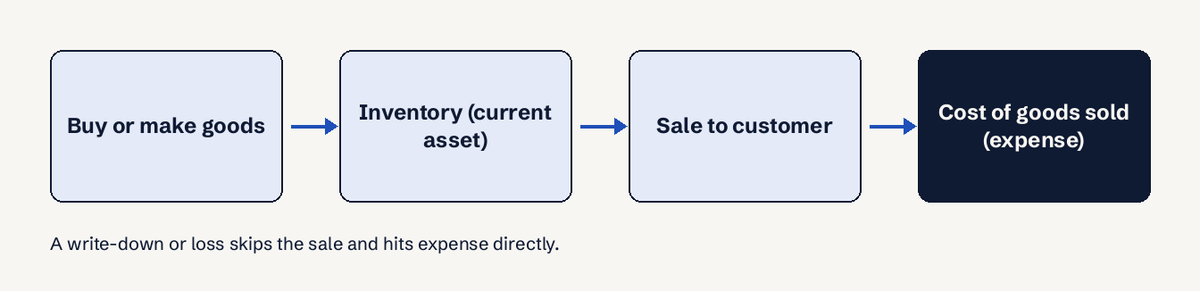
Inventory becomes an expense in three situations, set out in IAS 2 paragraph 34:
- When it is sold. Its carrying amount is recognised as an expense, cost of goods sold, in the same period as the revenue from the sale.
- When it is written down to NRV. The write-down is an expense in the period it happens, for example when stock is damaged, obsolete or selling below cost.
- When it is lost. Theft, spoilage and shrinkage found at a count are expensed when they occur.
A write-down can be reversed under IFRS and Ind AS if NRV recovers, up to the original write-down. US GAAP does not allow that reversal for annual periods.
Worked example: a year of inventory for a small trader
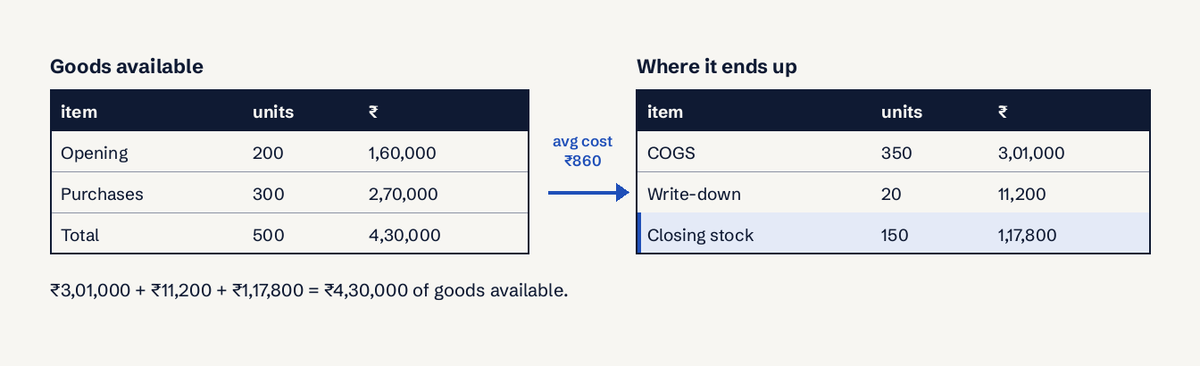
A Pune electronics trader starts the year with 200 power banks costing ₹800 each and uses weighted average cost.
| Event | Units | Unit cost (₹) | Inventory on balance sheet (₹) | Expense (₹) |
|---|---|---|---|---|
| Opening stock | 200 | 800 | 1,60,000 | 0 |
| Buys 300 at ₹900 | 500 | 860 avg | 4,30,000 | 0 |
| Sells 350 at ₹1,200 | 150 | 860 | 1,29,000 | 3,01,000 COGS |
| 20 damaged units, NRV ₹300 each | 150 | 860 / 300 | 1,17,800 | 11,200 write-down |
The purchase of 300 units at ₹900 (₹2,70,000) increases the asset, not expenses. The supplier also charged 18% GST, ₹162 per unit, but the trader claims it as input tax credit, so it stays out of cost: the unit cost is ₹900, not ₹1,062. Weighted average cost is ₹4,30,000 ÷ 500 = ₹860. The sale of 350 units moves 350 × ₹860 = ₹3,01,000 to cost of goods sold against ₹4,20,000 of revenue. The 20 damaged units drop from ₹860 to ₹300, a ₹11,200 write-down, a 65% cut on those units. At year end, inventory on the balance sheet is ₹1,17,800 and sits under current assets. The COGS formula gives the same answer from the other side: opening stock ₹1,60,000 + purchases ₹2,70,000 − closing stock ₹1,17,800 = ₹3,12,200, which is COGS plus the write-down.
Can inventory be a liability?
No. Inventory is always an asset; it can never be a liability. The confusion comes from three places:
- You still owe for it. Stock bought on credit of 60 days creates a liability, accounts payable, alongside the asset. Paying the supplier removes the liability; the inventory stays until sold.
- It costs money to hold. Storage, insurance, interest and obsolescence are real costs, which is why people say excess stock "is a liability" in an operational sense. In accounting terms it is an asset that may need writing down.
- Customer advances. If a customer pays before you deliver, the advance is a liability (contract liability), but the goods you hold for them are still your inventory until control passes.
Slow stock is the practical risk. Tracking inventory turnover and average inventory shows when an asset is quietly turning into a write-down.
What changed recently?
- IFRS 18 from 1 January 2027. IFRS 18 Presentation and Disclosure in Financial Statements, issued in April 2024, replaces IAS 1 for annual periods beginning on or after 1 January 2027. The current asset tests move across unchanged, so inventory stays a current asset.
- Ind AS 2 since 2015. Ind AS 2 was notified under the Companies (Indian Accounting Standards) Rules, 2015 and applies to companies listed outside SME exchanges and unlisted companies with net worth of ₹250 crore or more; other companies stay on AS 2.
- IAS 2 history. The IASB adopted IAS 2 in April 2001 and revised it in December 2003, which is when LIFO was removed.
- Disclosures. IAS 2 paragraph 36 requires the accounting policy, the carrying amount by classification, the amount expensed in the period, write-downs and reversals, and inventory pledged as security for liabilities.
Inventory vs fixed assets: what is the difference?
| Inventory | Fixed asset (PP&E) | |
|---|---|---|
| Purpose | Sold or consumed in the operating cycle | Used to run the business over years |
| Balance sheet | Current assets | Non-current assets |
| Measured at | Lower of cost and NRV | Cost less accumulated depreciation |
| How it becomes expense | COGS when sold, write-downs | Depreciation over useful life |
| Standard | IAS 2 / Ind AS 2 / ASC 330 | IAS 16 / Ind AS 16 / ASC 360 |
Pitfalls that misstate inventory
- Counting goods in transit wrongly. Goods shipped FOB shipping point belong to the buyer from dispatch; FOB destination, from arrival.
- Including recoverable GST or VAT in cost. Only non-recoverable taxes go into cost.
- Never writing down dead stock. Items that will not sell above cost must come down to NRV.
- Book stock that does not match the shelf. A perpetual record needs regular cycle counts, for example fast movers every 30 days and the rest every 90 days, or the balance sheet figure is a guess.
Keeping one record of items, warehouses and stock movements is what makes the balance sheet number defensible. LuckPanda's Inventory module tracks items and stock across warehouses on the same record your invoices and purchase bills use, so every sale and receipt moves stock without retyping.
Questions
Is inventory a current asset?
Yes. IAS 1, Ind AS and Schedule III, and US GAAP all present inventory as a current asset because it is sold or consumed within the normal operating cycle, even when that cycle is longer than 12 months.
Can inventory be a liability?
No. Inventory is an asset. The amount you owe the supplier for it is a liability (accounts payable), and holding too much stock is an operating risk, but the stock itself is never recorded as a liability.
When does inventory become an expense?
When it is sold (cost of goods sold, in the same period as the revenue), when it is written down to net realisable value, or when it is lost, damaged or stolen.
Is inventory a tangible asset?
Yes. Inventory is physical goods and materials, so it is a tangible current asset. It is different from intangible assets such as software licences or trademarks.
Is inventory an asset in the income statement?
No. Assets appear on the balance sheet. Inventory affects the income statement only through cost of goods sold, write-downs and losses.
Is LIFO allowed in India?
No. Ind AS 2 and AS 2 allow specific identification, FIFO and weighted average only. LIFO is allowed under US GAAP, not under IFRS or Indian standards.
This guide is general information, not accounting advice. Check the standard your business reports under, or ask your accountant.