 luckpanda
Retainer Invoice: Meaning, Template and a Worked Example
A retainer invoice bills a client in advance for work you will do later. See the fields, the accounting entries and a worked example with numbers.
On this page
- What is a retainer invoice?
- How does it differ from a regular invoice?
- Which fields does the template need?
- How do you account for a retainer payment?
- Worked example: a monthly retainer with numbers
- What happens to unused retainer funds?
- When is GST or VAT due on an advance?
- Retainer vs deposit vs proforma
- Common mistakes to avoid
- Tools to make the template
TL;DR: A retainer invoice asks a client to pay in advance for work you will do later. Until you do the work, that money is a liability (an advance you owe back in work or cash), not revenue. You draw it down with a normal invoice each period, and the contract decides what happens to anything unused.
A retainer invoice is a request for advance payment that reserves your time or funds future work for a client, usually a fixed amount each month. It looks like an invoice, but the money it collects is not yet earned: in your books it sits as a client advance until you deliver, and you then raise a regular invoice against it. A design agency that bills a ₹1,00,000 monthly retainer and does ₹80,000 of work that month has earned ₹80,000; the other ₹20,000 rolls over, is refunded or is kept, depending on the retainer agreement. Below: the fields a retainer invoice template needs, the journal entries, a worked example and the tax timing in India, the UK and elsewhere.
What is a retainer invoice?
A retainer invoice is a document that bills a client before the work, under a retainer agreement. A retainer agreement is a work-for-hire contract where "the client or customer pays in advance for professional work to be specified later" (Wikipedia, Retainer agreement). It can be one advance payment or a recurring monthly one.
Lawyers, agencies, consultants, accountants, developers and freelancers use retainers for the same reason: the client gets guaranteed capacity, and you get cash before you spend the hours.
There are three common kinds, and the invoice wording should say which one you mean (Cornell LII, Retainer):
| Type | What the client pays for | Is it earned on receipt? |
|---|---|---|
| General (availability) retainer | Reserving your time; work is billed separately | Usually yes, if the contract says it is for availability |
| Security retainer | A fund that pays future invoices, held until earned | No; drawn down as you bill |
| Advance fee retainer | Prepayment for the services themselves | No; earned as the work is done |
For lawyers in the US, a security retainer goes into a trust account and reaches the lawyer only as fees are earned, and some states restrict advance fee retainers altogether (Cornell LII). Check your bar's rules before using the template for legal work.
How does it differ from a regular invoice?
A regular invoice bills for work already delivered; a retainer invoice bills for work not yet delivered. That one difference changes the accounting, the tax timing and the wording.
| Retainer invoice | Regular (final) invoice | |
|---|---|---|
| Bills for | Future work or reserved capacity | Work or goods already delivered |
| In your books | Liability (client advance, unearned revenue) | Revenue and a receivable |
| Line items | Retainer amount for a period | Hours, deliverables or items |
| Typical label | "Retainer invoice", "Advance invoice" | "Invoice", "Tax invoice" |
| Followed by | A final invoice that applies the retainer | Payment, or a credit note if corrected |
| Refundable? | Often, if work is not done (contract decides) | No, it is a debt for delivered work |
A retainer invoice is also not a proforma invoice. A proforma is a quote-like preview of a future invoice and asks for no money in your books; a retainer invoice collects real money.
Which fields does the template need?
A retainer invoice template needs the usual invoice fields plus four that make the advance traceable:
- Title "Retainer invoice" (or "Advance invoice") so nobody books it as revenue.
- Your business and client details, including tax IDs (GSTIN, VAT number) where they apply.
- Number and date, from a separate series or prefix such as RET-2026-011.
- Period covered, for example 1 to 30 November 2026.
- Scope of the retainer: hours included, services, response times.
- Amount, tax and total, in the client's currency.
- How it will be applied: "Applied against invoices for work in this period".
- Unused balance rule: rolls over, refunded, or non-refundable for availability.
- Due date and payment details: bank details or a payment link, due before the period starts (for example 7 days before the 1st).
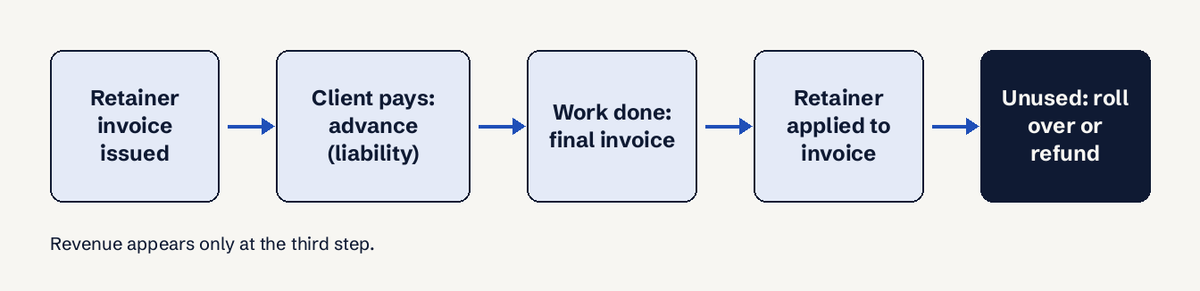
How do you account for a retainer payment?
You account for a retainer payment as a liability when it arrives and move it to revenue as you deliver. Zoho's own help puts it plainly: an advance "will not be an income but a liability to the company. The revenue is earned only when the product is delivered or the service is completed" (Zoho Books help). Under IFRS 15 (and Ind AS 115 in India), revenue is recognised when a performance obligation is satisfied, and for services that is usually over time as the work happens. The liability is called deferred income, unearned revenue or a contract liability (Wikipedia, Deferred income).
The entries, without tax:
| When | Debit | Credit |
|---|---|---|
| Client pays the retainer | Bank | Client advance (liability) |
| You invoice the month's work | Client advance | Revenue |
| You refund the unused part | Client advance | Bank |
| Unused part is non-refundable per contract | Client advance | Revenue |
The exception is a true availability retainer: if the contract says the fee buys your availability and is non-refundable, it is earned for that period as the period passes, not on delivery of specific work.
Worked example: a monthly retainer with numbers
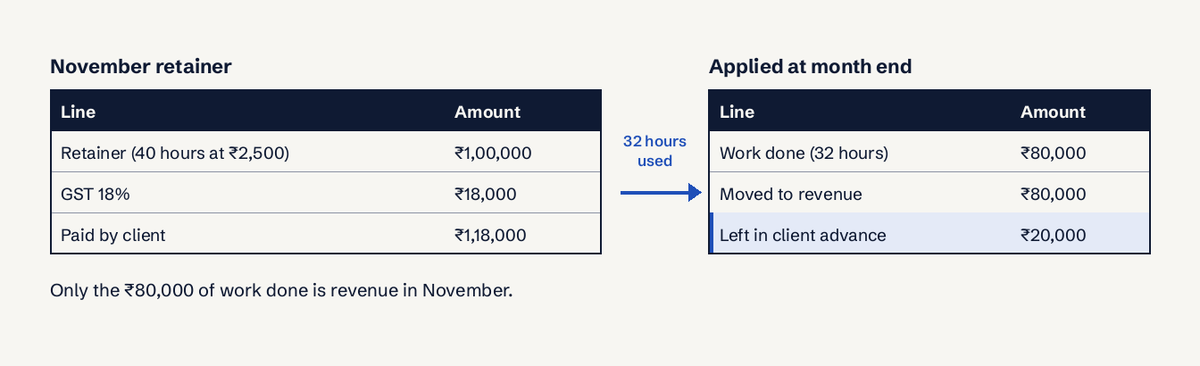
A Mumbai design studio signs a client on a ₹1,00,000 monthly retainer covering up to 40 hours at ₹2,500 an hour, plus 18% GST. Unused hours roll over one month, then lapse.
1 November: retainer invoice and payment. The studio issues retainer invoice RET-2026-011 for ₹1,00,000 + ₹18,000 GST = ₹1,18,000. The client pays on 3 November. GST on an advance for services is due when the payment is received (see the tax section below), so the studio books:
- Bank ₹1,18,000 debit
- Client advance ₹1,00,000 credit
- Output GST ₹18,000 credit
30 November: final invoice. The team logged 32 hours, so the work is 32 × ₹2,500 = ₹80,000. The studio raises tax invoice INV-2026-118 for ₹80,000 and applies ₹80,000 of the retainer, so the invoice shows ₹0 due. The GST on that ₹80,000 (₹14,400) was already paid on the advance, so it is adjusted, not charged twice.
- Client advance ₹80,000 debit
- Revenue ₹80,000 credit
The unused ₹20,000 (8 hours, 20% of the fee) rolls into December. If December also ends unused, the contract says it lapses: the studio moves ₹20,000 from client advance to revenue. If the contract had said "refundable", the studio would instead issue a refund voucher and repay ₹20,000 plus the ₹3,600 GST on it, and reverse that tax.
What happens to unused retainer funds?
Unused retainer funds follow the retainer agreement, so write the rule on both the contract and the invoice. The usual options:
- Roll over: the balance carries into the next period, often with a cap (30 days, or up to 20% of the fee).
- Refund: you return the balance at the end of the period or the engagement. Without an agreement saying otherwise, a retainer is generally refundable if the work is not done (Wikipedia, Retainer agreement).
- Use it or lose it: the client pays for capacity, and unused hours lapse. Defensible for availability retainers; spell it out.
- Replenish (evergreen): common for legal security retainers. You bill against the fund and the client tops it back up to the agreed level.
In the books, a refund reduces the liability and the bank; a lapse moves the liability to revenue.
When is GST or VAT due on an advance?
Tax on a retainer often falls due when the advance is paid, not when the work is done, so price the retainer with tax included.
- India (GST): for services, the time of supply is the earlier of the invoice date or the date of receipt of payment (CGST Act, section 13(2)). GST on a service advance is due in the month you receive it. Section 31(3)(d) requires a receipt voucher when you receive an advance, and section 31(3)(e) a refund voucher if the supply does not happen. Advances for goods are treated differently. An amount up to ₹1,000 received in excess of the invoice value can be taxed at the invoice date instead, at the supplier's option.
- UK (VAT): a payment received in advance creates a tax point for the amount received (HMRC VATTOS3600), and VAT is due on deposits that are part payment for a supply (VAT Notice 700).
- US: most services are not subject to sales tax; income tax timing for advance payments has its own rules, so ask your accountant.
This is information, not tax advice. Check the rules for your registration and contract.
Retainer vs deposit vs proforma
These three get mixed up because each comes before the work.
| Retainer invoice | Deposit invoice | Proforma invoice | |
|---|---|---|---|
| Purpose | Fund ongoing or future work | Secure one project or order | Preview the final invoice |
| Recurs? | Often monthly | Once per project | Once |
| Money in your books | Liability until earned | Liability until delivery | None |
| Common in | Agencies, law, consulting | Construction, events, custom goods | Exports, approvals |
Common mistakes to avoid
- Booking the retainer as revenue. It inflates the month it arrives and leaves later months looking empty.
- Billing late. A retainer sent 15 days into the month is a regular invoice with extra steps; send it 5 to 7 days before the period.
- No period on the invoice. "Retainer" with no dates makes it hard to match payments to months.
- Charging GST twice. If tax was paid on the advance, the final invoice applies it, it does not add it again.
- No unused-balance rule. State the cap in hours (say 8 hours or 20%) and the deadline (30 days or 60 days). Disputes about leftover hours are the most common retainer argument.
- Same number series as final invoices. Use a separate prefix so your sales register is clean.
Tools to make the template
Any invoice tool can produce the document; the difference is whether it tracks the advance. Zoho Books has a dedicated retainer invoice module on its Professional plan and above (Zoho Books help). Spreadsheet templates work for one client but don't track balances. In LuckPanda's Sales module you can set up the monthly retainer as a recurring invoice, record the payment and issue a receipt; drafts and branded PDFs are free, and issuing and sending need the Sales module at ₹249 a month. To try the layout first, use the free invoice generator, title it "Retainer invoice" and add the period and unused-balance rule.
Related: consulting invoice template, legal invoice template and what an invoice must include.
Questions
What is a retainer invoice?
A retainer invoice is a bill for advance payment under a retainer agreement. It collects money for work you will do later or for reserving your time, and the money is a liability in your books until you earn it.
How does it differ from a regular invoice?
A regular invoice bills for work already delivered and creates revenue. A retainer invoice bills before the work and creates a client advance; a later final invoice applies that advance.
How do you account for a retainer payment?
Record it the day it arrives, not 30 days later: debit bank and credit a client advance (liability) when paid. When you invoice work, debit the client advance and credit revenue. Refunds debit the advance and credit bank.
What happens to unused retainer funds?
Whatever the retainer agreement says: they roll over, are refunded, lapse as non-refundable, or are topped up in an evergreen retainer. Without a clause, a retainer is generally refundable if the work is not done.
Is GST charged on a retainer invoice?
Yes, for taxable services in India. GST is due when the advance is received, under section 13(2) of the CGST Act, and you issue a receipt voucher for it. The final invoice adjusts the tax already paid.
Should a retainer invoice be sent before the month starts?
Usually, yes. Most retainers are payable in advance so the funds are in place before the work begins; set the due date on or before the first day of the period.