 luckpanda
What Is an Accounting Voucher? Meaning, Types and Examples
An accounting voucher proves a transaction and supports its book entry. Types, required fields, a worked example in rupees and how long to keep vouchers in India.
On this page
- Why does a voucher matter?
- What are the types of accounting vouchers?
- How does a voucher become a journal entry?
- Worked example: one week of vouchers with rupee figures
- What details must a voucher contain?
- Voucher vs invoice: what is the difference?
- How long must vouchers be kept in India?
- Common voucher mistakes
- Keeping vouchers without the paper pile
TL;DR: An accounting voucher is the document that proves a business transaction happened and supports its entry in the books. The common types are receipt, payment, contra, journal, sales and purchase vouchers. In India, keep them for at least seven tax years under Rule 46 of the Income-tax Rules, 2026, and longer where GST or company law asks for it.
An accounting voucher is a written or electronic document that records one business transaction, shows who approved it, and is the evidence behind the matching journal entry. Every entry in a cash book, journal or ledger should point to a voucher number, and every voucher should point to its source document (a bill, an invoice, a bank slip or a payroll sheet). When an auditor or tax officer asks "why is this ₹18,000 in rent expense?", the voucher is the answer.
Why does a voucher matter?
A voucher matters because it turns a claim into evidence. Picture a 6-person design studio in Pune. The owner pays ₹18,000 rent in cash, the accountant posts it, and two years later the income-tax assessment asks for proof. Without a payment voucher signed by the landlord and linked to the rent agreement, the expense can be disallowed. With one, the question closes in a minute.
Vouchers also do three daily jobs:
- Control: a voucher needs a preparer and an approver, so nobody pays themselves without a second signature.
- Order: sequential voucher numbers show gaps. A missing number is the first sign of a lost or hidden transaction.
- Speed at month end: reconciliation and audit work from voucher numbers, not from memory.
What are the types of accounting vouchers?
The types of accounting vouchers follow the kind of transaction. Accounting software such as Tally, Zoho Books and others use similar names, so the table works across tools.
| Voucher type | Used for | Typical journal entry |
|---|---|---|
| Receipt voucher | Money coming in (cash or bank) | Cash/Bank Dr, Customer or Income Cr |
| Payment voucher | Money going out | Expense or Supplier Dr, Cash/Bank Cr |
| Contra voucher | Moves between cash and bank only | Bank Dr, Cash Cr (cash deposit) |
| Journal voucher | Non-cash adjustments: depreciation, accruals, corrections | Depreciation Dr, Asset Cr |
| Sales voucher | Credit or cash sales of goods or services | Customer Dr, Sales Cr, GST Output Cr |
| Purchase voucher | Credit or cash purchases | Purchases Dr, GST Input Dr, Supplier Cr |
| Debit note / credit note | Returns and price corrections | Supplier Dr, Purchase Returns Cr (debit note) |
Textbooks also group vouchers in two families:
- Cash vouchers, for transactions that move cash or bank: receipt, payment and contra.
- Non-cash (transfer) vouchers, for everything else: journal, sales on credit, purchase on credit, debit and credit notes.
A second split you will meet is supporting vs accounting voucher. A supporting voucher is the outside proof (the supplier's bill, the bank slip). The accounting voucher is the internal document your team prepares from it, and it carries the debit and credit.
How does a voucher become a journal entry?
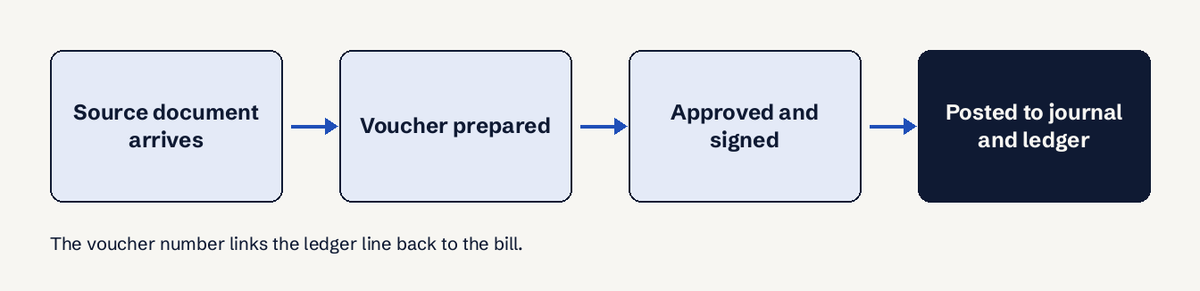
A voucher becomes a journal entry in four steps: the source document arrives, someone prepares the voucher with the accounts and amounts, an approver signs it, and the entry is posted to the journal and ledger with the voucher number as its reference.
Worked example: one week of vouchers with rupee figures
Here is one week at a small trading business, each transaction with its voucher and entry.
| Date | Voucher no. | Type | Transaction | Debit | Credit | Amount (₹) |
|---|---|---|---|---|---|---|
| 3 Nov | RV/2026-27/0141 | Receipt | Customer pays by UPI | Bank | Mehta Traders | 59,000 |
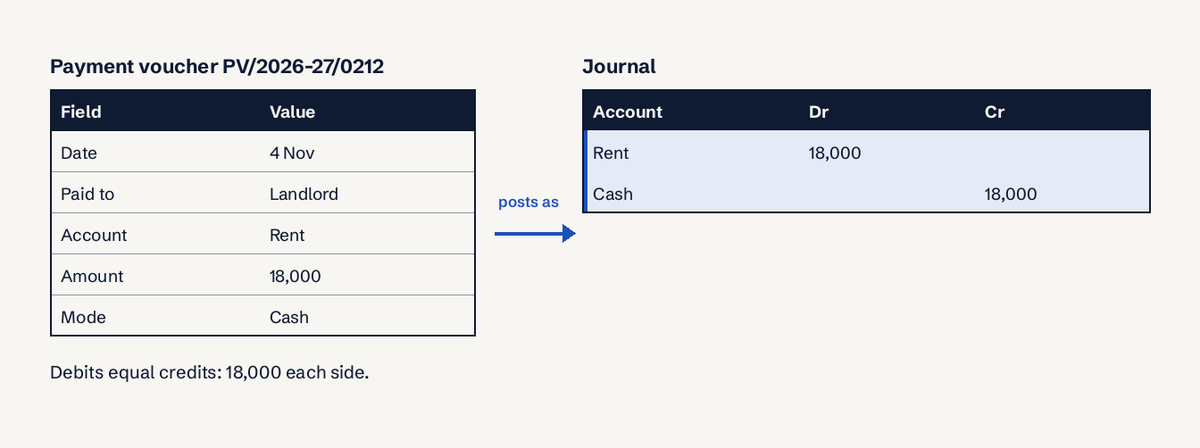
| 4 Nov | PV/2026-27/0212 | Payment | Shop rent in cash | Rent | Cash | 18,000 |
| 4 Nov | CV/2026-27/0033 | Contra | Cash deposited in bank | Bank | Cash | 25,000 |
| 5 Nov | PUR/2026-27/0088 | Purchase | Stock on credit, 18% GST | Purchases 40,000 and Input IGST 7,200 | Kumar Supplies | 47,200 |
| 6 Nov | SV/2026-27/0175 | Sales | Credit sale, 18% GST | Rao & Co | Sales 50,000 and Output IGST 9,000 | 59,000 |
| 7 Nov | JV/2026-27/0019 | Journal | Monthly depreciation on laptop | Depreciation | Computers | 1,250 |
Check the arithmetic in the sales line: ₹50,000 taxable value plus 18% GST of ₹9,000 equals ₹59,000 billed. In each row debits equal credits, which is the test every voucher must pass before approval.
What details must a voucher contain?
A voucher must contain enough to identify the transaction, the accounts, the amount and the people responsible. A practical checklist:
- Business name and voucher type (Receipt, Payment, Journal and so on).
- Voucher number, in an unbroken sequence per type and financial year, for example PV/2026-27/0212 for the 212th payment voucher of 2026-27.
- Date of the transaction.
- Accounts debited and credited, with amounts. Debits must equal credits.
- Amount in figures and in words (on paper vouchers).
- Narration: one plain sentence on what happened ("Rent for November 2026, shop 4, MG Road").
- Reference to the source document: bill number, invoice number, UTR or cheque number.
- GST details where relevant: GSTIN of the other party, taxable value and tax split.
- Prepared by, approved by, and the receiver's signature on cash payments.
A voucher without a source document is the weakest kind. For cash payments where the payee gives no bill, have the payee sign the payment voucher.
Voucher vs invoice: what is the difference?
An invoice is a document one business sends to another to ask for payment; a voucher is the internal record that books a transaction, which may be that invoice, a payment, or an adjustment.
| Point | Voucher | Invoice |
|---|---|---|
| Who prepares it | Your accounts team | The seller |
| Audience | Internal, auditors, tax officers | The customer |
| Purpose | Prove and authorise a book entry | Ask for payment, record a sale |
| Covers | Any transaction, including non-cash adjustments | Only sales of goods or services |
| Legal form | Your own format | Under GST, fields set by Rule 46 of the CGST Rules |
A purchase invoice you receive is a supporting document; the purchase voucher you prepare from it is the accounting voucher. A sales invoice you issue usually doubles as your sales voucher in software.
How long must vouchers be kept in India?
Vouchers must be kept for the longest period any law that applies to you sets. For most small businesses that is:
| Law | Who it applies to | How long |
|---|---|---|
| Income-tax Act, 2025, Section 62 and Rule 46 of the Income-tax Rules, 2026 | Businesses and professionals required to keep books | Seven tax years from the end of the relevant tax year |
| CGST Act, 2017, Section 36 | GST-registered persons | 72 months from the due date of the annual return for that year, longer if an appeal or proceeding is pending |
| Companies Act, 2013, Section 128(5) | Companies | At least eight financial years before the current year, with the vouchers for each entry |
What changed recently: the Income-tax Act, 2025 came into force on 1 April 2026. Section 62 replaced Section 44AA, and Rule 46 replaced Rule 6F, which had required six years from the end of the relevant assessment year. Rule 46 also requires that books kept electronically stay accessible in India, with a daily backup on servers located in India. Most guides on vouchers still quote only Rule 6F. Read the notified rule text on the Income Tax Department site before relying on any period, since this is information, not tax advice. GST retention is set by Section 36 of the CGST Act and company retention by Section 128 of the Companies Act.
Common voucher mistakes
- Gaps or reused numbers. Number per type and per financial year (RV/2026-27/0001 restarts at RV/2027-28/0001 on 1 April), and cancel with a "VOID" mark rather than reusing.
- No narration. "Paid" tells nobody anything. Write the who, what and period.
- Wrong voucher type. Cash deposited into the bank is a contra voucher, not a receipt; recording it as a receipt inflates income.
- Approver is the preparer. Even in a two-person business, have the owner approve what the accountant prepares.
- Bills not attached. Scan the source document and link it to the voucher number.
Keeping vouchers without the paper pile
Paper files work until someone needs a voucher from three years ago. If you would rather keep vouchers digital, the LuckPanda Finance module records payments and receipts against one shared record of clients and suppliers, posts them to the ledger, and keeps the document with the entry for reconciliation. For a one-off receipt, the free receipt generator needs no account.
Free toolReceipt generatorConfirm a payment you received, itemised.Open the receipt generatorQuestions
What is an accounting voucher in simple words?
It is the slip of paper or digital record that proves a transaction happened and tells the accountant which accounts to debit and credit. Every book entry should have one.
What are the main types of vouchers in accounting?
Receipt, payment, contra, journal, sales and purchase vouchers, plus debit and credit notes. Receipt, payment and contra are cash vouchers; the rest are non-cash or transfer vouchers.
What is the difference between a voucher and a receipt?
A receipt is a document given to the payer to confirm money was received. A receipt voucher is the internal accounting record of that same inflow, with the accounts debited and credited.
Who prepares and approves a voucher?
The accountant or bookkeeper prepares it from the source document, and the owner or an authorised manager approves it. On cash payments the payee also signs.
Is a journal voucher the same as a journal entry?
No. The journal voucher is the document that authorises a non-cash adjustment; the journal entry is the line posted in the books from it.
How long should I keep vouchers for GST?
Until 72 months after the due date of the annual return for that financial year under Section 36 of the CGST Act, and longer if you are party to an appeal or proceeding.