 luckpanda
Bar Inventory Template: Columns, Formulas and Free Sheets
The columns, usage and pour cost formulas a bar inventory sheet needs, with eight free templates to download.
On this page
- What LuckPanda does for bar inventory today
- What columns should a bar inventory sheet have?
- Five formulas that turn a count into control
- How do you calculate pour cost?
- How do you measure partial bottles?
- How often should you count stock behind the bar?
- Eight free downloads and three references
- Spreadsheets you can download
- Rules and references behind the numbers
- Start here
TL;DR: A useful bar inventory template has one row per product and eight columns: item, size, unit cost, opening count, purchases, closing count, usage and usage value. Add sales and pour cost and the same sheet tells you how much liquor went missing. Below is the exact layout with its formulas, eight free templates you can download today, and where LuckPanda fits on the supplier side while its Inventory module is being built.
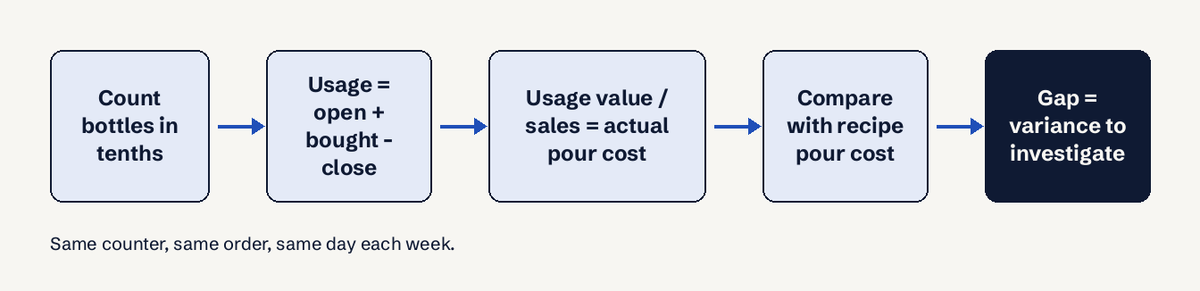
A bar inventory template is a sheet where you count every bottle, keg and case at the end of a period, add what you bought, and subtract what is left to get what you used. Usage is opening count + purchases - closing count. Multiply usage by unit cost and divide by bar sales and you have your pour cost percentage; compare that with what your recipes say it should be and the gap is your variance. Count partial bottles in tenths (0.1 to 0.9), the same way every week, and the sheet becomes a control, not a list.
Want the cost and margin numbers without building formulas? Use LuckPanda's free profit margin calculator and markup calculator: no account needed. Start free.
What LuckPanda does for bar inventory today
LuckPanda is a business operating system for small businesses: sales, purchasing, inventory and finance share one record of items and money. Be clear on where it stands for a bar:
- Inventory module: being built. Items, warehouses and stock movements are listed on the Inventory module page as being built. When live, every receipt, transfer and adjustment will be a stock movement linked to the document that caused it, and a stock count will be recorded as an adjustment, so the history explains every change. Today it does not hold your bottle counts; use one of the sheets below for that.
- Purchasing, today: the Purchasing module keeps vendors, purchase orders and bills, which is the "purchases" column of your sheet with a paper trail behind it.
- Free tools, today: the bill generator, profit margin and markup calculators work without an account.
- Price: drafts and branded PDFs are free; issuing and sending is $4.99 per module per month, or ₹199 for a business in India (pricing). Per module, not per user.
What columns should a bar inventory sheet have?
One row per product, in shelf order (the order you walk the bar), with these columns:
| Column | What goes in it | Example |
|---|---|---|
| Item | Brand and product | House vodka |
| Size | Bottle size | 750 mL |
| Unit cost | What you pay per bottle | $18.00 |
| Opening count | Last period's closing count | 6.4 |
| Purchases | Bottles received this period | 12 |
| Closing count | Full bottles plus tenths | 7.2 |
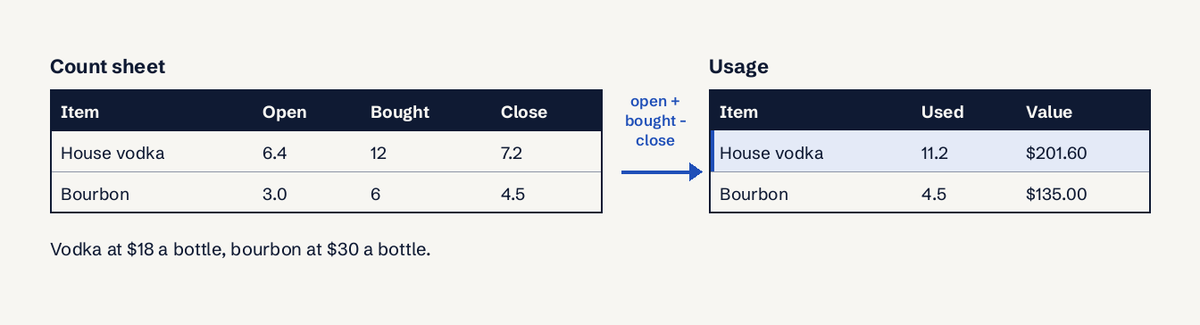
| Usage | Opening + purchases - closing | 11.2 |
| Usage value | Usage x unit cost | $201.60 |
| Par level | Bottles you want on hand after delivery | 10 |
| Order | Par - closing, rounded up | 3 |
Group rows by category (spirits, beer, wine, mixers) so you can see pour cost per category. Keep the location (back bar, well, store room) as a column if you hold stock in more than one place; count each location on its own row and sum them.
Five formulas that turn a count into control
Five spreadsheet formulas turn the count into a control. The cell references match the layout above: unit cost in column C, opening in D, purchases in E, closing in F, usage in G.
- Usage: =D2+E2-F2 (opening plus purchases minus closing)
- Usage value: =G2*C2 (usage times unit cost)
- Cost per ounce: bottle cost / 25.36 for a 750 mL bottle. One US fluid ounce is 29.5735 mL (NIST), so 750 mL is 25.36 fl oz.
- Pour cost %: usage value / sales for the same category and period x 100 (Sculpture Hospitality).
- Variance: actual pour cost % - theoretical pour cost % (what your recipes and sales mix say you should have used).
How do you calculate pour cost?
Pour cost is liquor cost divided by the price of the drink. Worked example for a US bar: an $18.00 bottle of 750 mL vodka costs $18.00 / 25.36 = $0.71 per ounce. A 1.5 fl oz pour, the US standard drink of spirits per the NIAAA, costs $1.06. Sold at $7.00, the pour cost is 1.06 / 7.00 = 15.2%.
For a bar in India, where spirits are poured in 30 mL or 60 mL pegs: a 750 mL bottle bought at ₹1,800 costs ₹2.40 per mL, so a 30 mL peg costs ₹72. Sold at ₹350, the pour cost is 20.6%. A 750 mL bottle gives 25 pegs of 30 mL and about 16.9 pours of 1.5 oz.
For a whole period, use the sheet's totals: if spirits usage value is $3,000 and spirits sales are $12,000, spirits pour cost is 25%. WISK's guide gives the variance logic in one line: if actual beverage cost is 30% and theoretical is 29.5%, variance is 0.5% (WISK).
How do you measure partial bottles?
Most bars estimate partial bottles in tenths: look at the liquid level and record 0.1 to 0.9 of a bottle. It is fast and consistent enough when the same person counts in the same order. Weighing is more exact: weigh an empty and a full bottle once, then each partial bottle's fill is (current weight - empty weight) / (full weight - empty weight). Use the weighing method for your top-selling spirits if your variance keeps moving and you can't tell why.
How often should you count stock behind the bar?
Weekly for liquor is the common rhythm, on the same day before opening or after closing, because a week is short enough to catch a problem and long enough to keep the work bearable. Monthly is the minimum for your books: your cost of goods sold for the month needs an opening and a closing count. In the US, inventory counts feed cost of goods sold on your tax return; IRS Publication 538 covers inventory accounting methods. Our guides on the COGS formula and how to calculate ending inventory walk through the same arithmetic for any business.
Eight free downloads and three references
Each of these was open and free to read when we checked on 14 November 2026. Several come from inventory software companies, and their sheets lead into their paid apps; the sheets work on their own.
Spreadsheets you can download
- Smartsheet: free bar and liquor inventory templates: the widest choice, with separate bar, liquor, bar and liquor, and beer and wine templates in Excel and Google Sheets. Start here if you want a ready layout.
- Backbar: free liquor inventory spreadsheet: a Google Sheet built around repeated counts, so you can compare periods and spot variance.
- WISK: free bar inventory spreadsheet: comes with a clear explanation of actual vs theoretical cost and variance.
- BinWise: free bar inventory spreadsheet: CSV files that open in Excel and Google Sheets, plus a printable version for counting on paper.
- Spreadsheet Daddy: bar inventory template: one template in Google Sheets, Excel and PDF, useful if staff count on a printout.
- MarketMan: bar inventory sheet template: a sheet aimed at restaurants with a bar, where food and beverage are costed side by side.
- Jotform: liquor inventory spreadsheet: an online table rather than a file, so several people can add counts from a phone.
- Microsoft Create: inventory templates: general Excel inventory templates you can adapt with the columns above.
Rules and references behind the numbers
- NIAAA: what is a standard drink: the 1.5 fl oz spirits pour most US recipes cost from.
- 27 CFR 5.203, standards of fill for distilled spirits: the bottle sizes US spirits are sold in.
- IRS Publication 538: accounting periods and inventory methods for US businesses, the reason your monthly count matters for tax.
Start here
- Download the Smartsheet bar inventory template or the Backbar sheet.
- Add the usage, usage value and par columns from the table above if the sheet lacks them.
- Count once to get your opening numbers, then count weekly on the same day.
- After four weeks, compare actual pour cost with your recipe cost per category.
- Record supplier deliveries as bills so the purchases column has a document behind every number.
Questions
What is a bar inventory template?
A bar inventory template is a spreadsheet with one row per bottle, keg or case and columns for opening count, purchases, closing count, usage and cost. It turns a weekly count into usage and pour cost.
What columns should a bar inventory sheet have?
Item, size, unit cost, opening count, purchases, closing count, usage, usage value, par level and order quantity. Add location if you store stock in more than one place.
How do you calculate pour cost?
Divide the liquor cost of a drink by its menu price and multiply by 100. A $1.06 pour sold for $7.00 is a 15.2% pour cost. For a period, divide usage value by sales.
How often should a bar do inventory?
Weekly for liquor, on the same day and in the same order; monthly at minimum so your cost of goods sold has an opening and closing count.
How do you measure partial bottles?
Estimate in tenths of a bottle, or weigh the bottle and compare with its empty and full weights. Weighing is more exact for high-volume spirits.
Can LuckPanda track bar stock?
Not yet. LuckPanda's Inventory module is being built; today you can keep vendors, purchase orders and bills in the Purchasing module and use the free margin and markup calculators. See the Inventory module or start free.