 luckpanda
Source to Contract vs Procure to Pay: Where Each Process Starts and Ends
Source to contract picks the supplier and signs the deal; procure to pay buys, receives and pays under it. Stages, owners, documents and what a small business needs.
On this page
- Source to contract vs procure to pay at a glance
- What happens in the sourcing half (S2C)?
- What happens in the buying half (P2P)?
- Where is the hand-off between S2C and P2P?
- What is S2P, the joined-up process?
- How do the controls differ?
- Does a small business need S2C software?
- Choose S2C first if, choose P2P first if
- Where LuckPanda fits
TL;DR: Source to contract (S2C) is the upstream half of buying: work out what you need, find and vet suppliers, negotiate, and sign a contract. Procure to pay (P2P) is the downstream half: raise a requisition, issue a purchase order, receive the goods, match the invoice and pay. Together they make source to pay (S2P). A 10-50 person business needs software for P2P first; S2C can usually run on email, a spreadsheet and a contract folder.
The difference between source to contract and procure to pay is where each one starts, where it ends and who does the work. S2C starts with a need that has no supplier yet and ends with a signed agreement: price, terms, service levels and a supplier set up in your vendor list. P2P starts with an approved purchase requisition against that supplier and ends with the invoice paid and posted to the books. S2C happens a few times a year per category and is run by the owner, a purchasing lead or a category manager. P2P happens every time anyone buys anything and touches requesters, approvers, the stores team and accounts payable. Source to pay (S2P) is the name for both halves joined, and it is now the label Microsoft uses for the whole cycle in its Dynamics 365 business process catalog.
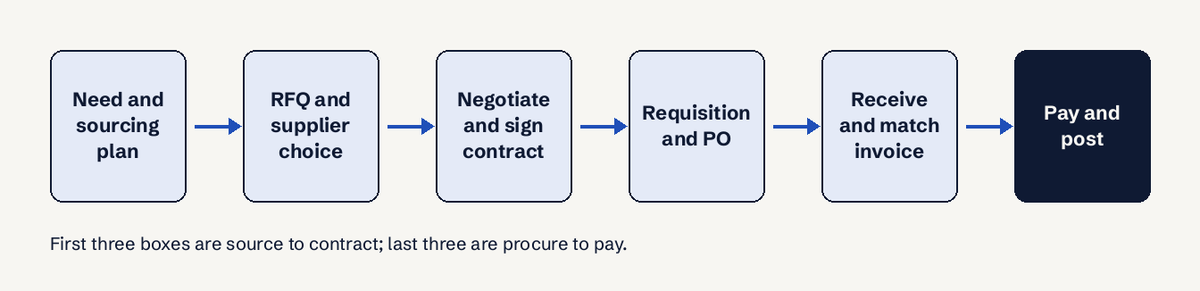
Source to contract vs procure to pay at a glance
The table below compares the two halves on the criteria that decide who owns them and what software they need.
| Criterion | Source to contract (S2C) | Procure to pay (P2P) |
|---|---|---|
| Starts with | A need with no agreed supplier | An approved purchase requisition |
| Ends with | A signed contract and a supplier set up in the vendor list | An invoice paid, reconciled and posted |
| Stages | Spend review, sourcing plan, RFI or RFQ, evaluation, negotiation, contract, onboarding | Requisition, approval, purchase order, goods receipt, invoice, 3-way match, payment |
| Main documents | RFQ, supplier quotations, comparison sheet, contract or rate agreement, vendor form | Purchase requisition, purchase order, goods received note, supplier invoice, payment advice |
| Owner | Owner, purchasing lead or category manager, with legal on large contracts | Requesters, approvers, stores, accounts payable |
| Frequency | Per category, usually once per 12 months or at renewal | Every purchase, daily |
| Time horizon | 12 to 36 months (contract term) | 7 to 45 days (PO to payment) |
| Main risk | Wrong supplier, weak terms, lock-in | Paying for goods not received, duplicate or late payments |
| What it saves | Price and total cost through negotiation | Errors, leakage and staff time per transaction |
| Typical software | Sourcing, e-RFx and contract lifecycle tools | Purchasing and AP automation tools, or an ERP |
Two things the table makes visible. First, the contract is the hand-off: P2P uses the price and terms S2C agreed, which is why a PO with a price above the contract rate is a red flag. Second, the RFQ sits on the line: it belongs to sourcing when it picks a supplier for a year, and to buying when it collects three quotes for a single order.
What happens in the sourcing half (S2C)?
Source to contract is the strategic process that picks the supplier and fixes the terms before any order is placed. It typically has seven stages:
- Spend review. Look at what you bought in the last 12 months by category and supplier, and list the suppliers that together take over 50% of spend.
- Sourcing plan. Decide what to buy, the volume, the quality standard and whether to use one supplier or several.
- Supplier discovery. Find candidates through referrals, trade directories or an RFI (request for information).
- RFQ or RFP. Send the same specification to several suppliers and ask for prices and terms.
- Evaluation. Compare quotations on price, lead time, quality, payment terms and risk.
- Negotiation and contract. Agree the price list, delivery terms, warranty, penalties (for example 0.5% of order value per day of late delivery) and payment period, and sign.
- Supplier onboarding. Collect the supplier's legal and tax details and bank account, check them, and add the supplier to the vendor list.
Microsoft's Dynamics 365 catalog splits this front end into "Develop procurement and sourcing strategy", "Manage supplier relationships" and "Source and contract goods and services". Its vendor onboarding flow creates a "prospective vendor request" that someone reviews before the vendor is added to the vendor master, which is the same control a small business should keep: no supplier is paid until someone has checked its details.
What happens in the buying half (P2P)?
Procure to pay is the transactional process that turns an approved need into a paid invoice. It has seven steps:
- Purchase requisition. An employee asks to buy something and states the item, quantity, estimated cost and reason. See our guide to the purchase requisition.
- Approval. The approver checks need and budget, often with value limits per role: for example, a team lead signs up to ₹25,000 per requisition and the owner signs anything above.
- Purchase order. Purchasing issues a PO to the contracted supplier at the agreed price. For repeat buying under a contract, a blanket purchase order covers many deliveries.
- Goods receipt. Stores records what actually arrived on a goods received note (GRN).
- Supplier invoice. The supplier bills for what it delivered.
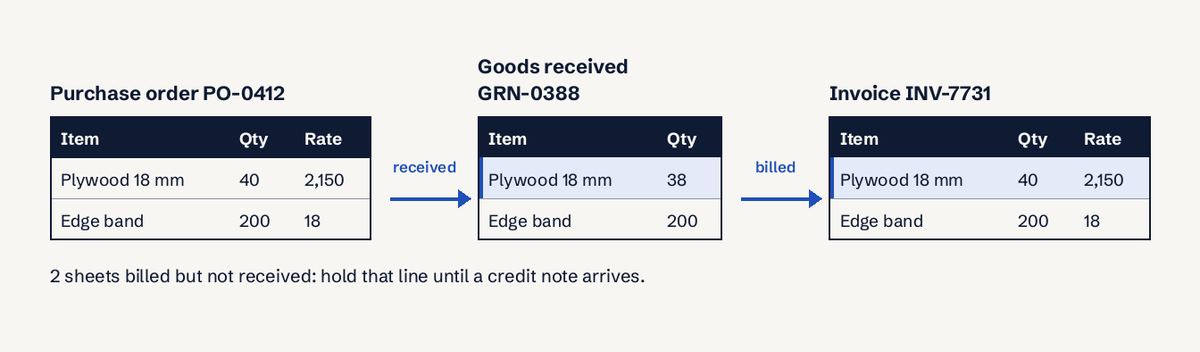
- Three-way match. Accounts payable checks the invoice against the PO and the GRN: same item, same quantity, same price, usually within a small tolerance such as 2% on price.
- Payment and posting. The invoice is paid within its terms (30 days is common; 45 days is the legal ceiling for micro and small suppliers in India) and posted to the ledger.
Our accounts payable process guide walks through steps 5 to 7 in detail, including the checks that stop duplicate payments.
Where is the hand-off between S2C and P2P?
Source to contract ends when a signed agreement and a set-up supplier exist; procure to pay begins with the first requisition raised against them. In practice the boundary is the vendor record. Once the supplier's legal name, tax ID, bank details, price list and payment terms are in your system, sourcing is done for that category, and every later purchase is P2P.
Three activities straddle the line, and the top-ranking guides disagree on where to put them:
- Supplier onboarding. Zip places it inside S2P after contracting; Microsoft treats vendor onboarding as its own capability. Treat it as the last step of S2C: P2P should never start with an unverified supplier.
- Supplier performance. Delivery and quality data come from P2P (GRNs, rejections, late deliveries) but are used in S2C at renewal. This is the feedback loop that makes the two halves one cycle.
- Spot buys. A one-off purchase with no contract still needs a quick sourcing step (two or three quotes) inside the P2P flow.
What is S2P, the joined-up process?
Source to pay (S2P) is the full cycle from identifying a need to paying the supplier, so S2P = S2C + P2P. Microsoft's Dynamics 365 business process catalog lists source to pay's component areas as: develop procurement and sourcing strategies, define procurement catalogs, manage vendor relationships, procure materials and services, process vendor invoices, issue and settle vendor payments, and process vendor rebates and incentives. Note the change: the old Microsoft Learn address for the "procure to pay overview" now resolves to the "source to pay end-to-end overview" (catalog version July 2026). Large-software vocabulary has moved to the joined-up term, and analyst firms rate "source-to-pay suites" as one market. For a buyer, that means a vendor calling its product "S2P" may still be strong in only one half.
Some guides also use source to settle (S2S), which is the same scope with "settle" stressing payment and reconciliation, and contract to pay, which is P2P under an existing agreement.
How do the controls differ?
S2C controls protect the price; P2P controls protect the payment. They catch different failures, so one does not replace the other.
| Control | Half | Failure it catches |
|---|---|---|
| Competitive quotes above a value limit, e.g. 3 quotes over ₹50,000 per order | S2C | Overpaying because nobody asked a second supplier |
| Signed price list or rate contract | S2C | Prices creeping up order by order |
| Vendor verification before first payment | S2C | Fake or misspelled suppliers, wrong bank accounts |
| Approval limits on requisitions | P2P | Spend nobody authorised |
| Three-way match | P2P | Paying for goods that did not arrive |
| Duplicate invoice check: same supplier, invoice number and amount within 90 days | P2P | Paying the same bill twice |
| Payment terms tracking against 30 or 45 days | P2P | Late fees and broken supplier terms |
Public procurement rules show where value thresholds for the sourcing step usually sit. In India, General Financial Rules 2017, as amended by Department of Expenditure OM No. F.1/3/2024-PPD dated 10 July 2024, allow goods up to ₹50,000 per occasion to be bought without quotations on a certificate from the competent authority (Rule 154), and goods above ₹50,000 and up to ₹5,00,000 on the recommendation of a three-member purchase committee that surveys the market (Rule 155), when the item is not on GeM. In the US, the Federal Acquisition Regulation (FAR 2.101) sets the micro-purchase threshold at $15,000 and the simplified acquisition threshold at $350,000, both raised on 1 October 2025 from $10,000 and $250,000. A private company is not bound by either, but they are a sensible template: below a small limit, buy directly; above it, get quotes; above a larger limit, run a proper sourcing round and sign a contract.
Does a small business need S2C software?
Most businesses with 10 to 50 people do not need dedicated S2C software; they need P2P discipline first. The reasons are volume and frequency. A business this size typically has a few dozen active suppliers and renegotiates a handful of contracts a year, which a spreadsheet comparison and a shared contract folder handle well. It raises purchase orders and receives bills every week, and that is where errors cost money: a missed GRN, a duplicate invoice, a payment to a changed bank account.
Here is the scale in an example. Take a 25-person furniture workshop (an illustration, not a customer) that spends ₹18 lakh per month on materials and services:
- S2C workload: 35 active suppliers, of which 6 take about 70% of spend. It re-quotes those 6 once per 12 months, so about 6 sourcing rounds per year, each 2 to 3 weeks of email and a comparison sheet.
- P2P workload: about 120 purchase orders per month, 120 GRNs, 140 supplier bills (some POs are billed in parts) and 4 payment runs per month.
- Where errors come from: almost all of them sit in the P2P volume. One unmatched bill per week is 52 bills per year paid without proof of delivery.
A practical split for a 10-50 person business:
| Need | Tool that is usually enough |
|---|---|
| Choosing a supplier for the year | RFQ by email, a comparison sheet, a signed rate agreement |
| Storing contracts and renewal dates | A shared folder plus calendar reminders 60 days before expiry |
| Spot buys under ₹50,000 / $1,000 | Two quotes by email, noted on the PO |
| Requisitions, POs, GRNs, bills and payments | Purchasing or AP software, or the purchasing module of your accounting system |
| Vendor checks | A tax ID check and a bank verification before the first payment |
Software prices follow the same split. Dedicated P2P tools aimed at mid-sized teams start in the hundreds of dollars a month: Precoro's Procure to Pay Core plan "starts at $499/month billed annually" and covers requisitions, POs, receipts, invoices and 2- and 3-way match (precoro.com/pricing, checked 13 November 2026). Buy S2C tooling when you have a full-time buyer, run competitive sourcing events several times a quarter, or manage contracts with legal obligations that need tracking clause by clause.
For India, P2P also carries a legal deadline that sourcing cannot fix. Section 15 of the MSMED Act, 2006 requires a buyer to pay a micro or small enterprise supplier by the agreed date, and the agreed period cannot exceed 45 days from acceptance or deemed acceptance of the goods or services (15 days if there is no written agreement). Section 16 adds compound interest at three times the RBI bank rate on late amounts, and suppliers can file delayed-payment cases on the Ministry of MSME's Samadhaan portal. Your P2P process has to track the supplier's MSME status and the acceptance date, not just the invoice date. Our AP aging report guide shows how to bucket bills so the 45-day line is visible.
Choose S2C first if, choose P2P first if
Put effort into S2C first if:
- a few suppliers take most of your spend and you have not re-quoted them in over a year;
- prices change on every order because there is no agreed price list;
- you are entering a new category (a new raw material, a new contract manufacturer) with no supplier yet.
Put effort into P2P first if:
- bills arrive without a PO, or nobody can say who approved a purchase;
- goods are paid for before stores confirms they arrived;
- you have paid a supplier twice, late or to the wrong account in the last year;
- month-end takes days because bills, receipts and payments live in different places.
Most small businesses tick the P2P list first. Fix P2P, and the data it produces (what you bought, from whom, at what price, how late) becomes the input for your next sourcing round. Our purchase price variance guide shows how to spot the categories where re-sourcing will pay off.
Where LuckPanda fits
LuckPanda's Purchasing module covers the P2P half and the light end of sourcing: vendors with their tax and payment details, RFQs to compare quotes, purchase orders, vendor bills matched against the order and what was received, expenses, and vendor payouts posted to the same books as sales. It is priced per module, not per user: ₹199 a month in India and $4.99 elsewhere (luckpanda.app/pricing, checked 13 November 2026), and drafting is free. It does not do contract lifecycle management, so keep signed agreements in your contract folder. To try the PO step without an account, start from the free purchase order format.
A short explainer that defines P2P as the transactional steps after a supplier is chosen, S2C as the strategic steps that end in a contract, and S2P as both joined, then uses a trip-planning analogy to fix the difference in scope.
Questions
What is the difference between source to contract and procure to pay?
Source to contract chooses the supplier and fixes the terms: sourcing plan, RFQ, evaluation, negotiation, contract and onboarding. Procure to pay buys under those terms: requisition, purchase order, goods receipt, invoice matching and payment. S2C ends with a signed contract; P2P ends with a paid invoice.
Where is the hand-off between S2C and P2P?
S2C ends when the contract is signed and the supplier is set up in your vendor list with verified tax and bank details. P2P begins with the first purchase requisition raised against that supplier.
What is S2P, the joined-up process?
Source to pay (S2P) is the whole cycle, from identifying a need and choosing a supplier to paying the invoice. It is source to contract plus procure to pay, and Microsoft's Dynamics 365 business process catalog now uses it as the name for the full end-to-end process.
Does a small business need S2C software?
Usually not. A business with 10 to 50 people renegotiates a handful of contracts a year, which email RFQs, a comparison sheet and a contract folder handle. It needs P2P controls first: purchase orders, goods receipts, three-way match and payment tracking.
Is P2P the same as accounts payable?
No. Accounts payable is the last part of P2P: receiving, checking, approving and paying supplier invoices. P2P also includes the requisition, approval, purchase order and goods receipt that come before the invoice.
Is an RFQ part of S2C or P2P?
Both, depending on its purpose. An RFQ that picks a supplier for a year or a contract term is sourcing (S2C). An RFQ that collects two or three quotes for a single order is a spot-buy step inside P2P.
What is the difference between S2P and P2P software?
P2P software handles requisitions, POs, receipts, invoices and payments. S2P suites add sourcing events, supplier evaluation, contract management and spend analysis. Check which half a product is actually strong in, since many products sold as S2P started in one half.