 luckpanda
Chatbot Fallback Message: 10 Examples to Copy
A chatbot fallback message is what the bot says when it can't answer. Copy 10 examples by cause, plus when to hand the chat to a person.
On this page
- What is a chatbot fallback message?
- How is a fallback different in an AI chatbot vs a rule-based bot?
- Fallback message examples by cause
- 1. The answer is not in your content
- 2. The words were not understood (first miss)
- 3. The question is out of scope
- 4. The question is ambiguous
- 5. Second miss in a row: hand over
- 6. The visitor asks for a person
- 7. Nobody is online
- 8. Price, policy or legal questions with no source
- 9. Sensitive or upset visitor
- 10. The question is in another language
- Which fallback message should you use?
- How many fallbacks before handing off to a human?
- What is a good chatbot fallback rate?
- How do you reduce how often the fallback fires?
- Fallback mistakes to avoid
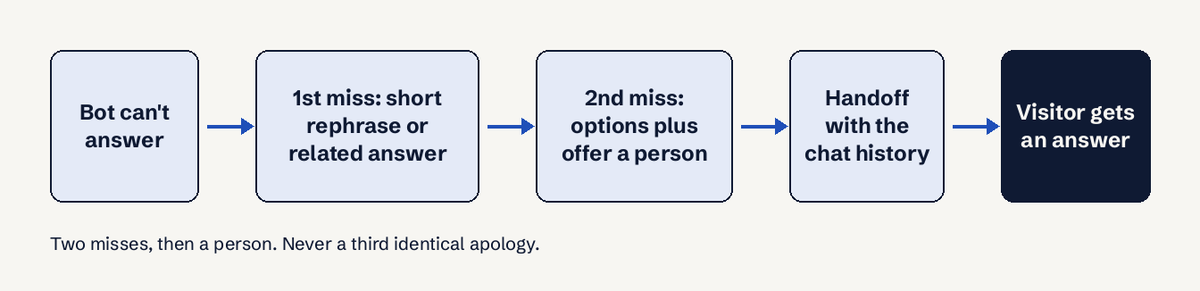
TL;DR: A chatbot fallback message is the reply your bot gives when it cannot answer: the question is not covered, it is outside what you sell, or the bot did not understand. A good fallback says plainly what the bot can't do, gives the visitor one useful next step, and passes the chat to a person after the second miss. Below are 10 fallback message examples, sorted by cause, that you can copy and adapt.
A chatbot fallback message (also called a fallback response, or the reply of a fallback intent) fires when the bot has no good answer. In rule-based bots that means no intent matched. In AI chatbots that answer from your own pages it usually means the answer is not in your content. Either way the message has three jobs: be honest that the bot does not know, keep the visitor moving with one next step (a related answer, a rephrase, or a person), and never guess. The worst fallback is not "Sorry, I didn't get that." It is a confident wrong answer, or the same apology three times in a row with no way out.
What is a chatbot fallback message?
A chatbot fallback message is the reply a bot sends when it cannot match the visitor's message to anything it knows how to answer. Every major bot platform builds one in. Dialogflow ES creates a Default Fallback Intent automatically with every new agent, pre-filled with lines like "I didn't get that. Can you say it again?", and Google's documentation says those responses "should communicate to the end-user that their input was not recognized" (Dialogflow ES default intents). Amazon Lex V2 adds AMAZON.FallbackIntent to every bot and triggers it when input does not match what the bot expects, is noise, or is ambiguous (Amazon Lex V2, AMAZON.FallbackIntent).
The defaults are placeholders. "I didn't get that" is fine once. Sent a second time, it tells the visitor the bot is stuck and they are stuck with it.
How is a fallback different in an AI chatbot vs a rule-based bot?
In a rule-based bot, the fallback fires when no intent scores above a confidence threshold. Rasa's FallbackClassifier, for example, predicts nlu_fallback when every intent falls below a threshold you set (0.7, or 70% confidence, in Rasa's example), and its RulePolicy runs action_default_fallback when no next action reaches 0.4 (40%) (Rasa: fallback and human handoff). The cause is almost always "the bot did not understand the words".
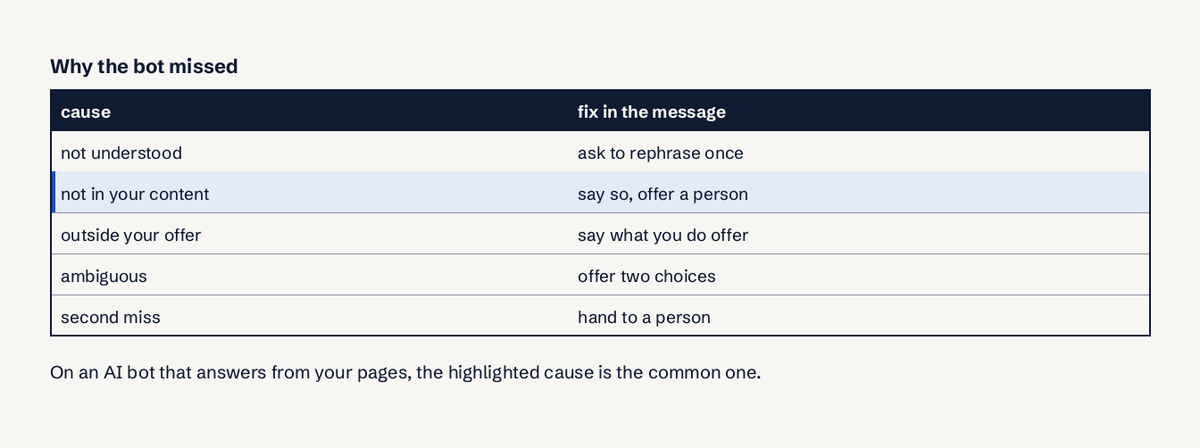
In an AI chatbot that answers from your website and documents, the bot usually understands the question fine. The fallback fires for a different reason: the answer is not in your content. That changes what the message should say. "Could you rephrase?" is the wrong reply to "Do you deliver to Lisbon?" when the bot understood perfectly and your pages simply do not say. Rephrasing will not help; a person or a pointer to the nearest answer will.
| Cause | Rule-based bot | AI bot on your content | Right fallback |
|---|---|---|---|
| Words not understood | Common | Rare | Short rephrase request |
| Answer not in your content | Shows as no match | Most common | Say so, offer a person |
| Outside what you sell | Out-of-scope intent | Common | Say what you do offer |
| Ambiguous question | Low confidence | Occasional | Offer two choices |
| Asked twice, still stuck | Repeat no match | Repeat miss | Hand to a person |
| Nobody online | Not handled | Not handled | Take contact, give a time |
Fallback message examples by cause
Each example below has the scenario, the message, what it does and how to adapt it. Replace the business details with your own; keep the structure.
1. The answer is not in your content
Scenario: a visitor asks something your pages and documents do not cover ("Can I get the sofa in a custom length?").
I don't have that in our product information, so I don't want to guess. A person from our team can confirm custom sizes. Want me to pass this chat on? You can also leave your email and we'll reply there.
What it does: admits the gap, explains why it is not guessing, and gives two ways forward. This is the single most important fallback on an AI bot, because the alternative is an invented answer. Adapt it: name the topic back ("custom sizes") so the visitor knows they were understood. If your team usually replies within 1 hour, say so in the message; if not, lead with the email option.
2. The words were not understood (first miss)
Scenario: a short or garbled message ("prce??", "the blue one thing").
Sorry, I didn't catch that. Are you asking about price, delivery or something else?
What it does: a rapid reprompt. Google's conversation design guidance for the first No Match says to combine a short apology with a condensed version of the question, and never to repeat the original prompt word for word, because it sounds robotic (Google conversation design: errors). Adapt it: use your three most common topics as the choices.
3. The question is out of scope
Scenario: the visitor asks for something your business does not do ("Do you repair laptops?" on a laptop shop that only sells).
We don't do repairs, we only sell new and refurbished laptops. If you're thinking of replacing yours, I can help you compare a few models by budget.
What it does: answers the real question (no), then offers the nearest thing you do sell. Rasa's documentation recommends handling known out-of-scope requests on their own so the visitor knows they were understood, for example "I understand you're looking for a job, but I'm afraid I can't handle that skill yet" (Rasa). Adapt it: pick the one adjacent product a person asking this might actually buy. Do not pitch more than one.
4. The question is ambiguous
Scenario: "How much is it?" asked on a page with three plans.
Happy to help with pricing. Do you mean the Starter plan, the Team plan, or delivery charges?
What it does: turns a miss into a choice. Rasa's Two-Stage Fallback works the same way: it first asks the visitor to confirm the likely intent, then asks for a rephrase, and only then triggers the final fallback. Adapt it: offer two or three options taken from the page the visitor is on.
5. Second miss in a row: hand over
Scenario: the bot has already missed once and the visitor tries again.
I'm still not getting this right, and I don't want to waste your time. I'm passing this chat to a person on our team now. They'll see everything you've written, so you won't need to repeat it.
What it does: stops the loop after two tries. Microsoft Copilot Studio's default system Fallback topic asks the user to rephrase at most twice, then redirects to the Escalate topic for a live representative (Copilot Studio fallback topic). Google's guidance also caps No Match retries at two. Adapt it: keep the "you won't need to repeat it" line only if your handoff really passes the transcript.
6. The visitor asks for a person
Scenario: "human", "agent", "can I talk to someone?"
Of course. I've flagged this chat for our team and someone will reply here. While you wait: what's the best email in case you need to step away?
What it does: honors the request on the first try. The US Consumer Financial Protection Bureau's June 2023 report on chatbots describes customers stuck in "doom loops" when their issue falls outside a chatbot's limited capabilities, with no way to reach a person. The same report estimates that about 37% of the US population interacted with a bank's chatbot in 2022 (CFPB, Chatbots in consumer finance). A request for a human is not a miss to recover from; it is an instruction. Adapt it: ask for contact details only here, when the visitor wants something, not at the start of the chat. If no one picks the chat up within 2 minutes, send example 7 instead of leaving the visitor waiting in silence.
7. Nobody is online
Scenario: the handoff is triggered at 11 p.m. or on a holiday.
Our team is offline right now (we're back Monday 9 a.m. IST). Leave your email or phone number and the question, and a person will reply within 24 hours. I've saved this chat so they'll have the context.
What it does: never promises a person who is not coming. A dead-end handoff is worse than no handoff. Adapt it: state your real hours and time zone, and the channel you will reply on. A team that works 9 a.m. to 7 p.m. is offline for 14 hours of every weekday, so this is the fallback most chats after dark will see.
8. Price, policy or legal questions with no source
Scenario: "Is there a discount for 50 units?" and your pages list no volume pricing.
Our site doesn't list volume pricing, so I can't quote a number. For 50 units our team can prepare a price and send it within 24 hours. Can I take your email and the date you need them by?
What it does: refuses to invent a price, then turns the miss into a qualified lead (quantity, timeline, contact). The risk of guessing is real: in Moffatt v. Air Canada (2024 BCCRT 149, decided 14 February 2024), a Canadian tribunal held the airline responsible for refund advice its website chatbot gave (that a bereavement refund could be claimed within 90 days of buying a full-price ticket) which contradicted its own policy, and ordered about CA$812 in compensation (Civil Resolution Tribunal decision). Adapt it: use this pattern for refunds, warranties, delivery dates, medical or legal questions: anything where a wrong answer costs money.
9. Sensitive or upset visitor
Scenario: "This is the third time my order is late. I want my money back."
I'm sorry, three late deliveries is not okay. Refunds are handled by our team, so I'm passing you to a person now with your messages attached. If you share your order number, they can start right away.
What it does: skips the reprompt entirely. Complaints, cancellations, bereavement and anything about money owed should go straight to a person. Adapt it: acknowledge the specific problem in the first sentence. For more lines, see our empathy statements library.
10. The question is in another language
Scenario: a visitor writes in Portuguese and your content is in English.
Desculpe, não encontrei isso nas nossas páginas. Posso passar esta conversa para alguém da equipe?
What it does: answers the miss in the visitor's language. A fallback in English to a Portuguese question reads like the bot gave up twice. Adapt it: if your bot replies in the visitor's language, check that its "I don't know" line does too, not just its answers.
Which fallback message should you use?
Use the cause, not the count, to pick the message. Most bots only have one fallback line; the table above shows why one is not enough.
| Situation | Example to use | Hand to a person? |
|---|---|---|
| Answer not in your content | 1 or 8 | Offer it |
| Garbled or very short message | 2 | Not yet |
| Outside what you sell | 3 | No |
| Ambiguous question | 4 | Not yet |
| Second miss in a row | 5 | Yes |
| Visitor asks for a person | 6 | Yes, first time |
| After hours | 7 | Take contact |
| Upset or sensitive | 9 | Yes, at once |
| Other language | 10 | Offer it |
How many fallbacks before handing off to a human?
Two. After two misses in a row, hand the chat to a person or take contact details. That is the default in Microsoft Copilot Studio (ask to rephrase at most twice, then escalate) and the cap in Google's conversation design guidance (end after two No Match attempts). Amazon Lex leaves the number to you: the response depends on the fulfillmentCodeHook setting of the CreateIntent API, and the documentation suggests a Lambda function that counts fallback calls in a session variable and switching to a callback or a customer service session once a threshold is passed.
Three exceptions skip the count entirely: the visitor asks for a person, the visitor is upset, or the question is about money, a refund or a policy the bot has no source for.
A short walkthrough of five rules for designing the handoff from an AI agent to a person: write the triggers down, pass the conversation history, plan for nobody being online, avoid doom loops, and measure why the agent escalates.
- 0:23 Rule one: write the escalation triggers down
- 1:07 Rule two: pass the conversation, not the customer
- 1:51 Rule three: plan for nobody being online
- 2:38 Rule four: do not build a doom loop
- 3:24 Rule five: measure the handoff, not just the bot
What is a good chatbot fallback rate?
Fallback rate is the share of chats in which the bot sent at least one fallback message: fallback chats divided by total chats. Track it weekly, with the reason for each miss, rather than chasing a universal benchmark (no public, reliable one exists for small business bots).
A worked example with illustrative numbers: a furniture shop's bot handles 400 chats in a week and 40 of them hit a fallback, a 10% fallback rate, or 10 per 100 chats. Reading the 40 misses shows 18 (45%) asked about custom sizes, 9 about delivery to islands and 13 were scattered. The owner adds two answers to the product and delivery pages. The next week, 22 of 410 chats hit a fallback: 5.4%. The 13 scattered questions (about 3.2% of chats) did not change, and that is fine: those are the misses a person should handle.
Pair the rate with a quality check. A falling fallback rate is bad news if the bot started guessing instead of admitting gaps, so read a sample of answered chats as well.
How do you reduce how often the fallback fires?
You reduce fallbacks by reading them. Every fallback is a question a visitor had that your content did not answer, so the fallback log is the most direct list of what to fix next.
- Review missed questions weekly. 15 minutes a week is enough for most small sites. Sort them by how many people asked. The top five are usually missing FAQ entries, prices or delivery details.
- Add the answer to your content, not just to the bot. If buyers ask about custom sizes, your product page should say. The bot and the page both get better.
- Separate "we don't offer it" from "we didn't write it down". The first is buyer feedback (people want something you do not sell); the second is a content gap. Our guide on turning chats into voice of customer data shows how to tell them apart.
- Add negative examples on rule-based bots. Dialogflow lets you add training phrases to a fallback intent as negative examples, so "I'd like to buy a book about rooms" does not trigger a room booking intent.
- Test with out-of-scope questions before launch. Ask five questions your content does not cover and check each reply admits it and offers a next step.
This is where an AI chatbot built for sales helps. LuckPanda Chatbot answers only from the pages, documents and answers you give it; when the answer is not there it says so and offers to pass the chat to a person, who can take over, reply and hand back. With request logging on, things visitors asked for that you do not offer are grouped on a Requests board, ranked by how many people asked. You can try a preview without an account (it reads up to 30 pages and is kept for 7 days), add documents up to 5 MB each once you keep it, and get leads by email alert or webhook; an AI agent can even build one over the API and MCP. Setting up and testing are free; putting it on your site is $4.99 per month for up to 10 websites.
Fallback mistakes to avoid
- Guessing instead of falling back. A wrong price or policy is worse than "I don't know".
- The same line every time. Vary the first and second miss (examples 2 and 5).
- "I'm just a bot" with no next step. Every fallback should end with an action the visitor can take.
- Hiding the person. If a visitor has to type "human" four times, the bot is a wall.
- Asking for contact details too early. Ask when the visitor wants something, as in examples 6 to 8.
For the rest of the conversation (greeting, qualifying questions, next step), see our chat bot scripts, and for ready-made support replies the canned responses library. If you are still deciding whether you need a bot or a person on chat, read chatbot vs live chat.
Questions
What is a fallback message in a chatbot?
A fallback message is the reply a chatbot sends when it cannot answer the visitor's message: no intent matched, the answer is not in its content, or the request is out of scope. Platforms such as Dialogflow and Amazon Lex create a default fallback intent automatically, and you should replace its generic text with your own.
What should a chatbot say when it does not know the answer?
Say plainly that it does not have the answer, do not guess, and offer one next step: a related answer, a person, or a way to leave contact details. For example: "I don't have that in our product information, so I don't want to guess. Want me to pass this chat to our team?"
What is a chatbot fallback intent?
A fallback intent is the built-in intent that catches every message no other intent matches. In Dialogflow it is the Default Fallback Intent, in Amazon Lex it is AMAZON.FallbackIntent, and in Copilot Studio it is the system Fallback topic triggered On Unknown Intent. You can customise its responses and, on some platforms, add more than one.
How many times should a chatbot ask the user to rephrase?
At most twice. Microsoft Copilot Studio's default fallback asks no more than twice before escalating to a live representative, and Google's conversation design guidance ends the attempt after two No Match errors. After that, hand the chat to a person or take contact details.
Should a fallback message apologise?
A short apology works on the first miss ("Sorry, I didn't catch that"). After that, swap apologies for action. Repeated apologies with no next step are the loop customers complain about.
Is "Sorry, I didn't understand" a good fallback response?
Only for messages the bot truly could not read. On an AI chatbot that answers from your content, most misses are questions it understood but cannot answer from your pages, and "please rephrase" is the wrong reply. Say the answer is not available and offer a person instead.