 luckpanda
What Is Speed to Lead? Definition, Formula and Examples
Speed to lead is the time from a buyer's enquiry to your first real reply. What the studies actually show, how to measure it, and how to answer leads after hours.
On this page
- What does speed to lead mean in practice?
- Why does speed to lead matter so much?
- Where do the speed to lead statistics come from?
- How do you measure lead response time?
- A worked example with real numbers
- What is a good speed to lead benchmark?
- How is speed to lead different from support metrics?
- Why are businesses slow to respond to leads?
- How do you improve speed to lead?
- How do you respond to leads after hours?
- Common speed to lead mistakes
TL;DR: Speed to lead is the time between a buyer raising their hand (a form, a chat, a quote request) and your first real reply. Measure it as first contact time minus lead created time, report the median and the share answered within 5 minutes, and count the nights and weekends, because that is where most of the delay hides.
Speed to lead, also called lead response time, is the elapsed time from the moment a prospect submits an enquiry to the moment someone (or something) from your business makes real contact: a call that connects, a reply that answers the question, or a booked meeting. It matters because interest fades in hours. A Harvard Business Review study of 1.25 million leads found that firms that tried to reach a lead within an hour were nearly 7 times as likely to qualify it as firms that waited one more hour, and over 60 times as likely as firms that waited a day or longer (HBR, March 2011). A good target for a direct enquiry is under 5 minutes during working hours, and an instant, useful answer outside them.
What does speed to lead mean in practice?
Speed to lead means the buyer's wait, not your team's. The clock starts when the person presses submit or types their first chat message, not when the lead is assigned or synced to the CRM. It stops on real contact, not when a rep opens the record or an autoresponder fires.
Three timestamps define it:
- Lead created time: the date and time the form was submitted or the chat began.
- First attempt time: the first call, email or message your team sends.
- First contact time: the first moment the buyer actually hears from a person or gets a substantive answer.
The 2007 MIT and InsideSales study used exactly this split, and it is worth copying: "first dial attempt" and "first contact" are different numbers (MIT Lead Response Management Study). Most CRM reports show the first, and buyers only feel the second.
Why does speed to lead matter so much?
Speed to lead matters because an enquiry is the peak of a buyer's interest, and most buyers ask more than one supplier at the same time. Picture a homeowner who fills in quote forms on three roofing sites at 8:40 pm. The first business that replies with a useful answer gets the site visit; the one that calls back at 11 am the next day is calling someone who has already booked.
The cost is not only lost deals. When leads wait a day, marketing reads the source as "low quality" and sales stops trusting inbound. Both teams end up measuring the delay and calling it lead quality.
Where do the speed to lead statistics come from?
Most speed to lead statistics come from four studies, and three of them involved the same lead response software company, InsideSales (later renamed XANT), whose CEO co-wrote the HBR article. Several popular pages mix them up, so here is what each one actually measured.
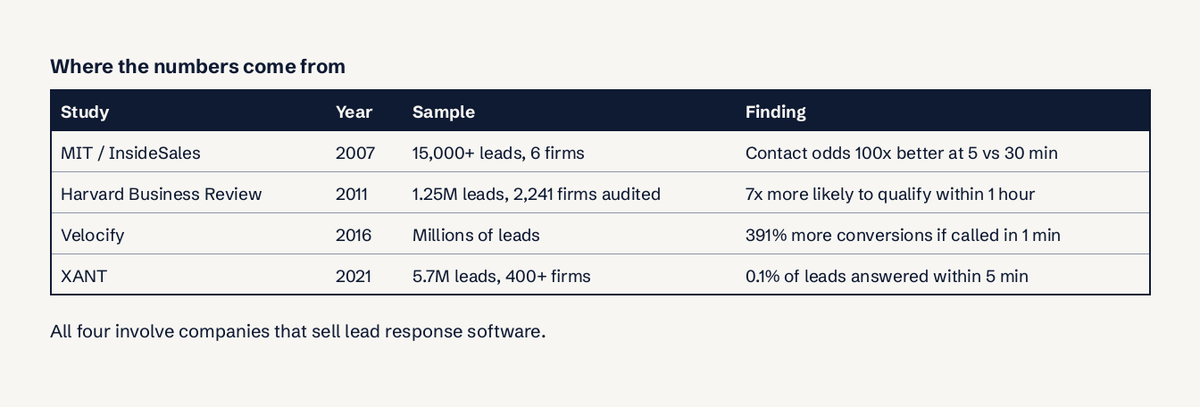
MIT and InsideSales, 2007. Three years of data from 6 companies, over 15,000 leads and over 100,000 call attempts. The odds of contacting a lead called within 5 minutes versus 30 minutes were 100 times better, and the odds of qualifying it 21 times better. This is where the "5-minute rule" comes from. Two caveats the summaries drop: it measured phone contact and qualification, not closed sales ("This study did not address close ratios"), and each company defined "qualified" its own way.
Harvard Business Review, 2011. The authors (Oldroyd, McElheran and Elkington) sent test enquiries to 2,241 US companies. 37% responded within an hour, 16% within 1 to 24 hours, 24% took longer than 24 hours, and 23% never responded. The average first response among those that did reply was 42 hours. The 7x and 60x qualification figures come from a separate analysis of 1.25 million leads. Some pages credit HBR with the "100x" figure; that number is from the 2007 MIT study.
Velocify, 2016. Prospects called within one minute of their enquiry were 391% more likely to convert than those called any time after, while the best and worst time of day to call differed by only 2.6 percentage points (PR Newswire, 26 May 2016).
XANT, 2021. A replication across 400+ companies, 5.7 million marketing leads and 55 million sales activities. Only 0.1% of leads got a first call within 5 minutes, 57.1% of first attempts came a week or more later, and conversion rates were 8 times higher within 5 minutes than at 6 minutes or more (XANT Lead Response Management 2021). Ten years after HBR, teams had not got faster.
The 78% figure. "78% of customers buy from the company that responds first" appears on many speed to lead pages. It is usually credited to a "Lead Connect" survey with no title, year, sample size or method, and we could not trace it to a published study. Treat it as a slogan, not data.
Read the studies as a shape, not a benchmark: contact and qualification odds fall steeply in the first hour, and most companies respond far slower than that.
How do you measure lead response time?
Measure lead response time per lead, in clock time, then summarise with the median and a percentage within target.
The formula for one lead:
Speed to lead = first contact time minus lead created time
For a period, report three numbers:
- Median response time: the middle value. Use it instead of the mean, because one weekend lead can drag the average up by a day.
- Share within target: for example, the percentage of leads contacted within 5 minutes and within 1 hour.
- Never contacted: leads with no first contact after 7 days. HBR found 23% of companies in this group.
Measure in clock time, not business hours. A lead that arrives at 7:30 pm on Friday and gets a call at 9:15 am on Monday waited almost 62 hours, even if a business-hours report says 15 minutes.
A worked example with real numbers
Here are six enquiries a small agency received in one week, with the time each waited for real contact.
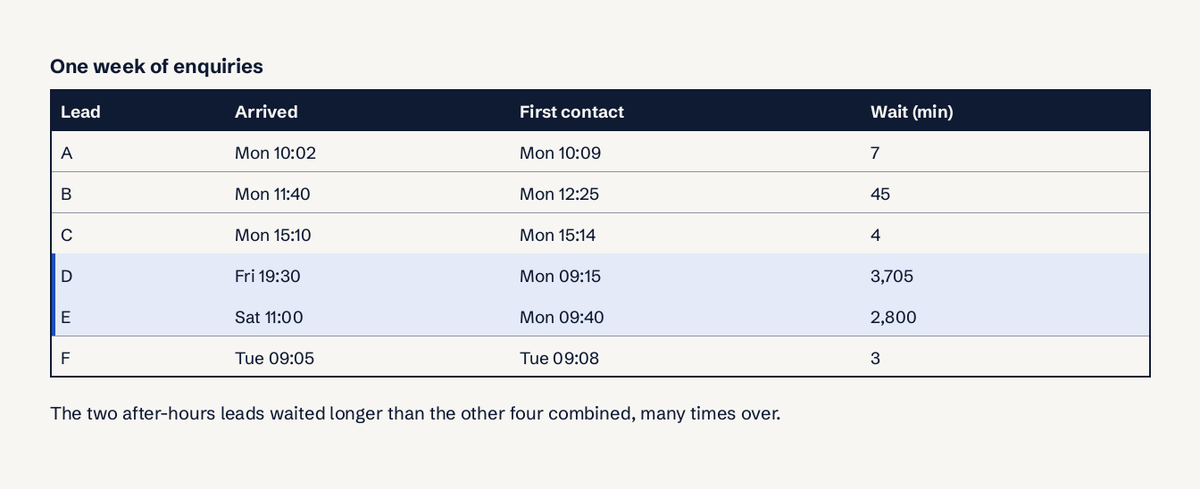
- Total wait: 7 + 45 + 4 + 3,705 + 2,800 + 3 = 6,564 minutes.
- Mean: 6,564 / 6 = 1,094 minutes, about 18.2 hours.
- Median: sorted waits are 3, 4, 7, 45, 2,800, 3,705; the median is (7 + 45) / 2 = 26 minutes.
- Within 5 minutes: 2 of 6 leads, 33%.
- Within 1 hour: 4 of 6 leads, 67%.
The team answers fast during the day (three of four weekday leads inside 10 minutes) and loses the evening and weekend completely. The fix here is not a faster sales rep. It is cover for the hours nobody is at a desk.
What is a good speed to lead benchmark?
A good lead response time is under 5 minutes for a direct enquiry (quote, demo, "call me back") during working hours, and under 1 hour as a hard ceiling. Those targets follow the MIT and XANT findings, where the drop after 5 minutes was steepest. For a low-intent lead, such as a guide download, a reply within one working day is reasonable.
Set different targets per lead type instead of one number for everything. A single target means either hot leads wait or reps learn to ignore the alerts.
How is speed to lead different from support metrics?
Speed to lead and support first response time measure the same kind of gap for different people.
| Metric | Who is waiting | Clock starts | Clock stops | Typical owner |
|---|---|---|---|---|
| Speed to lead | A new prospect | Form, chat or quote request | First real contact | Sales |
| First response time | An existing customer | Support ticket or message | First agent reply | Support |
| Speed to conversation | A new prospect | Form or request | First two-way conversation | Sales |
A business can have a 2-minute first response time on support tickets and a 2-day speed to lead, because sales enquiries go to a shared inbox nobody watches. Track them separately. Our guide to live chat metrics covers first response time in detail, and lead vs prospect explains when an enquiry becomes a prospect.
Why are businesses slow to respond to leads?
Businesses are slow to respond mostly because of handoffs, not laziness. Follow one lead from form to first call and the minutes collect in the same places:
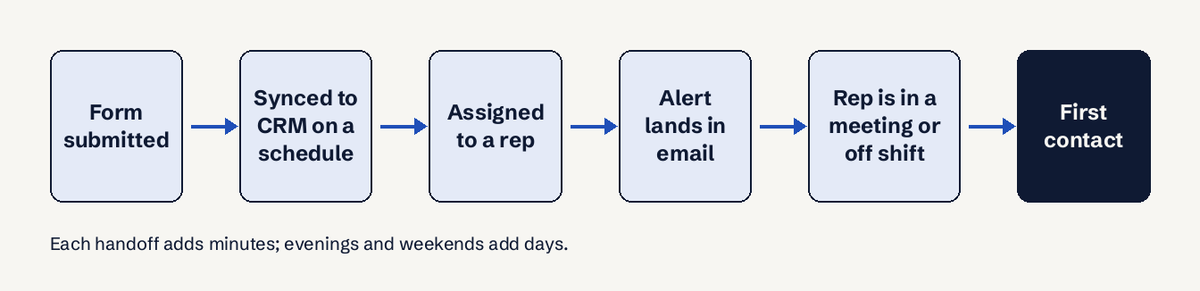
- Batch syncs: leads move from the website to the CRM on a schedule or a daily upload.
- Manual routing: someone has to decide who owns the lead.
- Email alerts: the notification sits among dozens of others.
- Nobody on shift: evenings, weekends and other time zones.
- False contact: opening the record or sending an autoresponder is logged as a response.
How do you improve speed to lead?
Improve speed to lead by removing waits in order of how many minutes they cost:
- Stamp the arrival time on every lead and measure from it.
- Move leads as they arrive with a trigger, not a scheduled sync.
- Alert where the team works (phone, chat app), with the name, need and source in the alert.
- Escalate and reassign: remind at half the target, reassign at the limit.
- Answer instantly when nobody is free. An autoresponder that says "we got your message" is not contact. A useful reply is.
- Review the median weekly, split by working hours and after hours.
How do you respond to leads after hours?
Respond to leads after hours with something that answers the actual question, not a receipt. Options, from cheapest to most complete:
- A specific autoresponder: "We'll call you at 9:30 am tomorrow" beats "We'll be in touch". It sets the wait but does not shorten it.
- A booking link: lets the buyer pick a call slot, which locks in the next step.
- An on-call rotation: works for high-value leads, costs people's evenings.
- A website chatbot that answers from your own pages: replies in seconds, asks a couple of qualifying questions, takes contact details when the buyer wants a quote or a call, and leaves a summary for the morning.
The last option is what LuckPanda Chatbot does: it answers visitors from your website and documents, asks two or three short questions, suggests one next step and saves each lead with a summary of the need, timeline and size, plus an email alert. When an answer is not in your content it says so and offers a person. You can try it on your own site without an account, and putting it live costs $4.99 a month for up to 10 websites. See how it handles after-hours enquiries and lead generation, and how handing a chat to a person works.
Common speed to lead mistakes
- Counting the autoresponder as the response. Track first human or first substantive reply as its own number.
- Reporting the mean. One weekend lead hides an otherwise fast team, or makes a slow one look fine.
- Business-hours clocks. They erase exactly the leads you are losing.
- Fast but empty replies. "Thanks, someone will call" in 30 seconds does not answer "do you deliver to Pune?" A slower specific reply usually beats an instant generic one.
- Quoting unsourced numbers internally. Use the four studies above and your own median.
Questions
What is speed to lead?
Speed to lead is the time between a prospect's enquiry (a form, chat or quote request) and the first real contact from your business. It is measured in clock time from the buyer's side, and it stops on a connected call, a substantive reply or a booked meeting.
Where does the 5-minute rule come from?
It comes from the 2007 MIT and InsideSales Lead Response Management Study, which found the odds of contacting a lead were 100 times better when called within 5 minutes than at 30 minutes, and the odds of qualifying it 21 times better. It measured phone contact and qualification, not closed sales.
What is the average lead response time?
In the 2011 Harvard Business Review audit of 2,241 US companies, the average first response among companies that replied was 42 hours, and 23% never replied. The 2021 XANT study found only 0.1% of 5.7 million leads got a call within 5 minutes.
Is speed to lead still relevant?
Yes. The 2021 XANT replication found conversion rates 8 times higher within 5 minutes than later, and most teams still respond in days. What has changed is the channel: buyers now expect chat replies in seconds, not a callback.
Is a fast generic reply better than a slower personalised one?
No. An instant receipt does not count as contact. Aim for a reply that answers the buyer's question and proposes a next step, and make that fast, with templates and alerts during the day and a chatbot that answers from your own content after hours.
How do you calculate speed to lead?
Subtract the lead created time from the first contact time for each lead, then report the median for the period and the percentage of leads contacted within your target, for example 5 minutes and 1 hour.