 luckpanda
Depreciation of Fixed Assets Rate Chart: Income Tax Act and Companies Act
Depreciation rates on fixed assets in India: computers 40%, plant and machinery 15%, furniture 10%, buildings 5-10% WDV, plus Companies Act useful lives and worked examples.
On this page
- Depreciation rate chart: Income-tax Act (WDV, block of assets)
- What is the depreciation rate on computers?
- What is the depreciation rate on furniture and plant and machinery?
- Companies Act Schedule II useful lives and equivalent rates
- Which rates apply, Income-tax or Companies Act?
- How is depreciation charged on assets bought mid-year?
- Worked example: one block with an addition, a late addition and a sale
- What changed in 2026?
- Keeping the asset register in step with the books
TL;DR: For Indian income tax, fixed assets are depreciated on the written down value (WDV) of their block at fixed rates: computers and software 40%, general plant and machinery 15%, cars 15% (30% if used on hire), furniture 10%, office buildings 10%, residential buildings 5% and intangibles 25%. An asset put to use for less than 180 days in the year gets half the rate. Companies use a second set of figures for their books: the useful lives in Schedule II of the Companies Act, 2013.
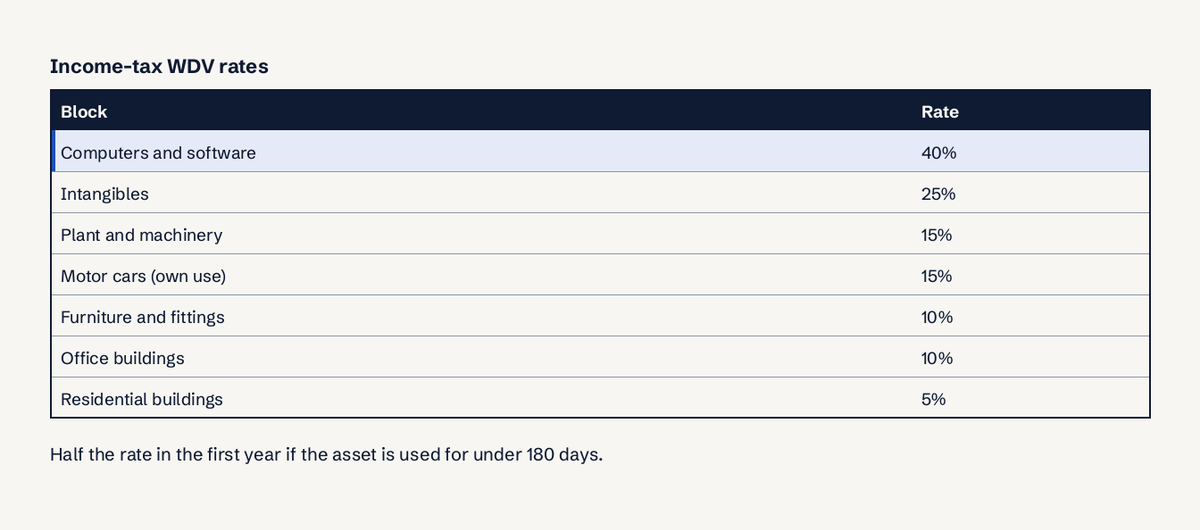
The depreciation of fixed assets rate depends on which law you are applying. For your income-tax return, the rate is the block rate in Appendix I to the Income-tax Rules: 40% WDV on computers including software, 15% on general plant and machinery and on motor cars, 30% on buses, lorries and taxis used in a hire business, 10% on furniture and fittings, 10% on non-residential buildings, 5% on residential buildings and 25% on intangibles such as patents and trademarks. From Tax Year 2026-27 these rates sit in Rule 25 of the Income-tax Rules, 2026 under section 33 of the Income-tax Act, 2025, unchanged from the 1961 Act. For a company's financial statements, Schedule II gives useful lives instead (computers 3 years, plant 15 years, furniture 10 years), from which you derive the rate.
Depreciation rate chart: Income-tax Act (WDV, block of assets)
The table below is the lookup most small businesses need. Rates apply to the written down value of the whole block, not asset by asset.
| Block of assets | Examples | Rate (WDV) | Half rate (used under 180 days) |
|---|---|---|---|
| Buildings, mainly residential | Staff quarters, a flat owned by the firm for employees | 5% | 2.5% |
| Buildings, other than residential | Office, shop, factory, warehouse, hotel | 10% | 5% |
| Temporary wooden structures | Purely temporary erections | 40% | 20% |
| Furniture and fittings | Desks, chairs, racks, electrical fittings and wiring | 10% | 5% |
| Plant and machinery, general | Machines, tools, air conditioners, office equipment, mobile phones | 15% | 7.5% |
| Motor cars, not used on hire | Company car, delivery van owned for own use | 15% | 7.5% |
| Motor buses, lorries and taxis used in a hire business | Transport operators, cab fleets | 30% | 15% |
| Ships and vessels | Ocean-going ships, inland vessels | 20% | 10% |
| Computers including computer software | Laptops, desktops, servers, printers attached to them, licensed software | 40% | 20% |
| Pollution control and renewable energy devices | Effluent treatment, solar panels and other specified devices | 40% | 20% |
| Books | Books owned by professionals, annual publications | 40% | 20% |
| Intangible assets | Know-how, patents, copyrights, trademarks, licences, franchises | 25% | 12.5% |
| Goodwill | Goodwill of a business or profession | Not allowed | Not allowed |
Sources: section 33 of the Income-tax Act, 2025 (Income Tax Department) and Rule 25 with Appendix I of the Income-tax Rules, 2026, notified by CBDT Notification No. 22/2026 [G.S.R. 198(E)] dated 20 March 2026. The same rates applied under Rule 5 of the Income-tax Rules, 1962 up to Tax Year 2025-26 (FY 2025-26).
The highest rate in Appendix I is 40%. Taxpayers who opt for a concessional tax regime cannot claim more than 40% on any block, and they also lose additional depreciation.
What is the depreciation rate on computers?
The depreciation rate on computers is 40% on the WDV of the block under the Income-tax Act, including computer software. That covers laptops, desktops, servers and the peripherals that work only with them. A laptop bought and put to use in the first half of the year gets the full 40%; one put to use after early October gets 20% in that year.
Exact values for a ₹90,000 laptop:
- put to use on 15 May 2026: 40% x ₹90,000 = ₹36,000, closing WDV ₹54,000
- put to use on 10 October 2026 (173 days to 31 March 2027): 20% x ₹90,000 = ₹18,000, closing WDV ₹72,000
- year 2 in the second case: 40% x ₹72,000 = ₹28,800
Under the Companies Act, Schedule II gives end-user devices (desktops, laptops) a useful life of 3 years and servers and networks 6 years.
What is the depreciation rate on furniture and plant and machinery?
Furniture and fittings, including electrical fittings such as wiring, switches and fans, are depreciated at 10% WDV. General plant and machinery is depreciated at 15% WDV. Plant and machinery is the default block for most business equipment that is not a building, furniture, a computer or a specified device: production machines, tools, generators, air conditioners and office equipment.
Exact values:
- furniture block, opening WDV ₹2,00,000, new tables of ₹60,000 put to use in June: 10% x ₹2,60,000 = ₹26,000
- plant block, opening WDV ₹8,00,000: 15% x ₹8,00,000 = ₹1,20,000
Additional depreciation: a business that manufactures or produces goods, or generates, transmits or distributes power, can claim an extra 20% of the actual cost of new plant and machinery in the year it is first used (10% if used for under 180 days). It does not apply to second-hand machines, office equipment, vehicles or assets installed in office premises or residential accommodation.
Companies Act Schedule II useful lives and equivalent rates
Schedule II of the Companies Act, 2013 does not give rates. It gives a useful life for each asset class, and the company works out its own rate using straight-line (SLM) or WDV, with a residual value that is generally not more than 5% of cost. The table converts the common lives into rates at a 5% residual value.
| Asset (Schedule II, Part C) | Useful life | SLM rate | WDV rate |
|---|---|---|---|
| Computers, end-user devices (desktops, laptops) | 3 years | 31.67% | 63.16% |
| Office equipment | 5 years | 19.00% | 45.07% |
| Servers and networks | 6 years | 15.83% | 39.30% |
| Motor buses, lorries, cars and taxis used on hire | 6 years | 15.83% | 39.30% |
| Motor cars, other than on hire | 8 years | 11.88% | 31.23% |
| Plant and machinery, continuous process plant | 8 years | 11.88% | 31.23% |
| Motor cycles, scooters, mopeds | 10 years | 9.50% | 25.89% |
| Furniture and fittings, general | 10 years | 9.50% | 25.89% |
| Electrical installations and equipment | 10 years | 9.50% | 25.89% |
| Plant and machinery, general | 15 years | 6.33% | 18.10% |
| Factory buildings | 30 years | 3.17% | 9.50% |
| Other buildings, RCC frame | 60 years | 1.58% | 4.87% |
The formulas behind the last two columns:
- SLM rate = (100% - residual %) / useful life, so (100 - 5) / 3 = 31.67%
- WDV rate = 1 - (residual / cost)^(1/n), so 1 - 0.05^(1/3) = 63.16%
Source: Schedule II, Companies Act, 2013. Intangible assets are not in Schedule II: they follow the accounting standard (AS 26 or Ind AS 38). For the full WDV method with a year-by-year schedule, see the written down value depreciation formula.
Which rates apply, Income-tax or Companies Act?
Both apply, to different documents. The Income-tax rates are the only ones allowed in your tax computation, whatever kind of business you are. The Companies Act lives are what a company must use in its financial statements.
| Question | Income-tax Act, 2025 | Companies Act, 2013 |
|---|---|---|
| Who uses it | Every business, for the tax return | Companies, for their books and audited accounts |
| What it prescribes | Fixed rates per block | Useful lives per asset class |
| Method | WDV on the block (SLM only for power undertakings) | SLM or WDV, chosen by the company |
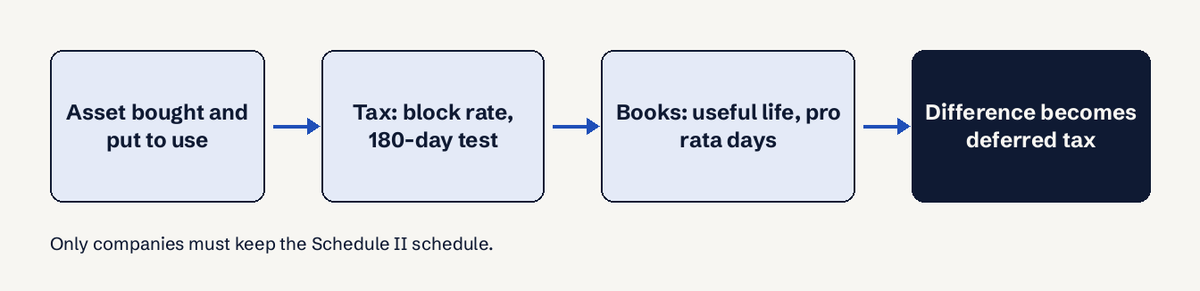
| Asset bought mid-year | Full rate or half rate (180-day test) | Pro rata by days from the date of addition |
| Residual value | None; the block runs down | Generally up to 5% of cost |
| Unit of calculation | Block of assets | Each asset or component |
A company therefore keeps two schedules, and the difference between book depreciation and tax depreciation creates deferred tax in its accounts. Proprietorships and partnership firms are not bound by Schedule II. Many of them use the Income-tax rates in their books as well so that one schedule serves both, while accounting standards ask that depreciation reflect the asset's real useful life.
How is depreciation charged on assets bought mid-year?
Under the Income-tax Act there is no day-count. If the asset is put to use for 180 days or more in the tax year it was acquired, it gets the full block rate; if it is put to use for fewer than 180 days, it gets 50% of the rate for that year only. The date that counts is the date it was put to use, not the invoice date, and the next year it gets the full rate on its WDV. In a tax year running 1 April to 31 March, anything put to use on or after about 4 October falls under the half-rate rule.
Under the Companies Act, depreciation on additions is calculated pro rata from the date of addition. The same ₹90,000 laptop put to use on 10 October 2026, on SLM over 3 years with a 5% residual:
- yearly charge: (₹90,000 - ₹4,500) / 3 = ₹28,500
- for 173 of 365 days: ₹28,500 x 173 / 365 = ₹13,508 in the books, against ₹18,000 for tax
Worked example: one block with an addition, a late addition and a sale
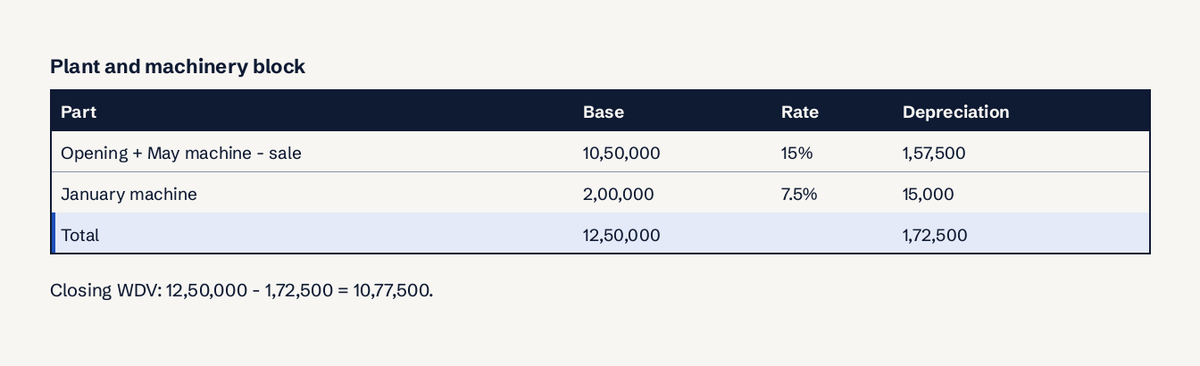
A manufacturer's plant and machinery block for Tax Year 2026-27:
| Item | Amount |
|---|---|
| Opening WDV on 1 April 2026 | ₹8,00,000 |
| Add: machine bought and put to use 20 May 2026 (full rate) | ₹3,00,000 |
| Less: sale price of an old machine, August 2026 | ₹50,000 |
| Base for full rate | ₹10,50,000 |
| Depreciation at 15% | ₹1,57,500 |
| Add: machine put to use 15 January 2027 (half rate) | ₹2,00,000 |
| Depreciation at 7.5% | ₹15,000 |
| Total normal depreciation | ₹1,72,500 |
| Closing WDV on 31 March 2027 (10,50,000 + 2,00,000 - 1,72,500) | ₹10,77,500 |
Because both new machines are new and the business manufactures, it can also claim additional depreciation: 20% x ₹3,00,000 = ₹60,000 and 10% x ₹2,00,000 = ₹20,000. The sale price, not the profit on the sale, is deducted from the block. If the sale price of assets ever exceeds the whole block, or the block has no assets left, the excess is taxed as a short-term capital gain.
What changed in 2026?
From 1 April 2026 the Income-tax Act, 2025 replaced the Income-tax Act, 1961. For depreciation, three things changed and one did not:
- the section is now section 33 of the 2025 Act (it was section 32);
- the year is called the tax year instead of the previous year, so FY 2026-27 is Tax Year 2026-27;
- the rates now sit in Rule 25 and Appendix I of the Income-tax Rules, 2026, which replaced the Income-tax Rules, 1962 (Rule 5);
- the rates themselves did not change: the 40%, 15%, 10% and 5% figures above apply as before, and the 180-day rule, additional depreciation and the goodwill exclusion carry over.
Many rate charts still cite "section 32 and Rule 5". They are right for FY 2025-26 and earlier returns; use the new references for Tax Year 2026-27 onwards.
Keeping the asset register in step with the books
The yearly depreciation from these tables becomes a journal entry (Depreciation A/c Dr, To Asset A/c or Accumulated Depreciation A/c), a line in the profit and loss account and a lower asset value on the balance sheet. If your invoices, bills and payments already live in LuckPanda, the Finance module's ledger holds those depreciation journals beside the rest of your books, so the trial balance and reports pick them up without a separate spreadsheet. For the idea of depreciation and the other methods, see what depreciation means.
This page is general information on Indian tax and company law, not tax advice. Check the current Appendix I and your facts with a chartered accountant before filing.
Questions
What is the depreciation rate on a mobile phone?
There is no separate block for mobile phones. They are usually treated as plant and machinery at 15% WDV, the same as other office equipment. Some practitioners classify smartphones as computers at 40%; the conservative position is 15% unless the device works as a computer for your business.
What is the depreciation rate on a car under the Income-tax Act?
A motor car used in your business, other than for hire, is depreciated at 15% WDV. Motor buses, lorries and taxis used in a business of running them on hire get 30%. Under the Companies Act, Schedule II gives cars 8 years of useful life, or 6 years if used on hire.
Can I claim depreciation on land?
No. Land is not a depreciable asset under either law. When you buy a building with its land, only the cost of the building is depreciated, so split the price between land and building.
Is goodwill depreciable?
No. Goodwill of a business or profession has not been a depreciable intangible since Assessment Year 2021-22, and section 33 of the Income-tax Act, 2025 keeps that exclusion. Other intangibles such as patents, trademarks, licences and franchises get 25%.
What is the highest rate of depreciation under the Income-tax Act?
40%. It applies to computers and software, temporary wooden structures, books, pollution control equipment and renewable energy devices. Higher rates that existed before Assessment Year 2018-19 were capped at 40%.
Do I have to claim depreciation every year?
Under the 1961 Act, depreciation was allowed whether or not you claimed it, so skipping it in a loss year did not preserve the WDV. Assume the same block rules under the 2025 Act and claim it each year in your return.