 luckpanda
Invoice With Bank Details: Template and Bank Fields by Country
Which bank details to put on an invoice in each country: IBAN and BIC, sort code, ACH routing, IFSC, BSB, plus a payment block template and fraud-safety notes.
On this page
- What bank details should I put on an invoice?
- Invoice with bank details template: the payment block to copy
- How safe is it to share your account number?
- Name checks now catch mismatches
- What is the difference between ACH routing and wire routing numbers?
- Do I need an IBAN for international invoices?
- How long does a bank transfer take after the invoice?
- Country notes
- United Kingdom
- Eurozone
- India
- United States
- Canada and Australia
- Common mistakes
- Make the invoice in one go
TL;DR: An invoice with bank details needs the account holder name exactly as the bank holds it, the bank name, the account number and the routing code your client's payment system uses: IBAN and BIC in Europe, sort code in the UK, ABA routing number in the US, IFSC in India. Add the SWIFT/BIC whenever the client pays from another country. Check the numbers once, and tell clients you will never change them by email.
To make an invoice with bank details, add a "Payment details" block below the totals with five things: account holder name, bank name, account number (or IBAN), the domestic routing code for your country, and the SWIFT/BIC code for payers abroad. Put the invoice number in the block as the payment reference, so the transfer arrives with something you can match. Bank details are not a legal invoice field in the UK, the EU or India; they are the payment instruction, and a wrong digit costs you weeks. The table below shows exactly which fields each country uses.
What bank details should I put on an invoice?
Put the fields your client's bank asks for when it sets up a transfer to you. Those depend on the country of your account, not the client's. This is the lookup table:
| Your account is in | Fields to print | Format of the routing code | Example (illustrative) |
|---|---|---|---|
| United States | Account name, bank, account number, ABA routing number (ACH and wire if they differ), SWIFT/BIC for foreign payers | 9 digits | Routing 123456789 |
| United Kingdom | Account name, bank, sort code, account number; IBAN and BIC for foreign payers | Sort code 6 digits, account 8 digits | 12-34-56, 98765432 |
| Eurozone (DE, FR, NL, IE, ES) | Account name, IBAN, BIC | IBAN 18 to 27 characters by country | DE: 22, FR: 27, NL: 18 |
| India | Account name, bank and branch, account number, IFSC, account type; SWIFT/BIC for payments from abroad | IFSC 11 characters, 5th is 0 | ABCD0123456 |
| Canada | Account name, institution number, transit number, account number | Institution 3 digits, transit 5 digits | EFT routing 0 + 004 + 10002 = 000410002 |
| Australia | Account name, BSB, account number | BSB 6 digits (AAB-CCC) | 123-456 |
| Singapore | Account name, bank name, bank code, branch code, account number; SWIFT/BIC from abroad | Bank code 4 digits, branch 3 digits | 1234-567 |
| United Arab Emirates | Account name, IBAN, BIC | IBAN 23 characters, starts AE | AE07 0331 2345 6789 0123 456 |
| Mexico | Account name, CLABE | 18 digits | 18-digit CLABE |
Example values are format illustrations, not real accounts. Always copy yours from your bank's own letter or app.
Two fields belong on every version, whatever the country:
- Account holder name, exactly as the bank holds it. Since name-checking services arrived (see below), "Asha Design" when the account says "Asha Design Studio LLP" can trigger a mismatch warning that stops the payment.
- Payment reference: "Please quote INV-2026-041". Without it, a client paying three invoices in one transfer leaves you guessing.
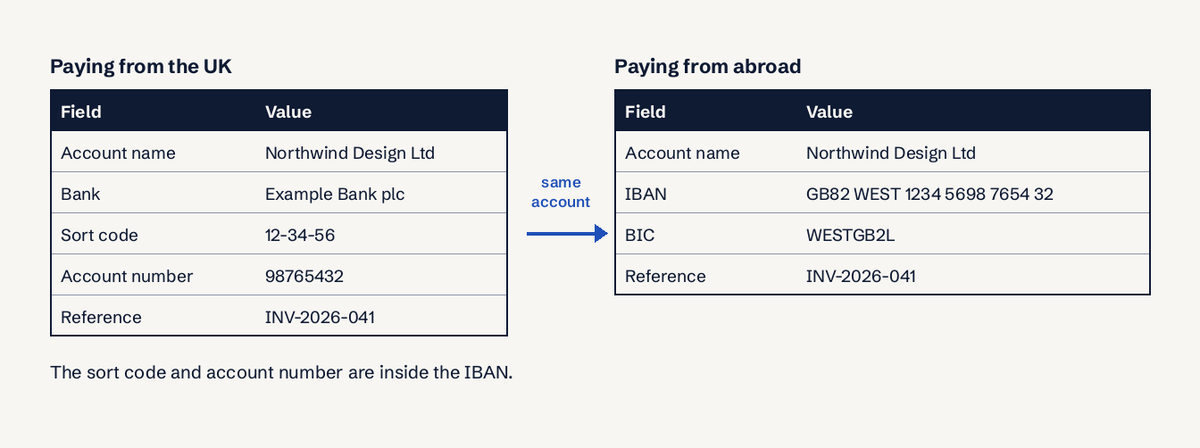
Invoice with bank details template: the payment block to copy
The template below is the block to paste under your totals. Delete the rows your country does not use.
| Payment details | |
|---|---|
| Account holder | Your legal or trading name, exactly as on the account |
| Bank | Bank name (and branch, in India) |
| Account number | Or IBAN, written in groups of four |
| Routing code | Sort code / ABA routing number / IFSC / BSB / transit and institution |
| SWIFT/BIC | 8 or 11 characters, for international payments |
| Currency | The currency the invoice is in, e.g. USD |
| Reference | The invoice number |
| Note | "We will never change these details by email. Call us on +91 ... to confirm." |
Place it after the total and the due date, so the reader sees what to pay, by when and where in one glance. On a one-page invoice it fits in the footer; our free invoice template already has the slot.
How safe is it to share your account number?
Yes. Account number and routing code only let someone send money in, not take it out, and every business that is paid by transfer shares them. The real risk is not that someone reads your details; it is that a fraudster replaces them. In business email compromise (BEC), a criminal sends a lookalike invoice or a "we've changed banks" email with their own account. The FBI's Internet Crime Complaint Center counted 21,442 BEC complaints and about $2.77 billion in reported losses in 2024, the second-largest loss category in its 2024 report.
What protects you and your clients:
- Send invoices from one consistent address and, where you can, as a PDF or a link rather than an editable file.
- Print a line saying your bank details will never change by email.
- When you genuinely change banks, tell clients by phone or in person and give them time to verify.
- Ask clients to make a small test payment the first time they pay a new account.
- Never put card numbers, online banking logins or one-time passwords on an invoice. Only the receiving details belong there.
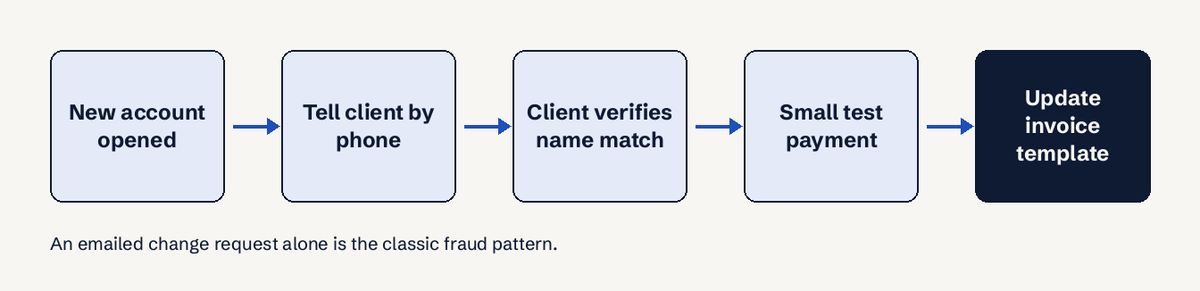
Name checks now catch mismatches
Payee-name checking makes the account name field matter more than it used to. In the UK, Confirmation of Payee checks the name a payer types against the sort code and account number before money moves, and warns on a mismatch. In the euro area, the Instant Payments Regulation (EU) 2024/886 has required payment providers to offer a free Verification of Payee check of name against IBAN since 9 October 2025; EU providers outside the euro area follow from 9 July 2027. If your invoice says a trading name and the account is in your company's legal name, print the legal name, or both ("Asha Design Studio LLP, trading as Asha Design").
What is the difference between ACH routing and wire routing numbers?
Both are 9-digit ABA routing numbers, but some US banks use one number for ACH transfers and another for domestic wires, because the two run on different networks. ACH is the batch network for most business-to-business transfers in the US; a domestic wire is a same-day, per-payment transfer. If your bank lists two numbers, print both and label them: "ACH routing: ..." and "Wire routing: ...". If it lists one, the same number covers both. Wells Fargo, for example, publishes separate routing numbers for ACH and wires. An invoice with ACH info only needs the ACH line; add the wire line when clients may pay larger amounts by wire.
For a client outside the US paying a US account, the routing number is not enough: they send an international wire using your bank's SWIFT/BIC and your account number, and sometimes an intermediary bank your bank names. Copy those exactly from your bank's "incoming international wire" instructions.
Do I need an IBAN for international invoices?
Only if your account is in a country that uses IBAN. An IBAN (ISO 13616) is up to 34 characters: a two-letter country code, two check digits and the domestic account number. More than 80 countries use it, including the UK, every EU member state and the UAE, and a payer in those countries' banks will usually insist on it. India, the US, Canada, Australia and Singapore do not have IBANs at all; for those, print the local account number and routing code plus the bank's SWIFT/BIC code. Do not invent an IBAN for an Indian or US account; a payer's bank will reject it.
The BIC (also called the SWIFT code) is 8 or 11 characters: 4 for the bank, 2 for the country, 2 for the location and an optional 3 for the branch. For euro transfers within SEPA, the IBAN alone is usually enough; for anything that crosses into SWIFT, print the BIC as well.
Before the first invoice goes out, paste your IBAN into our IBAN checker. It confirms the length for the country and the mod-97 check digits, which catches nearly every typing slip, and splits a UK IBAN into its sort code (characters 9 to 14) and account number (15 to 22). It cannot confirm the account exists; only your bank can.
How long does a bank transfer take after the invoice?
Speed depends on the rail the client's bank uses, which follows from the details you print. Set your due date with it in mind: on Net 30 terms, a client who pays by wire on day 30 may still land a few days late.
| Rail | Used with | Typical arrival |
|---|---|---|
| UK Faster Payments | Sort code + account number | Usually minutes, within 2 hours at most |
| UK Bacs | Sort code + account number | 3 days (input day, processing day, arrival day) |
| US ACH | ABA routing + account number | 1-2 days; Same Day ACH the same business day |
| SEPA Credit Transfer | IBAN | Within 1 day (end of the next business day) |
| SEPA Instant | IBAN | Seconds, 24/7 |
| India NEFT and IMPS | IFSC + account number | NEFT runs in half-hourly batches 24/7 since December 2019; IMPS is instant |
| International SWIFT wire | SWIFT/BIC + IBAN or account number | 1-5 days, longer with intermediary banks |
Sources: Pay.UK, Nacha, European Payments Council, RBI. For a first payment from a new client abroad, allow 5 days before you chase.
Country notes
United Kingdom
Sort code (six digits, written 12-34-56) and an eight-digit account number. For EU or other foreign clients add the IBAN (22 characters for the UK) and BIC. HMRC's VAT invoice rules do not require bank details; they are still the most useful line on the page.
Eurozone
IBAN and BIC only; nobody needs a separate account number. Lengths differ by country: 22 for Germany and Ireland, 27 for France, 24 for Spain, 18 for the Netherlands. Write the IBAN in groups of four (DE89 3704 0044 0532 0130 00) so it is easy to read back.
India
Account holder name, bank and branch, account number, IFSC and account type (current or savings). The RBI defines IFSC as 11 characters: four letters for the bank, a fifth character that is always 0, and six for the branch. UPI ID is a useful extra line for domestic clients. For export invoices add the bank's SWIFT/BIC; foreign inward remittances also usually carry a purpose code that the bank asks the remitter or you to confirm. GST Rule 46 lists what a tax invoice must contain and bank details are not on it, but they are expected in practice.
United States
Account name, bank, account number and ABA routing number(s), as above. There is no federal invoice format, so you decide the layout; label each number with what it is for.
Canada and Australia
Canada uses a 3-digit institution number and a 5-digit transit number; electronic payments combine them as 0 + institution + transit (for example 000410002). Australia uses a 6-digit BSB in the form AAB-CCC (bank, state, branch), which payers can check on AusPayNet's BSB lookup.
Common mistakes
- Trading name instead of the account name. The most frequent cause of a name-check warning.
- IBAN for a country without one. India and the US have none.
- Old details in a saved template. After a bank change, every saved template, PDF footer and email signature must be updated the same day.
- No reference. The payment arrives, but you cannot match it to an invoice.
- Currency left out. "1,200" means very different things in USD and INR; state the currency next to the total and in the payment block.
Make the invoice in one go
If you would rather not rebuild the block for each client, LuckPanda's free invoice generator has a payment details section for bank or payment instructions, formats amounts by the invoice's country (₹1,24,500.00, $12,400.00, 12.400,00 €), and downloads a PDF without an account. For more on cross-border billing, see how to invoice international clients and what a remit-to address is.
Questions
What bank details should I put on an invoice?
Account holder name exactly as the bank holds it, bank name, account number (or IBAN), the routing code your country uses (sort code, ABA routing number, IFSC, BSB, or transit and institution numbers), the SWIFT/BIC for foreign payers, and the invoice number as the payment reference.
How safe is it to share your account number?
Yes. Account and routing numbers only allow money to be sent to you. The risk is fraudsters sending fake invoices with their own details, so tell clients your details will never change by email and confirm any change by phone.
What is the difference between ACH routing and wire routing numbers?
Both are 9-digit ABA routing numbers. Some US banks use one for ACH transfers and another for domestic wires. If your bank gives two, print both with labels; if it gives one, it covers both.
Do I need an IBAN for international invoices?
Only if your account is in an IBAN country such as the UK, an EU member state or the UAE. Indian, US, Canadian, Australian and Singapore accounts have no IBAN; give the local account number, routing code and the bank's SWIFT/BIC instead.
Where do bank details go on an invoice?
Below the total and the due date, in a block labelled "Payment details" or "How to pay". On a one-page invoice the footer works as long as it is easy to find.
Should I put my UPI ID or a payment link on the invoice too?
Yes, as an extra option, not a replacement. A UPI ID suits domestic clients in India, and a payment link lets clients pay by card; keep the bank transfer details for clients whose finance teams only pay by transfer.