 luckpanda
PO vs Non-PO Invoice: Which Spend Needs a Purchase Order
A PO invoice is checked against an order approved before buying; a non-PO invoice is approved after it arrives. Here is when each one fits.
On this page
- PO invoice vs non-PO invoice at a glance
- How LuckPanda handles PO and non-PO bills
- Which bills arrive without an order?
- How does matching against an order work?
- When is a purchase order not needed?
- How do you approve an expense invoice?
- What does "no PO, no pay" mean for suppliers?
- Do tax and payment deadlines depend on the order?
- Choose a PO if, skip it if
TL;DR: A PO invoice matches a purchase order someone approved before the money was committed; a non-PO invoice has no order behind it, so it is approved after it arrives. Use POs for goods, stock and any one-off spend above a set amount; let rent, utilities, subscriptions and small ad-hoc costs come in as non-PO invoices with a named approver. LuckPanda Purchasing records both: a bill made from a purchase order line by line, or a bill on its own.
Raise your next purchase order free in LuckPanda Purchasing. Drafts are free; the module is $4.99 a month (₹199 in India) when you issue and share.
The difference between a PO and a non-PO invoice is when approval happens. With a PO invoice, the purchase, the vendor, the price and the quantity were approved on the purchase order before anything was bought, so accounts payable only checks that the invoice matches the order (and, for goods, the goods received note). With a non-PO invoice, also called an expense invoice, nothing was approved in advance, so someone has to find out who bought it, code it to the right account and get a manager to sign it off before it can be paid. Non-PO invoices are normal for utilities, rent, legal fees and small purchases; they become a problem when goods and large one-off spend arrive that way.
PO invoice vs non-PO invoice at a glance
| Criterion | In LuckPanda | PO invoice | Non-PO invoice |
|---|---|---|---|
| Approval | PO above a set amount goes to an approver first | Before the purchase, on the PO | After the invoice arrives |
| What AP checks against | Bill made from the PO line by line | PO, plus goods received note for goods | Nothing; requester confirms it |
| Overbilling | Billing more than ordered is refused | Caught by the match | Caught only if the approver notices |
| Typical spend | Stock, materials, contracted services | Goods, stock, large one-off services | Rent, utilities, subscriptions, legal fees, small ad-hoc buys |
| Coding to accounts | Lines carry item, tax and ITC eligibility | Done on the PO | Done by AP after arrival |
| Processing time | One step: record the bill | Same day when it matches | Often 5 to 10 days: find owner, code, approve |
| Fraud and duplicate risk | Vendor invoice number checked for duplicates | Lower | Higher |
Sources: GEP and Medius (read 2026-11-24); LuckPanda's live purchase orders and bills pages.
How LuckPanda handles PO and non-PO bills
LuckPanda Purchasing keeps both kinds of invoice in one list of vendor bills. What its live pages say, read on 2026-11-24:
- Purchase orders carry lines, HSN or SAC codes, prices, tax and an expected delivery date, in the vendor's currency, numbered in their own PO- series per financial year (for example PO-2026-27/0001).
- Approval before buying: orders above a set amount can go to an approver first (Workspace › Approvals). That threshold is your PO policy in one setting; a common start is 1 approver per order above ₹25,000.
- PO to bill: a purchase order converts to a bill line by line. Billing more than was ordered is refused, and the order's due date carries to the bill.
- Non-PO bills: a bill can also be recorded on its own, with its lines, tax and due date. The vendor's own invoice number is checked for duplicates either way.
- Input tax credit: each bill line is marked eligible or not for GST input tax credit; ineligible GST is added to the cost.
- Corrections: a wrong bill is cancelled or corrected with a purchase debit note, never edited after recording.
What it does not do yet: Expenses (receipts and categories for card and cash spend) and vendor payouts are marked as being built. Until they ship, record a non-PO invoice as a bill on its own and pay it from your bank.
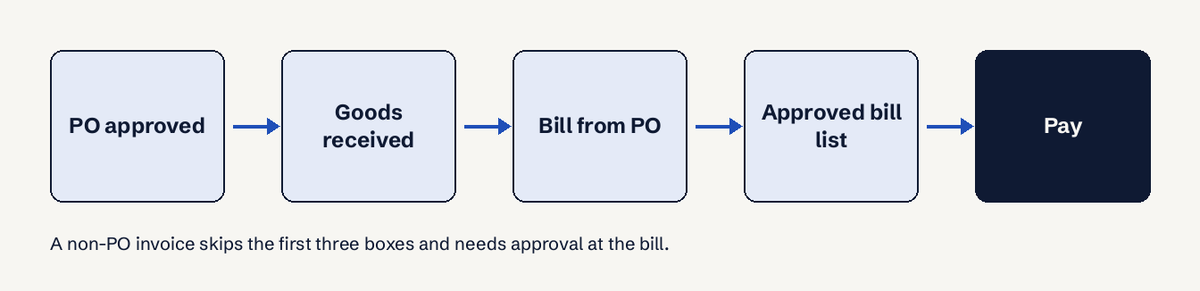
Which bills arrive without an order?
A non-PO invoice is a supplier invoice with no purchase order behind it. The purchase was made outside the ordering process, so the invoice is the first document the business sees. GEP lists the common ones: advertising, telephone, electricity and water bills, legal services, and food and travel reimbursements. Medius calls them expense invoices and notes they are usually indirect spend, not stock or materials.
Non-PO does not mean improper. A landlord does not send a rent invoice against a PO, and nobody raises an order for each month's electricity. The risk is the same invoice type used for things that should have had one: a ₹3,00,000 machine part bought on a phone call, or a supplier quietly raising its price because nothing on file says what was agreed.
How does matching against an order work?
A PO invoice is the vendor's invoice for something you ordered on a purchase order, and it quotes the PO number. Accounts payable checks it against the order for price, quantity and terms. For goods it also checks the goods received note, which is the three-way match:
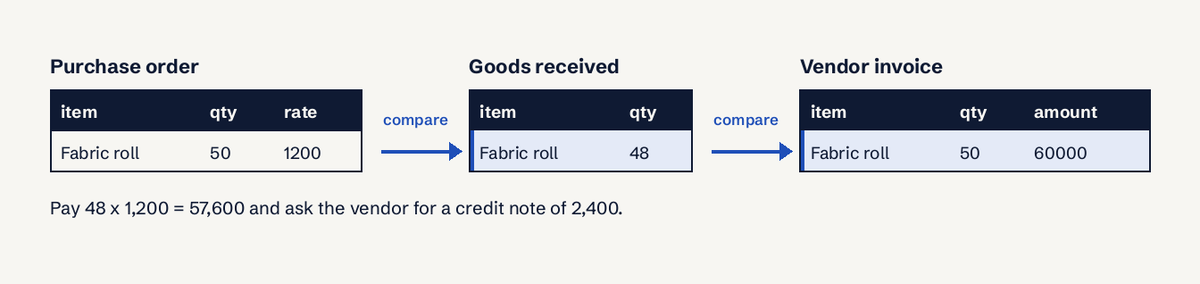
When all three agree, the invoice is already approved: the approval happened on the PO. That is why PO invoices move faster through AP even though they involve more documents: a matched invoice can be scheduled for payment within 1 day, while a short delivery like the one above is held until the 2 missing rolls are credited or delivered within 7 days.
When is a purchase order not needed?
A purchase order is not needed when the spend is recurring under a contract, fixed by a third party, or too small to justify the paperwork. A practical rule for a small business:
- Always a PO: stock, raw materials, goods you will receive and count, and any one-off purchase above your threshold (for example ₹25,000 or $500 per order). Review the threshold every 12 months.
- PO once, then call off: recurring supplies from one vendor at agreed prices. Raise a blanket PO with a ceiling (say ₹2,00,000 for 12 months) and bill against it.
- No PO, named approver (100% of these go to one person): rent, utilities, telecoms, software subscriptions, insurance, statutory fees, professional fees under an engagement letter.
- No PO, card or petty cash: small ad-hoc buys under the threshold, with the receipt kept.
Large organisations write the same list into policy. Clemson University's No PO, No Pay policy requires a PO before delivery for all goods and services, except with written approval of its Director of Procurement, orders on a purchasing card, or items on its approved direct expenditure list.
How do you approve an expense invoice?
Approve a non-PO invoice in four checks, in this order:
- Identify the requester. Who bought it? An invoice nobody claims is not paid.
- Confirm receipt. The requester confirms the goods arrived or the service was done, in writing, within 2 days.
- Code it. Assign the expense account, cost centre and tax treatment. In India, check that the invoice is a valid tax invoice with your GSTIN if you want to claim input tax credit.
- Approve by amount. The approver depends on value: a team lead below one limit (say ₹10,000 per invoice), the owner above it. Medius describes this as routing by spend threshold, cost centre, vendor or department.
Then record it as a bill with its due date (invoice date plus the vendor's terms, such as 30 days) so it enters the payment run like any other. If the same vendor keeps sending non-PO invoices for goods, that vendor should be on POs.
What does "no PO, no pay" mean for suppliers?
"No PO, no pay" means the buyer will not pay an invoice that does not quote a valid purchase order number; it is returned to the supplier unpaid. Norwich City Council's policy returns an invoice when the PO number is missing, when it does not match the description or dates, when one invoice quotes more than one PO, or when the invoice has more lines than the PO. bp's supplier guidance asks for one invoice per PO and does not accept pro-forma invoices or statements as invoices.
For a supplier, the fix is simple: get the PO number before you invoice, and quote it exactly. The University of York tells suppliers that invoices without a valid PO are returned unprocessed, which delays payment; with one, they are paid on its standard terms of 28 days from invoice date, so a returned invoice restarts that 28-day clock. If you sell to large buyers, put a PO number field on your own invoices: LuckPanda's invoice generator has one.
Do tax and payment deadlines depend on the order?
No. Tax and payment deadlines follow the invoice and the supply, not the PO.
- GST input tax credit (India): Section 16(2) of the [CGST Act] (claimable until 30 November after the financial year ends)(https://cbic-gst.gov.in/gst-acts.html) asks for a tax invoice, receipt of the goods or services, tax paid by the supplier and your return filed. A purchase order is not one of the conditions. Use the free ITC eligibility checker per line.
- MSME payment limit (India): Section 15 of the MSMED Act, 2006 caps payment to micro and small suppliers at 45 days from acceptance (15 days when no term is agreed), PO or not. Claimable GST on each bill line flows to Table 4 of GSTR-3B.
Information, not tax advice; check your case with your accountant.
Choose a PO if, skip it if
Choose a PO when:
- You will receive goods and need to count them against what you agreed.
- The price or quantity could be disputed later.
- The amount is above your approval threshold.
- The vendor is new.
Skip the PO when:
- The cost is fixed by a contract or a utility tariff.
- It recurs monthly at the same amount.
- It is under your threshold and paid by card with a receipt.
Our recommendation for a small business: set one threshold, put every goods purchase on a PO in LuckPanda Purchasing, and record everything else as a bill on its own with a named approver, reviewed every 7 days. The accounts payable process guide and the weekly routine in managing payables show where both fit, and the free purchase order format gets you started with no account.
Start with your next order: draft a purchase order free in LuckPanda Purchasing and turn it into a bill line by line when the invoice arrives. $4.99 a month (₹199 in India) per module when you issue.
Questions
Which bills arrive without an order?
A supplier invoice with no purchase order behind it. It is approved after it arrives instead of before the purchase. Utilities, rent, subscriptions, legal fees and small ad-hoc buys usually come in this way.
What is the difference between a PO and a non-PO invoice?
A PO invoice is matched against a purchase order approved before buying, so it is pre-approved if it matches. A non-PO invoice has nothing to match, so it needs a requester, coding and an approver after it arrives.
When is a purchase order not needed?
For recurring contracted costs (rent, utilities, subscriptions), professional fees under an engagement letter, and small purchases under your approval threshold paid by card or petty cash.
Can you pay an invoice without a purchase order?
Yes, unless your own policy says "no PO, no pay". Most businesses pay non-PO invoices after a named person approves them. Some buyers raise a retrospective PO to match a valid invoice that arrived without one.
What does "no PO, no pay" mean?
The buyer returns any invoice that does not quote a valid PO number, unpaid. Suppliers should get the PO number before invoicing and quote it exactly, one PO per invoice.
Is a PO required to claim GST input tax credit?
No. Section 16(2) of the CGST Act requires a tax invoice, receipt of the supply, tax paid by the supplier and a filed return. A PO helps prove the purchase but is not a condition.