 luckpanda
Managing Payables: A Weekly AP Routine for Small Business
Capture every bill the day it arrives, match it to the PO and goods received, approve it, and pay on one weekly run before the due date, including the 45-day MSME limit.
On this page
- What LuckPanda does for payables today
- What you need before you start
- How do you manage accounts payable in a small business?
- What is three-way matching in AP?
- How often should payables be paid?
- How do you avoid late payment interest to MSME vendors?
- How to check the routine works
- Common mistakes and fixes
TL;DR: Managing payables comes down to five habits: capture every bill the day it arrives, match it to the purchase order and what you received, approve it, pay it on one fixed weekly run, and check legal deadlines such as India's 45-day MSME limit. LuckPanda Purchasing records vendor bills against purchase orders and posts them to accounts payable, so what you owe is one list, not a pile of emails.
Record your next vendor bill free in LuckPanda Purchasing. Drafts are free; the module is $4.99 a month (₹199 in India) when you issue and share.
Managing payables (accounts payable management) is the routine that decides which supplier bills you owe, whether each one is correct, and when you pay it. For a small business the answer is a weekly cycle: every bill goes into one system the day it arrives, it is checked against the purchase order and the goods received note, a named person approves it, and approved bills are paid in a single weekly payment run, earliest due date first, with any statutory deadline (45 days for Indian micro and small suppliers, 30 days by default in the UK) treated as the real due date.
What LuckPanda does for payables today
LuckPanda Purchasing is the module for buying and paying vendors. What its live vendor bills page says it does, read on 2026-11-20:
- Records each bill with its lines, tax and due date, in the vendor's currency.
- Checks the vendor's own invoice number for duplicates, the most common cause of paying a bill twice.
- Builds a bill from a purchase order line by line, or records it on its own.
- Marks each line as eligible or not for GST input tax credit; ineligible GST is added to the cost.
- Posts the recorded bill to accounts payable, where it stays open until paid.
- Corrects a wrong bill by cancelling it or with a purchase debit note, never by editing a recorded bill.
What it does not do yet: vendor payouts are being built. The first version will record payments you make from your own bank; LuckPanda does not send money, and its AI agent can only prepare a list of bills due for a person to act on. Until then, pay from your bank and keep the bank reference against the bill.
What you need before you start
- A list of your vendors with payment terms (net 15, net 30, 2/10 net 30) and, in India, their Udyam registration status (micro, small or medium).
- Purchase orders for anything you buy repeatedly. Our free purchase order format works if you have none.
- A record of what arrived: a goods received note or a signed delivery challan.
- One person who approves bills, and one fixed weekday for payments.
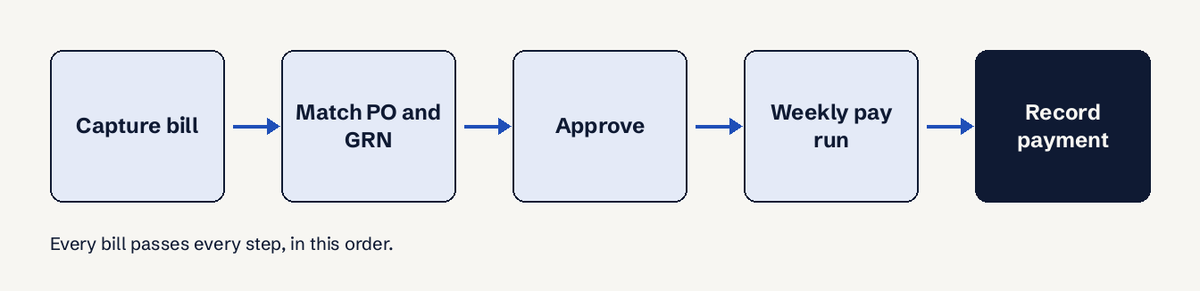
How do you manage accounts payable in a small business?
Run these six steps. Steps 1 to 3 happen the day a bill arrives; steps 4 to 6 happen once a week.
- Capture the bill the day it arrives. Record vendor, vendor invoice number, invoice date, due date, lines, tax and currency. Exact setting: due date = invoice date + the vendor's terms, or the statutory limit if that is earlier. In LuckPanda, record it under Purchasing, Bills; a repeated vendor invoice number is flagged.
- Match it before anyone approves it. Compare the bill with the purchase order (price, quantity, terms) and with the goods received note (quantity actually delivered). This is the three-way match, explained below.
- Approve or dispute. The approver signs off matched bills. A bill that does not match goes back to the vendor in writing the same day; in India the disputed amount is settled with a debit note, not by editing the bill.
- Build the weekly payment run. Every Monday (or your chosen day), list approved bills due in the next 7 days, plus any bill with an early-payment discount you will take. Sort by due date.
- Pay and record the payment. Pay from your bank, then record amount, date and bank reference against each bill so the bill closes.
- Review once a month. Check the aged payables list (0-30, 31-45, 46-60, 60+ days), and in India check every micro or small supplier bill older than 30 days so none crosses 45.
What is three-way matching in AP?
Three-way matching is the check that the purchase order, the goods received note and the vendor's invoice agree before you pay. The PO says what you agreed to buy and at what price, the GRN says what arrived, and the invoice says what the vendor is charging. Pay only the lowest of the three quantities at the PO price.
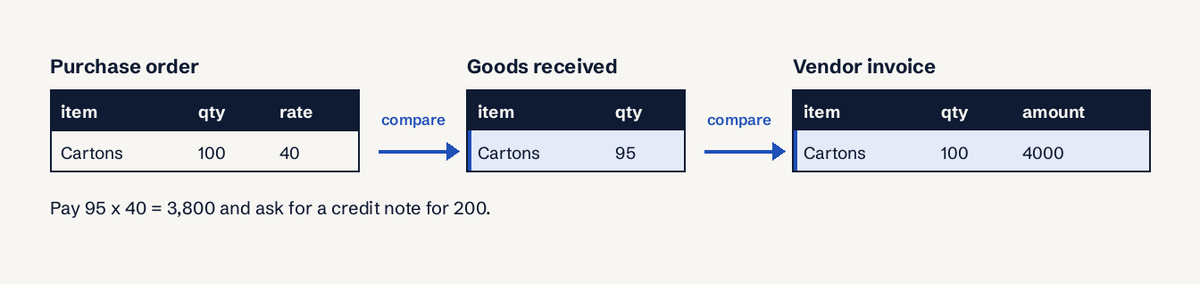
A two-way match (PO and invoice only) is fine for services, where there is nothing to receive. For goods, the GRN step is what catches short deliveries.
How often should payables be paid?
Pay once a week on a fixed day for most small businesses. A weekly run is frequent enough that no net-15 bill slips past its date, and batched enough that you log into the bank once instead of daily. Very small businesses with fewer than 20 bills a month can pay fortnightly, as long as the run always includes everything due before the next run.
Do not pay everything the day it arrives either. Paying net-30 bills on day 2 gives away 28 days of cash for nothing. The exception is an early-payment discount: on 2/10 net 30 terms, skipping the 2% to keep the cash 20 more days costs 2/98 x 365/20 = 37.2% a year, more than almost any business loan, so take it when cash allows.
| Terms | Pay on | Why |
|---|---|---|
| Net 30, no discount | the run just before day 30 | keeps cash longest, still on time |
| 2/10 net 30 | the run before day 10 | the discount is worth 37.2% a year |
| Indian micro or small supplier, 60 days agreed | the run before day 45 | the law caps terms at 45 days |
| UK supplier, no terms agreed | the run before day 30 | statutory default period |
How do you avoid late payment interest to MSME vendors?
Pay every Udyam-registered micro or small supplier within 45 days of accepting the goods or services, or within 15 days if you have no written agreement on terms. That is Section 15 of the MSMED Act, 2006, and a contract saying 60 or 90 days does not override it. Three things follow if you miss it:
- Interest: Section 16 charges compound interest with monthly rests at three times the RBI bank rate, and Section 23 says that interest is not tax deductible.
- Lost deduction: Section 43B(h) of the Income-tax Act, added by the Finance Act 2023 from assessment year 2024-25, allows the expense only in the year you actually pay, if you pay after the Section 15 limit. A March bill paid in May can push the expense into next year's return. See the Income Tax Department for the current text.
- Reporting: companies with micro or small supplier dues older than 45 days file MSME Form I with the MCA every half year (by 30 April and 31 October).
Medium enterprises are outside Section 15, so record each vendor's Udyam category when you add them. Separately, CGST Act Section 16(2) requires you to pay a supplier within 180 days of the invoice date to keep the GST input tax credit; our free ITC eligibility checker shows the rule for a given purchase.
In the UK, the Late Payment of Commercial Debts (Interest) Act 1998 lets a supplier charge 8% above the Bank of England base rate plus fixed compensation of £40, £70 or £100 depending on the debt.
How to check the routine works
- Aged payables: nothing in 46+ days for Indian micro or small suppliers, nothing past due for anyone.
- Days payable outstanding (DPO): average accounts payable divided by cost of goods sold, times days in the period. A steady DPO close to your average terms means you pay on time without paying early.
- Duplicate check: no vendor invoice number appears twice in a quarter.
- Discounts taken: count the 2/10 bills paid inside 10 days.
Common mistakes and fixes
- "Bill not found" at payment time: the bill lived in someone's inbox. Fix: one capture point, recorded the day it arrives.
- Paid twice: the same invoice came by email and by post. Fix: a duplicate vendor invoice number check before approval.
- Paid for goods that never came: no GRN. Fix: three-way match for every goods purchase.
- Editing a recorded bill: it breaks the audit trail and the GST return. Fix: cancel it or raise a debit note.
- Contract terms longer than 45 days with Indian micro or small suppliers: the law still applies at 45. Fix: set the due date to the earlier of the two.
For tracking how vendors perform once bills are flowing, see supplier performance metrics, and for where payables sit in the bigger buying process, source-to-contract vs procure-to-pay.
Questions
What does managing payables mean?
It means controlling the money you owe suppliers: recording every bill, checking it against what you ordered and received, approving it, and paying it on time, neither late nor needlessly early.
What is the difference between accounts payable and accounts receivable?
Accounts payable is what you owe vendors; accounts receivable is what customers owe you. Both sit on the balance sheet, payables as a current liability.
How do you organize accounts payable?
Keep one list of open bills sorted by due date, with vendor, vendor invoice number, amount and status (to match, approved, paid). Attach the PO and GRN to each bill and pay from that list on one weekday.
Can I take longer than 45 days if my MSME supplier agrees?
No. Section 15 of the MSMED Act caps the agreed period at 45 days from acceptance, whatever the contract says.
Does LuckPanda pay vendors for me?
No. LuckPanda records vendor bills and posts them to accounts payable; vendor payouts are being built and will record payments you make from your own bank. Its agent can prepare a list of bills due, and a person pays.
Put every open bill in one place. Start free with LuckPanda Purchasing: $4.99 per module per month, ₹199 in India, per module, not per user.