 luckpanda
Purchase Order Template with Terms and Conditions (Copy)
12 copy-ready purchase order terms and conditions for delivery, inspection, payment, warranty and cancellation, with the laws behind each.
On this page
- What LuckPanda does for purchase orders
- What terms and conditions go on a purchase order?
- 1. Acceptance: whose terms apply?
- 2. Delivery: where, when and on which Incoterm?
- 3. Late delivery: what can the buyer deduct?
- 4. Inspection: how long to check the goods?
- 5. Warranty: what does the vendor promise?
- 6. Price and taxes: can the price change?
- 7. Payment: when is the invoice due?
- 8. Changes: how are orders amended?
- 9. Cancellation: when can the buyer cancel?
- 10. Force majeure: what excuses a delay?
- 11. Liability: who pays for claims?
- 12. Governing law: which court decides?
- Are PO terms binding, and whose terms win?
- What payment terms are common on a PO?
- Free resources to check your PO terms against
- Make your purchase order now
TL;DR: A purchase order template with terms and conditions needs clauses for acceptance, delivery, inspection, price, payment, warranty, changes, cancellation, liability and governing law. Below are 12 copy-ready clauses grouped by risk, the laws that decide what happens when you leave one out, and 10+ free sources to check them against. LuckPanda's free purchase order format makes the PO itself (items, HSN codes, tax, delivery date, payment terms) as a PDF, no account needed.
Purchase order terms and conditions are the standard clauses printed on, or attached to, a purchase order that set the rules of the purchase: when the order counts as accepted, where and when goods are delivered, how the buyer inspects and rejects them, when payment is due, what the vendor warrants, and how either side can change or cancel. They become binding when the vendor accepts the PO, by signing it, confirming it or shipping against it. The template below gives each clause in plain words with a note on when to use it. It is information, not legal advice: have a lawyer review your final set, especially for cross-border buying.
Make the purchase order first, then attach these terms: open the free purchase order format. It is free, needs no account, and becomes a numbered PO in LuckPanda Purchasing when you sign in.
What LuckPanda does for purchase orders
LuckPanda is a business operating system for small businesses. Its Purchasing module covers vendors, RFQs, purchase orders, bills, expenses and vendor payouts. For purchase orders specifically, per the purchase order page:
- Purchase orders with lines, HSN or SAC codes, prices, tax and an expected delivery date, in the vendor's currency.
- Numbered in their own series (PO-) per financial year when you issue them.
- Convert to a bill line by line; billing more than was ordered is refused, and the order's due date carries to the bill.
- Orders above a set amount can go to an approver first (Workspace › Approvals).
- Free branded PDF of every order; the clean PDF comes with the Purchasing module, at $4.99 per module per month (₹199 for a business in India), per the pricing page.
What it does not do: LuckPanda does not write or review legal terms for you. You paste the terms you settle on (the template below is a starting point) into your PO notes or attach them as a separate sheet. An AI agent can draft a purchase order; a person approves and issues it.
What terms and conditions go on a purchase order?
A purchase order should carry terms in six risk groups. The table is the short version; the copy-ready text follows.
| Risk group | Clauses | What goes wrong without it |
|---|---|---|
| Formation | 1. Acceptance and order of precedence | The vendor's own terms may govern instead |
| Delivery | 2. Delivery and Incoterms, 3. Late delivery | No date to hold the vendor to; unclear who bears freight risk |
| Quality | 4. Inspection and rejection, 5. Warranty | Hard to reject defective goods after you have accepted them |
| Money | 6. Price and taxes, 7. Invoicing and payment | Surprise surcharges; disputes over when payment is due |
| Change | 8. Changes, 9. Cancellation, 10. Force majeure | No way to change quantities or exit cleanly |
| Liability | 11. Indemnity and liability, 12. Governing law and disputes | Unclear who pays for third-party claims; which court decides |
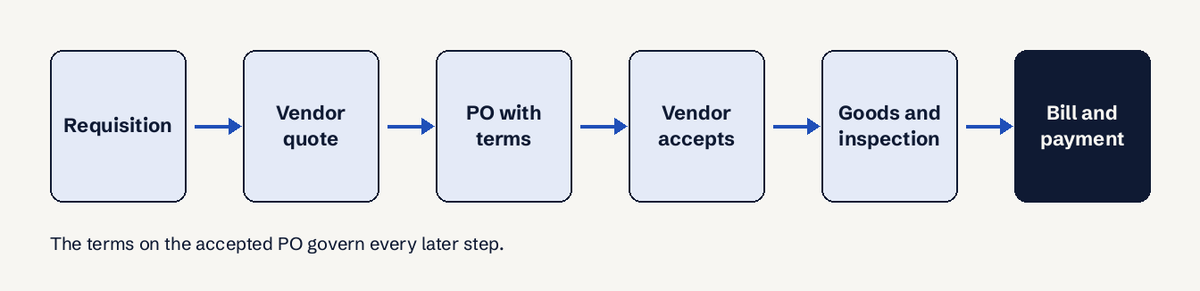
Replace the text in square brackets. Number the clauses on your PO so a later email can refer to "clause 7".
1. Acceptance: whose terms apply?
This Purchase Order (PO) is an offer by [Buyer] to buy the goods or services described in it. The Vendor accepts this PO by signing and returning it, by written confirmation, or by starting delivery or work. Acceptance is limited to these terms. Any additional or different terms in the Vendor's quotation, acknowledgement or invoice are rejected unless [Buyer] agrees to them in writing. If documents conflict, this order applies: (a) the PO face (items, prices, dates), (b) these terms, (c) any specification attached, (d) the Vendor's quotation.
When to use: always. In the US, UCC 2-207 lets a vendor's acknowledgement add terms between merchants unless the offer "expressly limits acceptance to the terms of the offer" (UCC 2-207). This clause is that express limit.
2. Delivery: where, when and on which Incoterm?
The Vendor shall deliver the goods to [delivery address] on or before [date], [Incoterm 2020 and named place, for example "DAP Bhiwandi warehouse"]. Each delivery must carry a delivery note quoting the PO number, line numbers and quantities. Partial deliveries need [Buyer]'s written approval.
When to use: every goods PO. For cross-border or freight-heavy orders, name an Incoterms 2020 rule; the ICC says the rules clarify "the tasks, costs and risks" from seller to buyer (ICC Incoterms rules).
3. Late delivery: what can the buyer deduct?
Time of delivery is of the essence. If the Vendor expects to miss the delivery date, it shall tell [Buyer] in writing at once, with the reason and a new date. For each week of delay, [Buyer] may deduct [0.5]% of the value of the delayed goods, up to [5]% in total, as liquidated damages, or may cancel the undelivered part of this PO without liability.
When to use: when a late delivery costs you money (production lines, events, projects). Keep the rate a genuine estimate of loss. In India, Section 74 of the Indian Contract Act, 1872 lets a court award reasonable compensation not exceeding the named sum, so an inflated figure will not be enforced in full.
4. Inspection: how long to check the goods?
All goods are subject to inspection by [Buyer] within [10] working days of receipt, despite any earlier payment. [Buyer] may reject goods that do not match the PO, the specification or the sample. Rejected goods will be held at the Vendor's risk and returned at the Vendor's cost; the Vendor shall repair, replace or refund, at [Buyer]'s choice, within [7] days.
When to use: always for goods. Under US law the buyer already has a right to inspect before payment or acceptance, and inspection costs can be recovered from the seller if goods are rejected (UCC 2-513); writing a window makes the timing clear. US federal buyers use the same pattern: repair or replacement "at no increase in contract price" (FAR 52.212-4(a)).
5. Warranty: what does the vendor promise?
The Vendor warrants for [12] months from acceptance that the goods are new, free from defects in material and workmanship, match the PO and specification, are fit for the purpose stated in this PO, and are packed and labelled as required. Services will be performed with due skill and care. These warranties are in addition to those implied by law.
When to use: always. In the US, a merchant seller already gives an implied warranty that goods are fit for ordinary purposes and adequately packaged and labelled, unless excluded (UCC 2-314); vendor terms often try to exclude it, which is why clause 1 matters.
6. Price and taxes: can the price change?
Prices are fixed as stated on this PO, in [currency], and include packing and [freight to the delivery address]. Taxes are shown separately on the Vendor's invoice as required by law [for India: GST with CGST and SGST, or IGST]. No surcharge, price increase or extra charge applies unless [Buyer] agrees in writing before delivery.
When to use: always. Name the currency even for domestic POs if you buy from abroad sometimes.
7. Payment: when is the invoice due?
The Vendor shall send one invoice per delivery, quoting the PO number. [Buyer] will pay correct, undisputed invoices [30] days after the later of receipt of the invoice and acceptance of the goods. [Buyer] may withhold the disputed part of an invoice and will pay the rest on time.
When to use: always. Check the limits where your vendor is. In India, if the vendor is a micro or small enterprise, the MSMED Act, 2006 caps the agreed period at 45 days from acceptance of the goods, and late payment carries compound interest at three times the RBI bank rate (MSME Samadhaan). In the UK, a supplier can claim statutory interest of 8% plus the Bank of England base rate unless the contract sets a different rate (GOV.UK). Our guide on net 30 payment terms covers the common terms.
8. Changes: how are orders amended?
[Buyer] may change quantities, delivery dates or the delivery address by written notice before dispatch. If a change affects cost or time, the Vendor shall say so within [5] days, and the parties will agree a fair adjustment in writing. No change binds [Buyer] unless made in writing by its authorised buyer.
When to use: always. FAR 52.212-4(c) says changes "may be made only by written agreement of the parties", a good default for any business.
9. Cancellation: when can the buyer cancel?
[Buyer] may cancel this PO in whole or in part (a) at any time before dispatch by written notice, paying only for work the Vendor shows was done specifically for this PO before the notice, up to the PO price, or (b) at once, without liability, if the Vendor breaches these terms and does not fix the breach within [10] days of notice, or becomes insolvent.
When to use: always. Without it, cancelling an accepted PO can be a breach of contract.
10. Force majeure: what excuses a delay?
Neither party is liable for delay caused by events beyond its reasonable control (for example natural disaster, war, government order or epidemic), provided it notifies the other party promptly in writing. If the delay lasts more than [30] days, either party may cancel the affected part of this PO without liability.
When to use: always. In the US, UCC 2-615 already excuses a seller's delay caused by such events only if the seller notifies the buyer "seasonably" (UCC 2-615); the 30-day exit protects you.
11. Liability: who pays for claims?
The Vendor shall indemnify [Buyer] against third-party claims arising from defective goods, the Vendor's negligence, or infringement of intellectual property by the goods. Each party's total liability under this PO is limited to [the PO value], except for indemnities, fraud, and death or personal injury caused by negligence. The Vendor shall keep [Buyer]'s drawings, prices and specifications confidential.
When to use: scale it to the risk. A stationery PO can skip most of this; machinery, food or custom parts should not.
12. Governing law: which court decides?
This PO is governed by the laws of [country / state], and the courts of [city] have exclusive jurisdiction. [Optional: disputes not settled within 30 days will be referred to arbitration under [rules] seated in [city].] [For international goods: the UN Convention on Contracts for the International Sale of Goods (CISG) [applies / is excluded].]
When to use: always. For cross-border purchases, say whether the CISG applies; it has been in force since 1 January 1988 (UNCITRAL).
Are PO terms binding, and whose terms win?
A PO binds once the vendor accepts it; shipping can count as acceptance (UCC 2-206). When the vendor's acknowledgement adds its own terms, the "battle of the forms" starts: if neither form wins but both sides perform, the contract is what both writings agree on plus default rules.
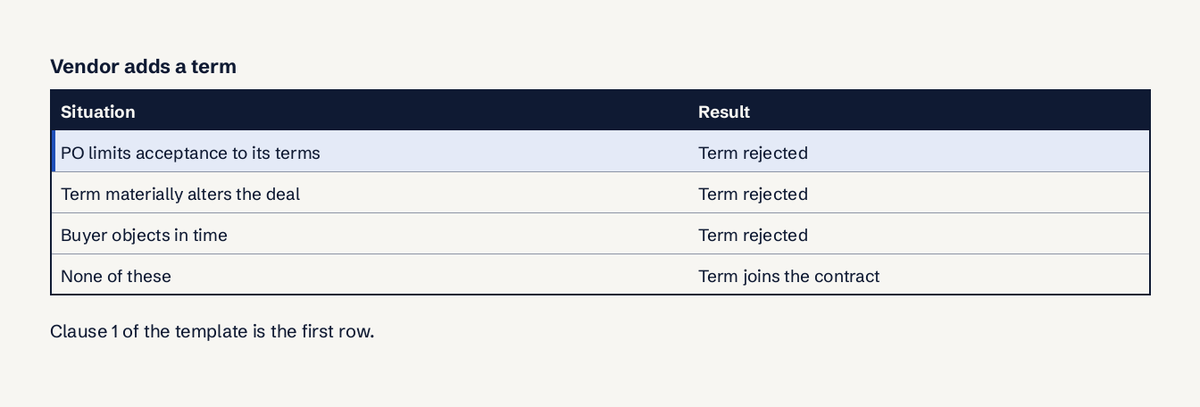
Ask vendors to sign and return your PO rather than send their own form, and reply in writing when an acknowledgement adds terms you do not accept.
What payment terms are common on a PO?
Net 30 (payment 30 days from invoice) is the most common business default. Others: Net 15, Net 45, Net 60, 2/10 Net 30 (2% discount if paid within 10 days, otherwise 30), advance payment for custom goods, and part payment on order with the balance on delivery. Check the legal caps in clause 7 before you choose: 45 days for Indian micro and small vendors, and statutory late-payment interest in the UK.
Free resources to check your PO terms against
Laws and official texts:
- UCC 2-207, additional terms in acceptance: the US battle-of-the-forms rule behind clause 1.
- UCC 2-206, offer and acceptance: when shipping counts as accepting a PO.
- UCC 2-513, buyer's right to inspect: default inspection rights for clause 4.
- UCC 2-314, implied warranty of merchantability: the warranty your clause 5 builds on.
- UCC 2-609, adequate assurance: what to do when a vendor looks unable to deliver; no answer within 30 days counts as repudiation.
- FAR 52.212-4, commercial terms: the US government's own standard terms, a well-tested model for inspection, changes and termination.
- MSME Samadhaan: the Indian portal where micro and small vendors file delayed-payment cases; read it to see the buyer's exposure.
- GOV.UK late payment interest: UK statutory interest, with a worked example.
- ICC Incoterms rules: the official source for delivery terms in clause 2.
- UNCITRAL CISG page: the treaty that may govern your cross-border purchases unless excluded.
Our free pages:
- Purchase order format with GST: make the PO itself, with a free PDF.
- PO approval workflow: who signs off before a PO goes out.
- Blanket purchase order: the extra terms a standing order needs.
- Purchase requisition: the internal request that comes before the PO.
Start here: make your PO in the free format, paste clauses 1, 2, 4, 6, 7 and 9 into its notes or attach all 12 as a sheet, and have a lawyer check them once.
Make your purchase order now
Open the free purchase order format, fill in the vendor and items, add your terms, and download the PDF. Sign in when you want it numbered in the PO series, routed for approval and converted into a bill when the vendor invoices.
Questions
What terms and conditions go on a purchase order?
Six groups: formation, delivery, quality, money, change and liability. Small routine orders can use clauses 1, 2, 4, 6, 7 and 9 only.
Are purchase order terms legally binding?
Yes, after acceptance. Terms on the reverse bind only when the face of the PO points to them and the vendor saw them first.
What payment terms are common on a PO?
Net 30, Net 15, Net 45, Net 60 and 2/10 Net 30. Indian micro and small vendors: 45 days at most.
How do PO terms interact with the supplier's own terms?
Your clause 1 rejects them in advance; without it, a vendor's extra terms can become part of the deal in the US.
Should terms and conditions be on the front or the back of a PO?
Key commercial terms (date, Incoterm, payment) on the front; standard clauses on the back or an attached sheet that the front refers to.
Can I make a purchase order with terms for free?
Yes. LuckPanda's free purchase order format has a payment terms field and downloads a branded PDF without an account.