 luckpanda
Voiceflow Pricing: Plans, Credits and What You Pay
Voiceflow pricing is a plan fee plus credits: $0.005 per chat message, plus LLM tokens. Plans, credit rates and a worked monthly bill.
On this page
- Voiceflow pricing at a glance
- How LuckPanda Chatbot prices the same job
- What do Voiceflow add-ons cost you?
- Is Voiceflow free?
- What are Voiceflow credits?
- LLM token rates (per 1K tokens, self-serve)
- Voice rates
- A worked monthly bill for a small website
- Which Voiceflow plan do you need to publish?
- How to check the current Voiceflow price yourself
- When Voiceflow is worth it, and when it is not
- Try it on your own website
TL;DR: Voiceflow pricing has three parts: a plan fee (Free, Pro, Business or Enterprise), optional add-ons, and credits that every chat message and AI reply use up. Voiceflow no longer prints plan prices on its pricing page; the public numbers are the credit rates, such as $0.005 per chat message plus the model's token cost. If you want a sales chatbot for a website at a fixed price, LuckPanda Chatbot costs $4.99 a month for up to 10 websites, plus prepaid AI tokens.
Try LuckPanda Chatbot free with your website address, no account needed.
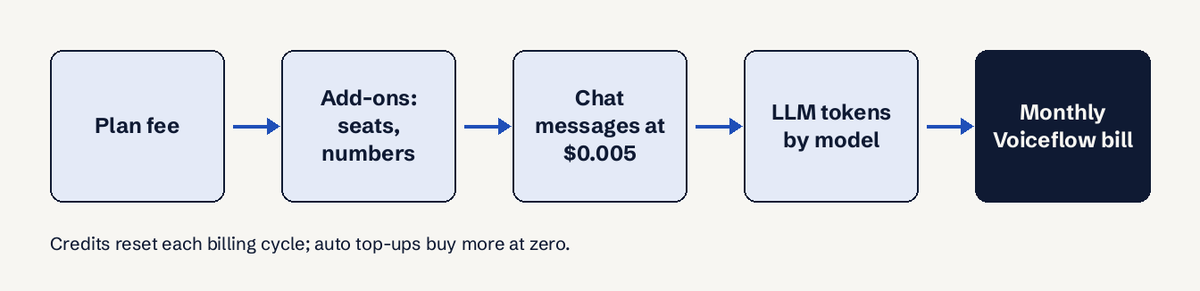
How much does Voiceflow cost? As of 15 November 2026, voiceflow.com/pricing shows no dollar amounts. It offers a free trial with usage-based billing for agencies and partners, and "Request pricing" with a demo for businesses. Voiceflow's billing docs say your bill is a monthly plan fee plus add-ons (editor seats, phone numbers) plus credit usage, and that current plan, add-on and credit bundle prices are shown inside the app under Plans and Billing (Voiceflow billing overview). The usage side is public: each user message costs $0.005, each phone minute $0.05, and the LLM is charged per 1,000 tokens at the rates in the credits pricing table (last updated 4 May 2026).
Voiceflow pricing at a glance
| Part of the bill | What it is | Public price (read 15 Nov 2026) |
|---|---|---|
| Free plan | Trying Voiceflow, one-time credit grant that does not renew | $0, not for production |
| Pro plan | Individual builders, all LLM models, higher agent limit | Shown in app only |
| Business plan | Growing teams, LLM fallback models, priority support | Shown in app only |
| Enterprise plan | SSO, private cloud, custom credits, unlimited product usage | Contract, via sales |
| Chat usage | Each user message or Conversations API request | $0.005 |
| Phone usage | Each minute of a call | $0.05 |
| LLM tokens | Per 1K input and output tokens, by model | From $0.000063 per 1K |
| Add-ons | Extra editor seats, phone numbers, concurrent calls | Shown in app only |
How LuckPanda Chatbot prices the same job
LuckPanda Chatbot is an AI chatbot for your website that turns visitors into customers. Its price is on the page, not behind a demo:
- Plan: $4.99 a month or $44.91 a year, tax included, for up to 10 websites. A business in India pays ₹199 a month or ₹1,791 a year (LuckPanda Chatbot pricing).
- AI replies: 10,000 free tokens once per business, then one-time credit packs that never expire, starting at $10 for 2M tokens. No per-message fee.
- Free to try: paste your website address and a preview bot reads up to 30 pages and answers up to 20 questions, kept for 7 days, no account.
- After you keep it: up to 50 pages per website, plus PDF, DOCX, TXT, MD and CSV documents of up to 5 MB each.
- Built for sales: it answers only from your pages and documents, asks two or three qualifying questions, suggests one next step and saves the lead to LuckPanda CRM.
What it does not do, so you can compare honestly: no voice or phone agents, no SMS, no WhatsApp inbox and no platform plugins. If you need a phone agent or a multi-channel enterprise build, Voiceflow does things LuckPanda does not.
What do Voiceflow add-ons cost you?
Add-ons are billed monthly with the plan and priced in the app. Three rules from the billing docs decide whether you need them:
- Editor seats: every paid plan includes some free editor seats; extra editors are an add-on. Viewers are free and unlimited on all plans.
- Phone numbers: 1 Voiceflow phone number per workspace is included; more numbers are an add-on.
- Concurrent calls: each plan caps simultaneous calls, raised with the concurrent calls add-on. The cap does not apply to chat or API sessions, so a website-only chatbot never needs it.
Is Voiceflow free?
Yes, there is a Free plan, but it is for testing. Voiceflow's docs say the Free plan "has limited features and a one-time credit grant that does not renew, so it isn't suitable for production usage." Once the grant is spent, you need a paid plan or credits to keep the agent answering. The agency track on the pricing page also offers a free trial with no credit card.
What are Voiceflow credits?
Credits are how Voiceflow charges for usage. Every user message, LLM call and phone minute uses credits. On self-serve plans the table lists them in dollars:
- Chat usage: $0.005 per user message or Conversations API request (launch events excluded)
- No-reply messages: $0, though a generative no-reply still uses LLM tokens
- Phone usage: $0.05 per minute, plus speech-to-text and text-to-speech
Paid plans include a monthly credit allotment that resets each billing cycle and is shared across all workspaces in the organization. When credits run out you can upgrade the bundle or turn on auto top-ups, which buy a dollar amount you choose each time the balance hits zero (managing your subscription).
LLM token rates (per 1K tokens, self-serve)
| Model | Input | Output |
|---|---|---|
| voiceflow-flash-4.2 | $0.0003 | $0.001 |
| gpt-5-mini | $0.000313 | $0.0025 |
| gpt-4.1-mini | $0.0005 | $0.002 |
| gemini-2.5-flash | $0.000375 | $0.003125 |
| claude-haiku-4-5 | $0.00125 | $0.00625 |
| claude-sonnet-5 | $0.0025 | $0.0125 |
Some OpenAI models also have a higher "priority" rate. The full table, including Groq, xAI and older models, is on the credits pricing table.
Voice rates
Voice agents add speech costs on top of the $0.05 phone minute. Examples from the same table: Deepgram speech-to-text at $0.005 to $0.007125 per minute, ElevenLabs text-to-speech at $0.045 to $0.09 per 1,000 characters, Amazon text-to-speech at $0.005 per 1,000 characters.
A worked monthly bill for a small website
Here is the usage part of a Voiceflow bill for a small business site, using the public rates above. Assume 1,000 chats a month, five visitor messages each, and roughly 2,000 input tokens and 200 output tokens per AI reply (instructions, knowledge base context and history).
| Line | Calculation | gpt-4.1-mini | claude-sonnet-5 |
|---|---|---|---|
| Chat messages | 5,000 x $0.005 | $25.00 | $25.00 |
| Input tokens | 5,000 x 2K tokens | $5.00 | $25.00 |
| Output tokens | 5,000 x 0.2K tokens | $2.00 | $12.50 |
| Usage total | before plan fee | $32.00 | $62.50 |
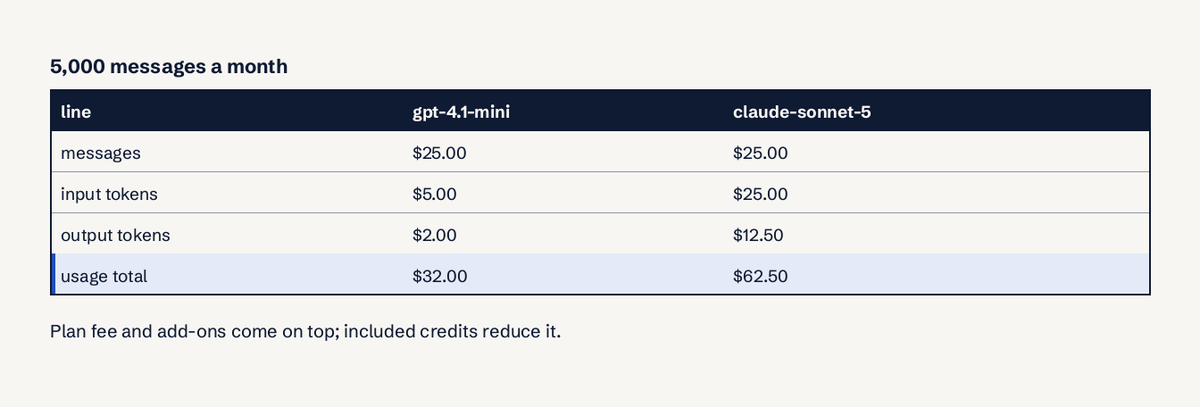
Two things follow. First, the $0.005 message fee is the biggest line on a cheap model, so a chatty bot costs more than a short one. Second, the plan fee and its included credits decide the final number, and you only see those inside the app. Your real token counts depend on prompt length and knowledge base chunks, so treat the numbers above as an estimate, not a quote.
Which Voiceflow plan do you need to publish?
You can build and test on Free, but Voiceflow itself says Free is not suitable for production because its credits do not renew. For a live agent you need at least Pro (one builder) or Business (a team that wants fallback models and priority support). Enterprise is for SSO, private cloud hosting and custom credit allotments, and is billed by contract through an account manager.
How to check the current Voiceflow price yourself
- Sign up for the free trial at voiceflow.com.
- Open Plans and Billing from the workspace sidebar, then Plans for the side-by-side comparison.
- Open Billing, click Manage, then Edit credit bundle to see bundle sizes.
- Check the Add-ons tab for editor seat and phone number prices.
Cancelling keeps paid features until the end of the billing period, then the account drops to the free tier. Refunds, tax exemptions and custom invoices go through support@voiceflow.com.
When Voiceflow is worth it, and when it is not
Voiceflow is strong when you need a designed agent: voice and phone calls, workflows mixing scripted steps with LLM playbooks, a choice of models, integrations with Zendesk, Salesforce, HubSpot and Shopify, and staging environments. Agencies get multi-client workspaces and white-labeling.
It is more than a small business needs when the job is "answer visitors on my website and catch leads". For that, a priced-on-the-page tool is simpler. LuckPanda Chatbot builds the bot from your website address, replies in the language the visitor writes in, hands chats to a person when needed and groups what visitors asked for that you do not offer on a Requests board. Compare it with others on LuckPanda Chatbot alternatives, see LuckPanda vs Chatbase, or read chatbot vs live chat.
Try it on your own website
Paste your website address and the preview chat opens after about five pages are read or 30 seconds, free and without an account. Start with LuckPanda Chatbot.
Questions
How much does Voiceflow cost per month?
Voiceflow does not publish plan prices on its pricing page as of November 2026; they are shown in the app under Plans and Billing or quoted by sales. On top of the plan, usage costs $0.005 per chat message plus LLM tokens at the model's rate.
Is Voiceflow free?
There is a Free plan with a one-time credit grant that does not renew. Voiceflow says it is for trying the product and not suitable for production.
What are Voiceflow credits?
Credits are Voiceflow's usage currency. A user message costs $0.005, a phone minute $0.05, and LLM calls are charged per 1,000 input and output tokens by model. Paid plans include monthly credits that reset each billing cycle.
What happens when Voiceflow credits run out?
You can upgrade your plan or credit bundle, or turn on auto top-ups, which buy a dollar amount you choose whenever the balance hits zero.
Which Voiceflow plan do you need to publish an agent?
A paid plan in practice: Pro for one builder, Business for teams, Enterprise for SSO and private hosting. Free credits do not renew.
Is there a cheaper alternative to Voiceflow for a website chatbot?
For a website sales and support chatbot, LuckPanda Chatbot costs $4.99 a month for up to 10 websites plus prepaid tokens, with no per-message fee. It does not do voice or phone.