 luckpanda
Best AI Chatbot for Small Business: 8 Tools Compared on Real Monthly Cost
The best AI chatbot for a small business is the one you can test on your own site and afford at 100 chats a month. 8 tools priced at real volume.
On this page
- How we judged these chatbots
- Best AI chatbots for small business: summary table
- 1. Tidio: best for live chat and AI in one inbox
- 2. Chatbase: best for teams with a helpdesk
- 3. Crisp: best flat price for a small team
- 4. Kommunicate: best free trial and channels
- 5. Chatling: best free AI plan
- 6. tawk.to: best free live chat
- 7. LuckPanda Chatbot: best for qualifying buyers
- 8. Intercom Fin: best for SaaS already on Intercom
- How much does a chatbot cost a small business per month?
- Is there a free chatbot for a small business website?
- What should a small business chatbot do?
- Do small businesses need live chat as well as a chatbot?
- How to choose the right chatbot for your business
TL;DR: For most small businesses the shortlist is Tidio (live chat and AI in one inbox), Chatbase (an AI agent trained on your documents), Crisp (flat price per workspace), Kommunicate (longest free trial), Chatling (best free AI plan) and tawk.to (free live chat). At 100 AI conversations per month, the same workload costs anywhere from about $25 to $128 depending on the tool, so price the month you expect, not the entry plan.
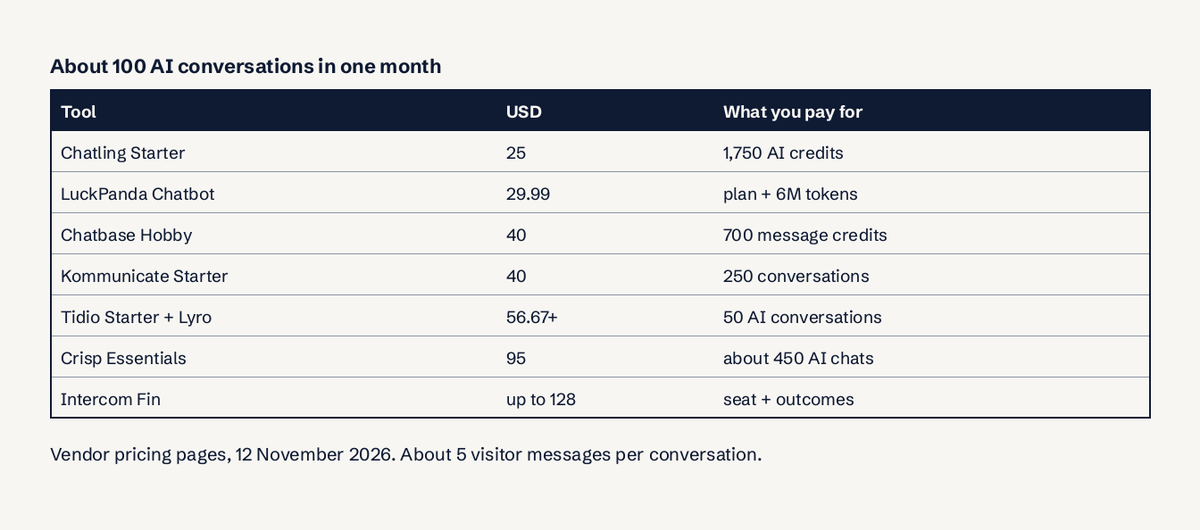
The best AI chatbot for a small business is one that answers visitors from your own website and documents, hands a chat to a person when it cannot help, and costs what you can carry at your real chat volume. On 12 November 2026, a business with about 100 AI conversations per month pays $25 on Chatling Starter, about $30 on LuckPanda Chatbot, $40 on Chatbase Hobby or Kommunicate Starter, $95 on Crisp Essentials and up to $128 on Intercom with Fin. Tidio suits online stores that want live chat and AI together, Chatbase suits teams with a helpdesk already, and tawk.to suits owners who will answer chats themselves for free. Every price below comes from the vendor's own pricing page, checked on that date.
How we judged these chatbots
We ranked tools on four things a small business actually feels, using only each vendor's own pricing and documentation pages:
- Cost at real volume. One month of 100 AI conversations on one website with one person, billed monthly where per monthly price exists. We assume about 5 visitor turns per conversation, so roughly 500 replies.
- Free test on your own site. A free plan, a trial or a preview you can load with your real pages before paying.
- Handoff to a person. A live takeover inside the same chat, or a ticket someone works later.
- Fit for a small team. People included in the price, how many bots or domains you get, and the extras owners usually end up buying.
We did not use review-site star ratings, because they mix company sizes and we cannot check them. The order below is not a score: it runs from all-in-one tools to specialised ones, and each one wins for a different kind of business.
Best AI chatbots for small business: summary table
| Tool | Best for | Free way to try it | Cost at about 100 AI conversations per month | Handoff to a person |
|---|---|---|---|---|
| Tidio | Online stores wanting live chat and AI in one inbox | 7-day trial | From $56.67 billed annually (covers 50 AI conversations) | Live chat in the same platform |
| Chatbase | AI trained on documents, teams with a helpdesk | 7-day trial | $40 (Hobby, 700 message credits) | Ticket, or Chatbase live chat |
| Crisp | Teams of 4 to 10 who want a flat price | Free plan (no AI), 14-day trial | $95 (Essentials; Mini covers about 90) | Shared inbox, seats included |
| Kommunicate | Long trial, WhatsApp and Instagram too | 30-day trial, no card | $40 (Starter, 250 conversations) | Built-in human handoff |
| Chatling | Starting on a free AI plan | Free plan, 200 AI credits per month | $25 (Starter, 1,750 credits) | Team seats on paid plans |
| tawk.to | Answering chats yourself, free | Free for life | AI Assist from $29 (volume not stated) | Free live chat, or hired agents at $1 an hour |
| LuckPanda Chatbot | Sales-first bot across several websites | No-account preview from your URL | About $29.99 ($4.99 plan plus a $25 token pack) | Take over the chat, bot stays quiet |
| Intercom (Fin) | SaaS teams already on Intercom | Trial | Up to $128 ($29 seat plus $0.99 per outcome) | Live chat on all plans |
Prices are each vendor's pricing page on 12 November 2026 (Intercom and Tidio's Lyro add-on checked 11 November 2026). They change often.
1. Tidio: best for live chat and AI in one inbox
Tidio is a live chat and help desk tool with an AI agent called Lyro, sold together so AI and human conversations sit in one inbox. Its pricing page describes the plan as a way to "combine AI and human conversations on the Tidio Platform".
- Best for: online stores and service businesses that want a person to answer some chats and AI to answer the rest.
- Pricing: Starter is $24.17 per month billed annually with 100 billable conversations and 50 Lyro AI conversations one-off (not monthly). Growth starts at $49.17 per month with 250 billable conversations. Recurring AI needs the Lyro AI Agent add-on, from $32.50 per month for 50 Lyro conversations (Tidio pricing).
- Cost at 100 AI conversations: at least $56.67 per month billed annually, and that covers 50 AI conversations; 100 needs a larger Lyro tier from the slider on the page.
- Limits to know: Tidio meters two things, billable conversations for your team and Lyro conversations for AI. Count both before you choose a tier.
- Verified detail: the free trial of 7 days applies to Starter and Growth.
2. Chatbase: best for teams with a helpdesk
Chatbase builds an AI agent from your website, files and text, and charges in message credits.
- Best for: businesses that want an AI agent grounded in documents and already use a helpdesk such as Zendesk, Freshdesk, HubSpot or Help Scout.
- Pricing: Hobby is $40 per month ($32 billed yearly) with 700 message credits per month and 2 workspace seats. Standard is $150 ($120 yearly) with 4,000 credits. Extra credits cost $40 per 1,000, an extra AI agent $25 per month, and removing the Chatbase branding $99 per month (Chatbase pricing).
- Cost at 100 AI conversations: $40 on Hobby, since about 500 messages fit inside 700 credits. If you want the widget without Chatbase branding, the same month is $139.
- Handoff: the Escalations Action creates a ticket in Chatbase Helpdesk or a connected platform with the conversation attached. Chatbase's escalation docs say to use its live chat instead if you want a person in real time.
- Verified detail: 7-day trial on paid plans.
3. Crisp: best flat price for a small team
Crisp is a shared inbox with live chat and an AI chatbot, priced as a flat rate per workspace instead of per seat.
- Best for: small teams of 4 to 10 people who all answer chats and want one predictable bill.
- Pricing: Free has 2 seats and no AI credits. Mini is $45 per month with 4 seats and $5 of AI credits, which Crisp puts at around 90 automated conversations. Essentials is $95 with 10 seats and around 450 automated conversations. Plus is $295 with around 1,350 (Crisp pricing).
- Cost at 100 AI conversations: Mini stops at about 90, so 100 per month means Essentials at $95.
- Handoff: people and AI work the same shared inbox; seats are included rather than charged one by one.
- Verified detail: any paid plan can be tried free for 14 days.
4. Kommunicate: best free trial and channels
Kommunicate is an AI agent and live chat platform with channels beyond the website on its entry plan.
- Best for: businesses that want a long trial and plan to answer on WhatsApp, Telegram or Instagram as well as the website.
- Pricing: Starter is $40 per month billed monthly ($34 billed yearly) with 1 AI agent, 1 team member, 250 conversations per month (about 10,000 messages) and channels for web, mobile apps, WhatsApp, Telegram and Instagram. Extra AI agents and team members are $20 per month each; extra conversations are $15 per 1,000. Professional is $200 ($167 yearly) with 2,000 conversations (Kommunicate pricing).
- Cost at 100 AI conversations: $40, well inside the 250 included.
- Limits to know: removing Kommunicate branding is listed only on Enterprise.
- Verified detail: every plan has a free trial of 30 days with no credit card required, the longest on this list.
5. Chatling: best free AI plan
Chatling is an AI chatbot builder with a permanent free tier, so you can start at $0 and upgrade only when traffic grows.
- Best for: an owner who wants to test AI answers on a live site for months before spending anything.
- Pricing: Free costs $0 with 200 AI credits per month, 1 AI agent and 1 seat. Starter is $25 per month, or $21 per month billed $250 annually, with 1,750 AI credits (Chatling pricing).
- Cost at 100 AI conversations: $25 per month, provided 1,750 credits stretch over roughly 500 replies on the model you pick.
- Limits to know: Chatling says usage varies by model, and its flagship options (OpenAI, Anthropic, Google, Mistral and others) are on paid tiers. A logo-free widget is sold separately.
- Verified detail: Starter adds 4 actions and 5 workflows per AI agent, plus voice input and analytics on peak chat times and top countries.
6. tawk.to: best free live chat
tawk.to is free live chat software that makes its money from optional add-ons.
- Best for: an owner who is happy to answer chats in person and wants to pay nothing for the software.
- Pricing: live chat is free for life. Removing the "Powered by tawk.to" badge is $29 per month. AI Assist, its AI chatbot that answers from your Knowledge Base and Shortcut FAQs, starts "from as little as $29/month". Trained chat agents who answer for you cost $1 an hour (tawk.to pricing).
- Cost at 100 AI conversations: from $29 for AI Assist; the pricing page does not state how many conversations that covers.
- Handoff: you are the handoff. Live chat is the core product, so a person can take any conversation.
- Verified detail: the page works out that one agent covering 24/7 at $15 an hour costs $131,400 a year, against $8,736 for its hired agents.
7. LuckPanda Chatbot: best for qualifying buyers
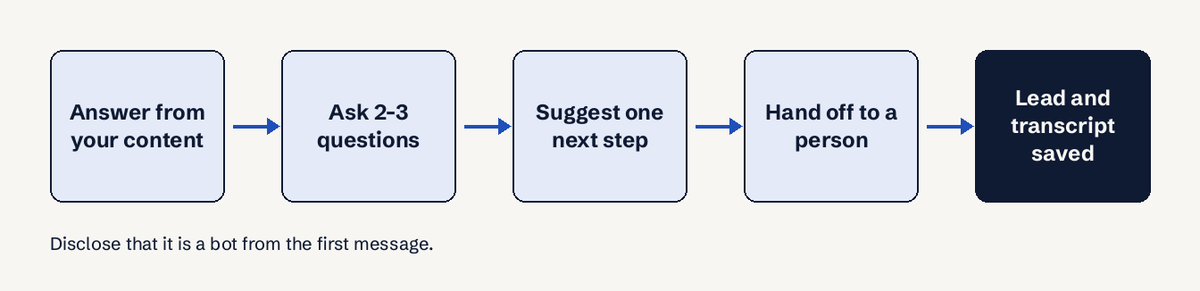
LuckPanda Chatbot is a website chatbot built to turn visitors into customers: it answers from your own pages and documents, asks at most two or three short questions, suggests one next step and hands you the lead with a summary of the need.
- Best for: a small business that wants the bot to sell first and support second, or one owner running several websites on one plan.
- Pricing: setting up and testing are free. Putting it on a website needs the Chatbot plan, $4.99 per month or $44.91 a year, tax included, for up to 10 websites with no per-seat charge (₹199 per month in India). AI replies use tokens: 10,000 free once, then one-time packs that never expire, from $10 for 2M tokens (about 30 conversations) to $25 for 6M tokens (about 100) (Chatbot pricing).
- Cost at 100 AI conversations: about $29.99 in per month you buy the $25 pack. Short chats use fewer tokens, and replies your team writes use none.
- Handoff: chats that need a person are flagged as waiting; you take over, reply as your business, and the bot stays quiet until you hand back.
- Limits to know: no platform plugins yet; you install it with one line of script on any site that allows one (WordPress, Shopify, Wix, Webflow). It answers only from what you give it and does not browse the web.
- Verified detail: questions visitors ask for things you do not offer are grouped on a Requests board, ranked by how many people asked.
You can paste your website address into LuckPanda Chatbot and see it answer from your own pages without an account: the preview reads up to 30 pages and answers up to 20 questions.
8. Intercom Fin: best for SaaS already on Intercom
Intercom is a customer service platform whose AI agent, Fin, is billed per resolved conversation on top of helpdesk seats.
- Best for: software and SaaS businesses that already run support in Intercom.
- Pricing: Fin costs $0.99 per Fin outcome. Seats on the Essential plan are $29 per month, or $19 billed annually. All plans include live chat (Intercom pricing).
- Cost at 100 AI conversations: up to $128 per month for one seat if every conversation is a Fin outcome; you pay less when Fin hands more chats to a person.
- Limits to know: the per-outcome price scales with success, so a good month costs more, which is hard to budget on a small business's fixed costs.
- Verified detail: Fin is billed per outcome rather than per message or credit, and live chat comes with every plan.
How much does a chatbot cost a small business per month?
A small business pays $0 to about $130 per month for an AI chatbot at 100 conversations per month, and most land between $25 and $60. The entry price is the smaller part of the bill: what decides it is the unit each vendor meters.
| Unit the vendor meters | Tools | What to count before you buy |
|---|---|---|
| Message credits | Chatbase, Chatling | Visitor messages per conversation, and which AI model you pick |
| Conversations | Tidio, Kommunicate, Crisp | Conversations per month, and whether AI and human chats are counted apart |
| Outcomes | Intercom Fin | Conversations the AI resolves without a person |
| Tokens | LuckPanda Chatbot | Length of chats; packs are one-time, not monthly |
Add the costs that sit outside the plan: branding removal ($99 per month on Chatbase, $29 on tawk.to, an add-on on Chatling), extra seats ($20 per month on Kommunicate) and extra bots. For a full list of entry prices and free plans, see our cheapest AI chatbot price list.
Is there a free chatbot for a small business website?
Yes, three tools on this list have plans that stay free. Chatling Free includes 200 AI credits per month for one AI agent. Crisp Free covers 2 seats of live chat but no AI credits. tawk.to's live chat is free for life with a small "Powered by tawk.to" badge. Kommunicate (30 days), Crisp (14 days), Tidio and Chatbase (7 days each) offer trials instead. A free plan is enough to learn whether visitors actually use chat on your site; it is rarely enough to run AI replies all month.
What should a small business chatbot do?
A small business chatbot should do four jobs, in this order:
- Answer from your own content. Pages, price lists, policies and FAQs, and say "I don't know" when the answer is not there rather than guess.
- Qualify and suggest a next step. Two or three short questions (what they need, when, how big), then one action: book a call, request a quote, or buy.
- Hand off to a person. In the same chat when someone is available, or as a ticket or email alert when not. Our guide to chatbot human handoff covers the triggers.
- Keep the transcript. Every chat, word for word, is the cheapest customer research a small business can get: the questions people ask before buying are the gaps on your website.
It should also say it is a bot. The EU AI Act's Article 50 requires AI systems that talk to people to tell them so unless it is obvious, from 2 August 2026, and California's SB 1001 has made it unlawful since 1 July 2019 to use a bot that hides its artificial identity to push a sale.
Do small businesses need live chat as well as a chatbot?
Most small businesses need both, but not staffed all day. A chatbot covers the hours you are closed and the repeat questions; live chat is how a person steps in for a big order, a complaint or anything the bot cannot answer. The practical setup is a bot that answers by default and alerts you when a chat needs a person, so one owner can cover the site without watching it. We compare the two in detail in chatbot vs live chat, and our live chat best practices cover reply times when a person takes over.
How to choose the right chatbot for your business
Pick by the job and the month you expect, not by the longest feature list:
- You sell online and want people and AI in one inbox: Tidio or Crisp.
- You already use Zendesk, Freshdesk, HubSpot or Help Scout: Chatbase, whose escalations create tickets there.
- You need WhatsApp, Telegram or Instagram as well as the website: Kommunicate.
- You want to start free and grow into AI: Chatling, or tawk.to if you will answer chats yourself.
- You want the bot to qualify buyers and run several websites on one small plan: LuckPanda Chatbot.
- You are a SaaS business already on Intercom: Fin.
Before you pay, run the same test on every shortlisted tool: load your real pages, ask ten questions your customers actually ask (including two the site does not answer), and check whether the bot admits it does not know and how fast a person gets the chat. Free tools such as our chatbot tools help you write the greeting and fallback replies for that test.
Questions
What is the best AI chatbot for a small business?
There is no single best one; it depends on the job. Tidio fits stores that want live chat and AI in one inbox, Chatbase fits businesses with a helpdesk, Kommunicate fits multi-channel teams, Chatling fits a free start, and tawk.to fits owners who answer chats themselves. Choose the tool whose price at your expected monthly chat volume you can carry.
How much does a chatbot cost a small business per month?
At about 100 AI conversations per month on one website, prices on 12 November 2026 ran from $25 (Chatling Starter) and about $30 (LuckPanda Chatbot) to $40 (Chatbase Hobby, Kommunicate Starter), $95 (Crisp Essentials) and up to $128 (Intercom with Fin). Add branding removal and extra seats if you need them.
Is there a free chatbot for a small business website?
Yes. Chatling has a free plan with 200 AI credits per month, Crisp has free live chat for 2 seats without AI, and tawk.to's live chat is free for life with its badge. Kommunicate offers a 30-day trial without a credit card.
Do I need a developer to add a chatbot to my website?
No. Every tool here installs by pasting a short script into your site or adding it through your site builder. You need access to your site's settings or theme to paste it.
Can a chatbot give wrong answers to my customers?
Yes, if it is allowed to guess. Choose a bot that answers only from the content you give it, test it with questions your site does not answer, and read the transcripts in the first weeks. A good bot says it does not know and offers a person.
Does a small business have to tell visitors they are talking to a bot?
In many places, yes. The EU AI Act's Article 50 requires disclosure from 2 August 2026 unless it is obvious, and California's SB 1001 bars bots that hide their identity to drive a sale. A short line in the greeting covers it.