 luckpanda
Freight Invoice Template: Every Field a Carrier or Trucking Company Needs
Field-by-field freight and trucking invoice reference: load and BOL numbers, linehaul, fuel surcharge, detention, attachments and FMCSA billing deadlines.
On this page
- Freight invoice fields: the reference table
- How LuckPanda handles a freight invoice
- What goes on a freight invoice?
- Which documents attach to a trucking invoice?
- How do I bill detention and accessorial charges?
- How do I calculate a fuel surcharge?
- What payment terms do freight brokers use?
- Freight vs trucking vs commercial invoice
- Free freight invoice templates compared
TL;DR: A freight invoice template needs the load number, the bill of lading (BOL) and rate confirmation numbers, the pickup and delivery points, and separate lines for linehaul, fuel surcharge and each accessorial such as detention or a lumper fee, with the signed documents attached. LuckPanda's free invoice generator builds that freight or trucking invoice online with no account and downloads a PDF. The table below is the field-by-field reference; the sections after it cover attachments, detention and payment terms.
Bill your next load now, free and without an account: open the LuckPanda trucking invoice template.
A freight invoice (also called a freight bill or trucking invoice) is the bill a carrier, owner-operator or logistics company sends the shipper or broker after a load is delivered. It must let the payer match every dollar to three documents they already have: the rate confirmation (what was agreed), the bill of lading (what was picked up) and the signed proof of delivery (what arrived). If the load number, rate and accessorials on your invoice match those three, the invoice gets paid without a phone call.
Freight invoice fields: the reference table
| Field | What to put | Example |
|---|---|---|
| Your business | Legal name, address, phone, email | Lone Star Haulage LLC, Dallas TX |
| MC and USDOT numbers | Your operating authority numbers | MC 123456, USDOT 7654321 |
| Bill to | Broker or shipper legal name and billing address | Summit Freight Brokerage Inc. |
| Invoice number and date | Unique number, issue date | INV-2026-0412, 2026-11-20 |
| Load or PRO number | The payer's load number from the rate confirmation | Load 77812 |
| BOL number | From the signed bill of lading | BOL 4410982 |
| Pickup | Shipper name, city, date | Acme Foods, Dallas TX, 2026-11-18 |
| Delivery | Consignee name, city, date | Peach Grocers DC, Atlanta GA, 2026-11-19 |
| Equipment and freight | Trailer type, pieces, weight, commodity | 53 ft dry van, 22 pallets, 38,000 lb, canned goods |
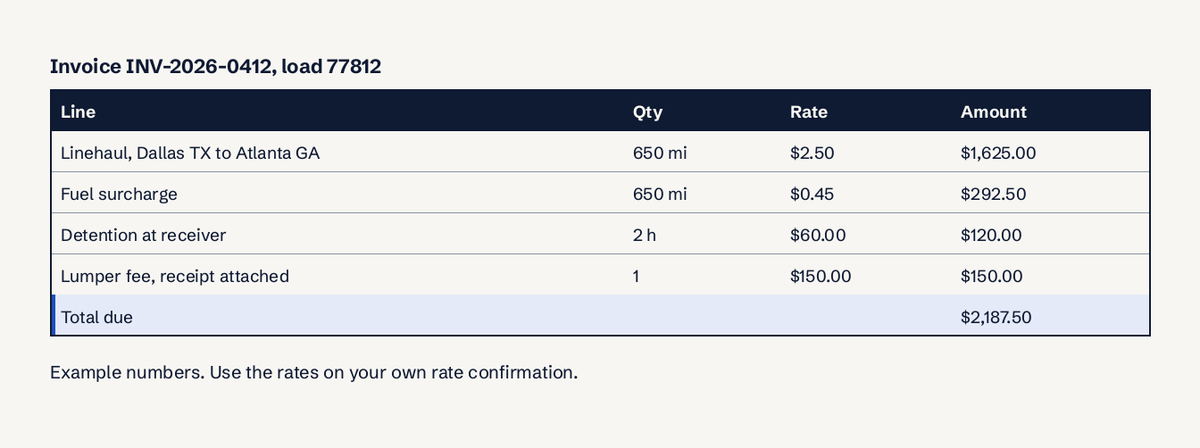
| Linehaul | Loaded miles x rate, or the flat rate | 650 mi x $2.50 = $1,625.00 |
| Fuel surcharge | Per mile or percent, as agreed | 650 mi x $0.45 = $292.50 |
| Accessorials | Detention, layover, lumper, stop-off, TONU, each on its own line | Detention 2 h x $60.00 = $120.00 |
| Total and balance due | Sum, less any advance | $2,187.50 |
| Terms and due date | Credit days and a calendar date | Net 15, due 2026-12-05 |
| Remit to | Bank details, or your factoring company if you factor | ACH details or factor's remit address |
| Attachments | Rate confirmation, signed BOL or POD, receipts | 3 files |
The load in this table uses example numbers: 650 loaded miles at $2.50 per mile ($1,625.00), a fuel surcharge of $0.45 per mile ($292.50), two billable hours of detention at $60.00 ($120.00) and a $150.00 lumper fee, for a total of $2,187.50.
How LuckPanda handles a freight invoice
LuckPanda is a business operating system for small businesses. Its Sales module covers quotes, invoices, receipts and payment links, so a carrier can quote a lane, invoice the load and record the payment against the same client. For freight billing specifically:
- A free trucking invoice template at luckpanda.app/templates/trucking-invoice-template, already laid out with linehaul per loaded mile, fuel surcharge, detention and a lumper line. Free to create, no account needed.
- Line items with quantity, price and tax so "650" loaded miles at "2.50" calculates itself, and each accessorial is its own line.
- A prefill link: the page accepts seller_name, buyer_name and one item parameter per line in the pattern description|quantity|price|tax. For the example load that is item=Linehaul load 77812|650|2.50|0, item=Fuel surcharge|650|0.45|0, item=Detention|2|60|0 and item=Lumper|1|150|0.
- AI assistant support: the page gives a prompt for ChatGPT, Claude, Gemini or Perplexity and a public MCP server at luckpanda.app/mcp/public, so an assistant can open the invoice filled in for you to check. The assistant drafts; you decide what is sent.
- Any currency, formatted by the document's country: a US load prints $2,187.50; a cross-border load can be billed in CAD or INR.
- Free branded PDF. Numbering, sending by email, share links, payment links and clean PDFs without LuckPanda branding need the Sales module: $4.99 a month (₹199 for a business in India), per module, not per user (pricing).
What it does not do: it is not a TMS or a load board. It does not import rate confirmations, track trucks, calculate mileage or submit invoices to a factoring company. You enter the miles and rates from your rate confirmation and attach the paperwork when you send.
What goes on a freight invoice?
A freight invoice must carry enough to identify the load and the price. In practice that is your business and authority numbers, the bill-to party, an invoice number and date, the load or PRO number, the BOL number, pickup and delivery points with dates, the freight description, each charge on its own line, the total, the payment terms with a due date and where to send payment.
The bill of lading sets the floor for the shipment details. Under 49 CFR 373.101, a for-hire motor carrier's bill of lading must show the consignor and consignee, origin and destination, the number of packages, a description of the freight, and its weight, volume or measurement if that is used to rate it (eCFR, 49 CFR 373.101). Copy those onto the invoice exactly as they appear on the BOL so the payer's matching check passes.
If you work with brokers, the BOL or freight bill number matters to them too: brokers must keep a record of each transaction that includes the bill of lading or freight bill number and the carrier's name, address and registration number, for three years (eCFR, 49 CFR 371.3).
Which documents attach to a trucking invoice?
Attach three documents to every trucking invoice, plus receipts for any reimbursed cost:
- Rate confirmation: the broker's signed agreement for the load, with the rate and agreed accessorials.
- Signed bill of lading or proof of delivery (POD): signed by the consignee, with any shortage or damage notes.
- Receipts: lumper receipt, scale ticket, toll or permit receipts for anything you bill back.
- Detention evidence, when you bill detention: in and out times, ideally signed on the BOL or shown by ELD or check-call records.
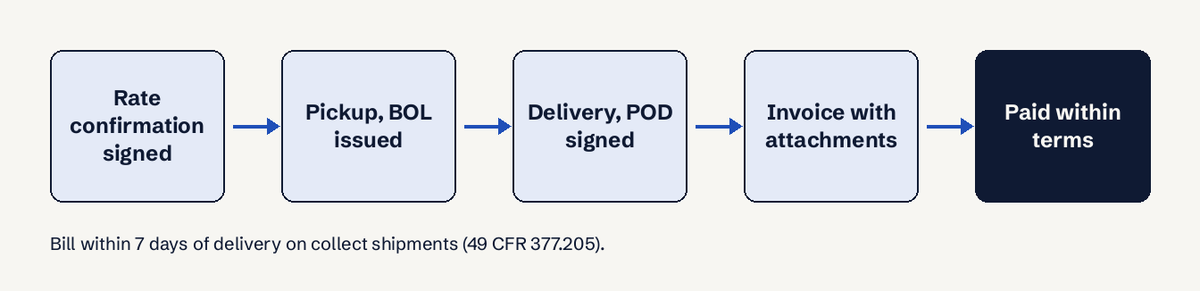
Most broker payment delays trace back to a missing or unreadable POD. Send one PDF that contains the invoice first, then the rate confirmation, then the signed BOL, then receipts, named with the load number.
Before you send, check for the mistakes that delay payment most often:
- Missing load number. The payer's system matches on it; without it the invoice sits in a queue.
- Rate different from the rate confirmation. Bill the confirmed rate; put extras on separate, approved lines.
- Unsigned or unreadable POD. Rescan before you send.
- Detention counted from arrival. Subtract the free time.
- No due date. "Net 15" with no date gets paid late more often than a printed date.
- Billing late. On collect shipments the rule is 7 days from delivery; the longer you wait, the longer you wait to be paid.
How do I bill detention and accessorial charges?
Bill each accessorial as its own line, with the quantity and rate that the rate confirmation allows, and attach the proof. Lumping them into the linehaul hides them from the payer's audit and is the usual reason they get short-paid.
| Accessorial | When it applies | Line looks like |
|---|---|---|
| Detention | Truck held past the free time at pickup or delivery | 2 h after 2 free hours x $60.00 |
| Layover | Load not ready, truck held overnight | 1 day x $250.00 |
| Lumper fee | Third-party unloading paid by the driver | 1 x $150.00, receipt attached |
| Stop-off | Extra pickup or drop on the load | 1 stop x $75.00 |
| TONU | Truck ordered, not used: load cancelled after dispatch | 1 x $150.00 |
| Driver assist | Driver loads or unloads | 1 x $100.00 |
The rates in this table are examples; use the amounts in your rate confirmation. If the confirmation does not mention an accessorial, get it approved in writing (an email from the broker with the load number) before you bill it, and attach that email.
Detention arithmetic is where invoices go wrong. Bill from the end of the free time, not from arrival: a truck that arrived at 08:00 with two free hours and left at 12:00 bills two hours, not four.
How do I calculate a fuel surcharge?
A fuel surcharge (FSC) is billed either per loaded mile or as a percentage of linehaul, using the method in your rate confirmation or your customer's fuel table. Most fuel tables key off the U.S. Energy Information Administration's weekly on-highway diesel price, which is released every week; the U.S. average was $5.695 per gallon for the week of November 23, 2026 (EIA).
Per mile: 650 loaded miles x $0.45 = $292.50. Percentage: 18% x $1,625.00 linehaul = $292.50.
Write the method on the line ("FSC, $0.45 per mile, EIA week of 2026-11-23") so the payer can check it against their table. If the rate confirmation gives an all-in rate that includes fuel, do not add an FSC line.
What payment terms do freight brokers use?
Broker and shipper terms are agreed per contract, but federal rules set defaults for for-hire, non-exempt motor carriers extending credit to shippers:
- Standard credit period: 15 days, starting the day after the freight bill is presented, weekends and holidays included (eCFR, 49 CFR 377.203).
- Maximum: 30 calendar days. A carrier can set a different credit period by tariff rule, but not longer than 30 days, including any extra credit period with a service charge.
- Bill within 7 days: on collect shipments, the freight bill is due within 7 days of delivery; on prepaid shipments, within 7 days of receiving the shipment, not counting weekends or holidays (eCFR, 49 CFR 377.205).
- State the terms on the bill: when credit is extended, the bill or a notice with it must state the payment deadline and any service charges, and that "failure timely to pay freight charges may be subject to tariff penalties" (or similar).
- Additional charges billed after the original bill was paid get 30 calendar days of credit (eCFR, 49 CFR 377.209).
In broker contracts, net 30 is common and many brokers offer quick pay for a fee. Whatever the terms, print a calendar due date on the invoice, not only "Net 15".
Freight vs trucking vs commercial invoice
These three get confused because they all travel with freight:
- A freight or trucking invoice bills for the transport service: miles, fuel, accessorials. This page covers it.
- A commercial invoice describes the goods themselves for customs on an international shipment: seller, buyer, HS codes, value, origin. See the commercial invoice template.
- A transport bill is the common name in India for a freight invoice from a transporter, usually with GST. See the transport bill format.
Free freight invoice templates compared
| Option | Format | Cost to create |
|---|---|---|
| LuckPanda trucking invoice template | Online, PDF | $0, no account |
| Wave freight templates | Word, Excel, PDF, Google Docs, Google Sheets | $0 |
| FreshBooks freight template | Download, online generator | $0 |
| Invoice Simple freight templates | Excel, Word | $0 |
- LuckPanda: linehaul per mile, fuel surcharge, detention and lumper lines already in the example; prefill link and MCP for AI assistants; any currency. Best if you want to fill it online and later number, send and take payment from the same place.
- Wave: five file formats and variants for freight, shipping services, corporate, rush delivery and additional services (read 2026-11-26). Best if you want an offline file.
- FreshBooks: a downloadable freight template plus a free online generator (read 2026-11-26).
- Invoice Simple: commercial freight, customs, trucking and transport templates in Excel and Word (read 2026-11-26).
For a general layout, see the invoice template or start from the invoice generator.
Questions
What goes on a freight invoice?
Your business and MC/USDOT numbers, the bill-to party, an invoice number and date, the load and BOL numbers, pickup and delivery points with dates, the freight description, linehaul, fuel surcharge and each accessorial on its own line, the total, a due date and remit-to details.
Which documents attach to a trucking invoice?
The rate confirmation, the signed bill of lading or proof of delivery, and receipts for any reimbursed cost such as a lumper fee. Add in and out times when you bill detention.
How do I bill detention and accessorial charges?
Put each on its own line with the quantity and rate from the rate confirmation, bill detention only from the end of the free time, and attach proof or written approval from the broker.
What payment terms do freight brokers use?
Terms are set by contract; net 30 is common, with quick pay offered for a fee. Under 49 CFR 377.203 the default credit period for motor carriers extending credit to shippers is 15 days, and tariff rules cannot extend it beyond 30 calendar days.
How soon should I send a freight invoice?
For collect shipments, federal rules say within 7 days of delivery, not counting weekends and holidays (49 CFR 377.205). In practice, send it the day you have the signed POD.
Is there a free freight invoice template?
Yes. LuckPanda's trucking invoice template is free online with no account and downloads a PDF; Wave, FreshBooks and Invoice Simple also offer free freight templates.
Ready to bill your next load? Create your freight invoice free in LuckPanda, and see pricing for numbering, sending and payment links.