 luckpanda
Cash Voucher Format: 6 Filled-In Examples and Fields
Six filled-in cash voucher formats (payment, receipt, petty cash, expense, debit, credit) with the fields, signatures and journal entry each supports.
On this page
- How LuckPanda helps with cash vouchers
- What fields does a cash voucher format need?
- 1. Cash payment voucher
- 2. Cash receipt voucher
- 3. Petty cash voucher for a ₹5,000 float
- 4. Expense voucher
- 5. Debit voucher
- 6. Credit voucher
- Which cash voucher format should you use?
- How does the petty cash book differ from the main cash book?
- Who signs a cash voucher?
- Is it the same as a GST payment voucher?
- Cash limits to keep in mind
TL;DR: A cash voucher is the internal document that proves money left or entered the cash box: voucher number, date, payee or payer, amount in figures and words, the account head it is charged to, and the signatures of the person who prepared, approved and received it. Below are six filled-in cash voucher formats (payment, receipt, petty cash, expense, debit and credit) with the journal entry each one supports. When the cash is a sale you want to give a customer, LuckPanda drafts the receipt for free and posts the payment to double-entry books.
Need a receipt for a customer instead of an internal voucher? Make one free with the LuckPanda receipt generator, no account needed.
A cash voucher format is a one-page record with eight fields: a serial number, the date, the name of the person paid or paying, the purpose, the account debited or credited, the amount in figures and in words, the mode (cash), and three signatures (prepared by, approved by, received by). Use a cash payment voucher when cash goes out, a cash receipt voucher when cash comes in, and a petty cash voucher for small day-to-day spends from an imprest float. In India, Rule 6F(2)(e) of the Income-tax Rules expects a signed payment voucher for small expenses where no bill or receipt is issued, and cash payments above ₹10,000 per day to one person are not deductible as a business expense.
How LuckPanda helps with cash vouchers
LuckPanda does not have a separate "cash voucher" document today. What it does for the same job:
- Receipts for customers. The free receipt generator and the cash receipt template produce a numbered receipt with payer, amount and mode. Drafting and downloading a branded PDF is free.
- Books that post themselves. Issuing an invoice and recording a payment in the Sales module post balanced journal entries, so the cash entry a receipt voucher would justify is already in the ledger. Posted entries are never edited; a mistake is corrected by a reversal, which is the same audit trail a voucher book gives you.
- Expenses. The Purchasing module's expenses screen is where spends against vendors are recorded.
- Price. ₹199 per month per module for a business in India ($4.99 elsewhere), tax included, per module and not per user. Payment, reconciliation and report screens in Finance are still being built (marked in progress on the Finance module page), so keep a paper or spreadsheet voucher book for internal petty cash until they ship.
What fields does a cash voucher format need?
Every example below uses the same core fields. Keep them in this order so an auditor can read any voucher in the book the same way.
| Field | What to write | Why it matters |
|---|---|---|
| Voucher no. | Consecutive, with a series prefix (CP-, CR-, PC-) | Gaps show missing vouchers |
| Date | Date the cash moved | Matches the cash book line |
| Paid to / Received from | Full name, and GSTIN if a registered supplier | Identifies the party |
| Account head | Ledger the amount goes to (Travel, Repairs, Sales) | Drives the journal entry |
| Particulars | One line on what it was for | Supports the expense claim |
| Amount (figures) | ₹2,450.00 | The number posted |
| Amount (words) | Rupees two thousand four hundred fifty only | Stops later alteration |
| Signatures | Prepared by, approved by, receiver | Proves who handled the cash |
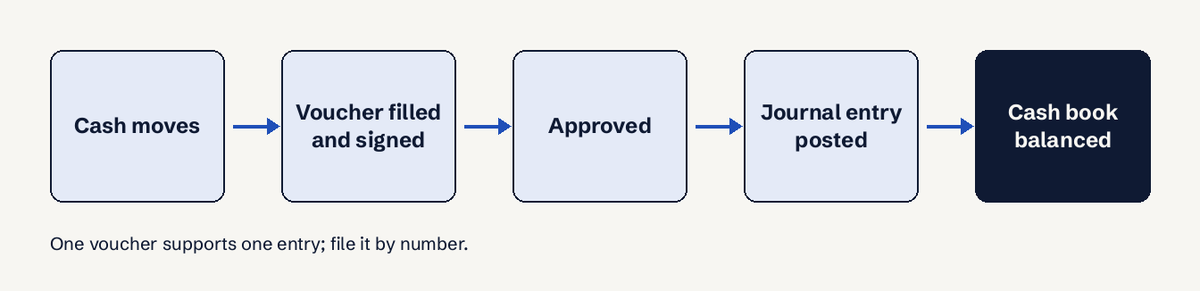
1. Cash payment voucher
Scenario: a trading firm pays ₹4,800 in cash to a local electrician for repairs.
| Field | Entry |
|---|---|
| Voucher no. | CP-0142 |
| Date | 12-11-2026 |
| Paid to | Ramesh Electricals |
| Account head | Repairs and Maintenance |
| Particulars | Rewiring of godown lights, bill no. 88 attached |
| Amount | ₹4,800.00 (Rupees four thousand eight hundred only) |
| Signatures | Prepared: accountant; Approved: owner; Received: Ramesh |
Journal entry: Repairs and Maintenance A/c Dr ₹4,800 to Cash A/c ₹4,800.
What it shows: a single outflow backed by the supplier's own bill. Adapt it: if the payee's bill is missing, write "no bill issued" in particulars and get the receiver's signature; that signed voucher is your evidence.
2. Cash receipt voucher
Scenario: a customer pays ₹18,500 in cash against invoice INV-2026-311.
| Field | Entry |
|---|---|
| Voucher no. | CR-0057 |
| Date | 13-11-2026 |
| Received from | Kavya Textiles |
| Account head | Kavya Textiles (Debtor) |
| Particulars | Against INV-2026-311, full settlement |
| Amount | ₹18,500.00 (Rupees eighteen thousand five hundred only) |
| Signatures | Received by: cashier; Checked by: accountant |
Journal entry: Cash A/c Dr ₹18,500 to Kavya Textiles A/c ₹18,500.
What it shows: the internal side of a receipt; the customer gets a separate receipt copy. Adapt it: never accept ₹2,00,000 or more in cash from one person in a day or for one transaction or event; the penalty under the old section 269ST equals the amount received, and the Income-tax Act, 2025 keeps the same limit from 1 April 2026.
3. Petty cash voucher for a ₹5,000 float
Scenario: the office pays ₹340 for courier and tea from a ₹5,000 imprest float.
| Field | Entry |
|---|---|
| Voucher no. | PC-0219 |
| Date | 14-11-2026 |
| Paid to | Blue Dart counter / tea vendor |
| Account head | Postage ₹220; Staff Welfare ₹120 |
| Particulars | Courier to Pune client; tea for audit team |
| Amount | ₹340.00 (Rupees three hundred forty only) |
| Signatures | Petty cashier; Approved: office manager |
Journal entry (when the float is topped up): Postage A/c Dr ₹220, Staff Welfare A/c Dr ₹120 to Cash A/c ₹340.
What it shows: one voucher can split across account heads. Adapt it: refill the float every 7 days or every 30 days, whichever you set. At each refill, total the petty cash vouchers, add the cash left, and check it equals ₹5,000; a gap of even 1% means a missing voucher.
4. Expense voucher
Scenario: a salesperson claims ₹2,450 spent on an auto and lunch while visiting clients.
| Field | Entry |
|---|---|
| Voucher no. | EX-0033 |
| Date | 10-11-2026 |
| Paid to | Arjun Mehta (employee) |
| Account head | Travelling ₹1,650; Business Promotion ₹800 |
| Particulars | Client visits, Andheri and Powai, receipts attached |
| Amount | ₹2,450.00 (Rupees two thousand four hundred fifty only) |
| Signatures | Claimant; Approved: sales head; Paid: cashier |
Journal entry: Travelling A/c Dr ₹1,650, Business Promotion A/c Dr ₹800 to Cash A/c ₹2,450.
What it shows: a reimbursement to a staff member, not a payment to a supplier. Adapt it: set a claim window, for example within 15 days of the visit, and attach every bill; for small items with no bill, the employee signs the voucher as the receiver.
5. Debit voucher
Scenario: cash of ₹12,000 is paid as an advance to a contractor. Banks and many firms call any cash-out voucher a "debit voucher" because the account named on it is debited.
| Field | Entry |
|---|---|
| Voucher no. | DV-0011 |
| Date | 05-11-2026 |
| Paid to | Sai Interiors |
| Account head | Advance to Sai Interiors |
| Particulars | Advance for office partition work, 40% of ₹30,000 quote |
| Amount | ₹12,000.00 |
| Signatures | Prepared, approved, received |
Journal entry: Advance to Sai Interiors A/c Dr ₹12,000 to Cash A/c ₹12,000.
What it shows: above ₹10,000 in a day to one person. Adapt it: an advance is not an expense yet, but when it is adjusted against the contractor's bill, a cash payment above ₹10,000 in a day to one person is disallowed as a deduction (section 40A(3) of the 1961 Act; ₹35,000 for transporters). Pay this by bank transfer or UPI instead.
6. Credit voucher
Scenario: ₹6,000 of scrap is sold for cash. A credit voucher names the account credited.
| Field | Entry |
|---|---|
| Voucher no. | CV-0008 |
| Date | 08-11-2026 |
| Received from | Shree Scrap Traders |
| Account head | Sale of Scrap |
| Particulars | 120 kg packing scrap at ₹50/kg |
| Amount | ₹6,000.00 |
| Signatures | Cashier; Accountant |
Journal entry: Cash A/c Dr ₹6,000 to Sale of Scrap A/c ₹6,000.
What it shows: a cash inflow that is not from a regular customer invoice. Adapt it: if the sale is taxable under GST, issue a tax invoice too at the rate for the scrap's HSN code; the voucher is internal and does not replace it.
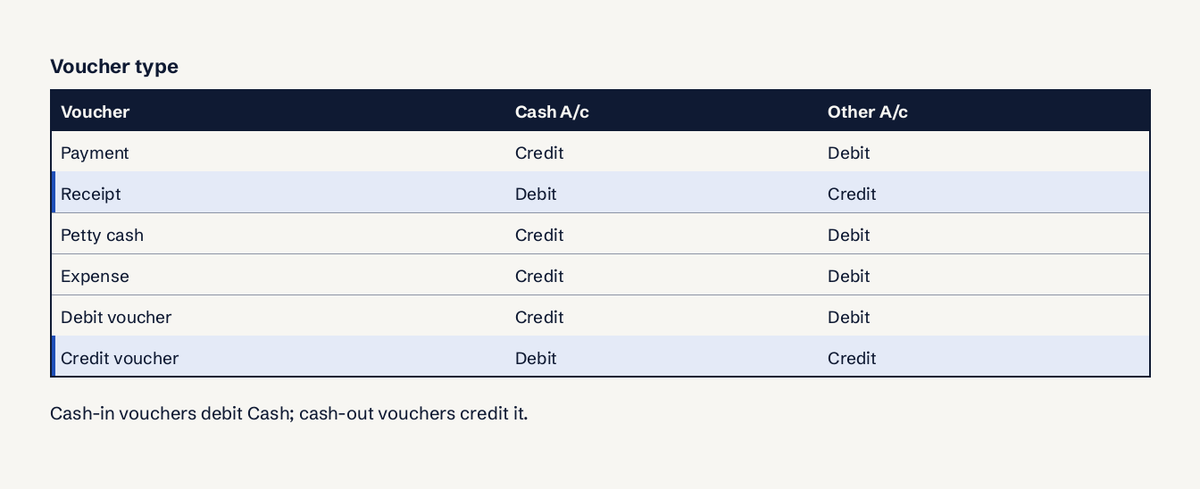
Which cash voucher format should you use?
| Situation | Use |
|---|---|
| Paying a supplier or worker in cash | Cash payment voucher |
| Customer pays you in cash | Cash receipt voucher (plus a receipt for the customer) |
| Small daily spends from a float | Petty cash voucher |
| Staff reimbursement | Expense voucher |
| Your bank or books name the debited account | Debit voucher |
| Cash in that is not a customer invoice | Credit voucher |
| GST reverse charge purchase from an unregistered supplier | GST payment voucher under CGST Rule 52 |
How does the petty cash book differ from the main cash book?
A cash voucher covers any cash payment or receipt, of any size, and is posted to the main cash book. A petty cash voucher covers small spends from a fixed float held by one person (the imprest system), and the vouchers are totalled and posted when the float is refilled. The fields are the same; the petty cash version usually has lower approval limits and splits one spend across several account heads.
Who signs a cash voucher?
Three people: the person who prepared it (accountant or cashier), the person who approved it (owner, manager or department head), and the person who received the cash (payee on a payment voucher, cashier on a receipt voucher). In a one-person business, sign as preparer and approver and get the payee's signature; Rule 6F(2)(e) of the Income-tax Rules, 1962 treats a signed payment voucher as the record when no bill is issued for a small expense.
Is it the same as a GST payment voucher?
No. A GST payment voucher is a statutory document under CGST Rule 52, issued by a registered recipient who pays tax under reverse charge. It must carry the supplier's name, address and GSTIN if registered, a consecutive serial number of up to 16 characters, the date, the recipient's details, a description, the amount paid, the tax rate and amount, the place of supply and a signature. An internal cash voucher has no prescribed format; use the fields above.
Cash limits to keep in mind
- Payments: cash above ₹10,000 per day to one person for a business expense is disallowed (section 40A(3) explained); ₹35,000 per day for hiring goods carriages. Rule 6DD lists exceptions.
- Receipts: no cash receipt of ₹2,00,000 or more from one person in a day, for one transaction or for one event (old section 269ST), with a penalty equal to the amount.
- New Act: the Income-tax Act, 2025 applies from 1 April 2026; the limits carry over under new section numbers, so check them with your CA.
This is information, not tax advice.
For balance checks at year end, see the trial balance format and balance sheet format.
Taking cash from a customer? Give them a proper numbered receipt with the free LuckPanda receipt generator. Drafts and branded PDFs are free; issuing and sending is ₹199 a month per module.
Questions
What is a cash voucher?
A cash voucher is an internal accounting document that records a payment or receipt made in cash, with a number, date, party, account head, amount and signatures. It is the evidence behind each line of the cash book.
What fields does a cash voucher format need?
Voucher number, date, paid to or received from, account head, particulars, amount in figures and words, and the signatures of the preparer, approver and receiver.
How does the petty cash book differ from the main cash book?
A cash voucher records any cash movement and posts to the main cash book. A petty cash voucher records small spends from a fixed float and is posted in total when the float is refilled.
Who signs a cash voucher?
The preparer, the approver and the person who received the cash. A signed voucher is the record for a small expense where no bill was issued.
Can I pay more than ₹10,000 in cash with a voucher?
You can, but the expense is not deductible for income tax when one person is paid more than ₹10,000 in cash in a day, unless a Rule 6DD exception applies. Pay by bank or UPI instead.
Is a debit voucher the same as a payment voucher?
Usually yes. A debit voucher names the account debited, which for a cash payment is the expense or party account, so most firms use the two terms for the same cash-out voucher.