 luckpanda
What Is Departmental Accounting? Meaning, Format and a Worked Example
Departmental accounting finds the profit of each department of one business. The columnar format, apportionment bases and a worked two-department example.
On this page
- What LuckPanda does for departmental accounts today
- What are the advantages of departmental accounting?
- What are the methods of departmental accounting?
- How are common expenses apportioned between departments?
- What is the format of departmental accounts?
- Worked example: a store with two departments
- How are inter-department transfers treated?
- Departmental accounts vs segment reporting
- Pitfalls to avoid
TL;DR: Departmental accounting prepares a separate trading and profit and loss account for each department of one business, so you can see which department earns and which one only looks busy. Direct income and costs go straight to their department; shared costs such as rent and salaries are apportioned on a fair basis (floor area, sales, time). LuckPanda keeps your books posted from your invoices, and its free profit margin calculator checks each department's margin in seconds.
Run a shop with two or three counters? Start free with LuckPanda Finance: invoices post to double-entry books for you, and budgets per account and month show where the money goes.
Departmental accounting is a system in which one business keeps the income and expenses of each of its departments separately, then apportions common expenses among them, to find the gross profit and net profit of every department. A single profit and loss account tells you the shop made money; departmental accounts tell you whether the clothing counter is carrying the footwear counter, or the other way round. The ICAI Intermediate study material describes the aim as finding "the working results of each department" to judge their relative efficiency (ICAI, Advanced Accounting study material).
A combined profit hides a losing department. In the worked example below, a store earns ₹32,000 net on ₹6,00,000 of sales, a 5.3% net margin. Split by department, Clothing keeps 3.7% of its ₹3,60,000 sales and Footwear keeps 7.8% of its ₹2,40,000. An owner looking only at the total would give the bigger department more floor space; the split shows each extra square foot of clothing costs rent at the 2:1 floor ratio while returning less than half Footwear's margin.
What LuckPanda does for departmental accounts today
LuckPanda's Finance module is double-entry accounting that posts from your documents (Finance module, read 2026-11-19):
- Every invoice and credit note you issue in Sales is posted to balanced journal entries, so sales figures are not typed twice.
- Posted entries are never edited; a mistake is corrected by a reversal, so the history is traceable.
- Budgets let you plan income and spending per account and month and compare them with the books.
- The free profit margin calculator and break-even calculator work for each department's figures, no account needed.
What it does not do: LuckPanda does not have department or cost-centre tags on transactions today, so it will not produce a columnar departmental P&L by itself. The practical route is to keep one sales and expense account per department in your books, then apportion common costs with the bases below. Paid use of the module is $4.99 per month, or ₹199 for a business in India (pricing).
What are the advantages of departmental accounting?
The ICAI material lists these advantages, each of which a small business can use:
- Evaluation of performance: each department's trading result is visible, so you can push the one that earns most.
- Growth potential: you can compare how fast each department grows against the others.
- Justification of capital outlay: you see whether the money put into a department's space, stock or staff pays back.
- Judgement of efficiency: stock turnover can be calculated per department.
- Planning and control: separate cost and profit figures make budgets and targets per department possible.
The cost is extra bookkeeping: more accounts, an apportionment worksheet each period, and the judgement calls that come with any allocation.
What are the methods of departmental accounting?
There are two methods (summary of the ICAI chapter):
- Columnar books (one set of books): the sales book, purchase book and ledger have one column per department. This suits small businesses and is what most shops do.
- Separate books per department: each department keeps a complete set, including stock received from and sent to other departments. Even then, common expenses still need apportioning to get net profit.
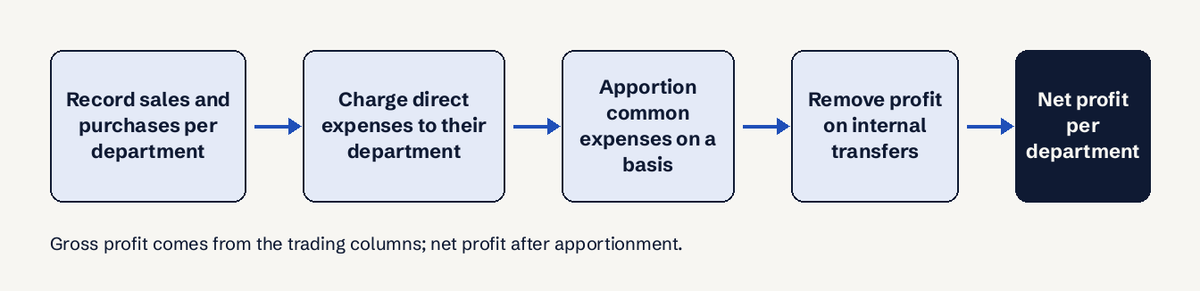
How are common expenses apportioned between departments?
Common expenses are apportioned on the basis that best reflects the benefit each department receives. Expenses that belong to one department (its own salesperson, insurance on its stock) are charged to it directly. The standard bases from the ICAI material are:
| Expense | Basis of apportionment |
|---|---|
| Rent, rates, taxes, building repairs and insurance | Floor area occupied (else time) |
| Lighting, heating, electricity | Energy used by each department (metered units) |
| Selling expenses: discount allowed, bad debts, sales commission, freight outward | Sales of each department |
| Carriage inward, discount received | Purchases of each department |
| Wages and salaries | Time devoted to each department |
| Depreciation, insurance and repairs of assets | Value of assets in each department |
| Administrative expenses, common advertisement | Time basis, sales, or equally |
| Labour welfare | Number of employees |
When a basis is not available, use the next most reasonable one and write it down so the same basis is used every period. Changing the basis each month makes the comparison meaningless.
What is the format of departmental accounts?
The format is a columnar trading and profit and loss account: one amount column per department on each side, plus a total column. The items are the same as an ordinary profit and loss account format; only the columns change. Your trial balance must already split sales, purchases and stock by department.
Worked example: a store with two departments
A store has a Clothing department and a Footwear department. Figures for the year, in rupees:
| Item | Clothing | Footwear | Total |
|---|---|---|---|
| Opening stock | 40,000 | 30,000 | 70,000 |
| Purchases | 2,40,000 | 1,50,000 | 3,90,000 |
| Sales | 3,60,000 | 2,40,000 | 6,00,000 |
| Closing stock | 50,000 | 20,000 | 70,000 |
Common expenses: rent ₹60,000 (floor area 2:1), electricity ₹18,000 (meter units 1,200:600), advertisement ₹28,000 (on sales, 3:2), salaries ₹72,000 (time, 2:1).
Step 1, gross profit. Clothing: 3,60,000 + 50,000 − 40,000 − 2,40,000 = ₹1,30,000. Footwear: 2,40,000 + 20,000 − 30,000 − 1,50,000 = ₹80,000.
Step 2, apportion and net profit:
| Item | Clothing | Footwear | Total |
|---|---|---|---|
| Gross profit | 1,30,000 | 80,000 | 2,10,000 |
| Rent (2:1) | 40,000 | 20,000 | 60,000 |
| Electricity (2:1 by units) | 12,000 | 6,000 | 18,000 |
| Advertisement (3:2) | 16,800 | 11,200 | 28,000 |
| Salaries (2:1) | 48,000 | 24,000 | 72,000 |
| Net profit | 13,200 | 18,800 | 32,000 |
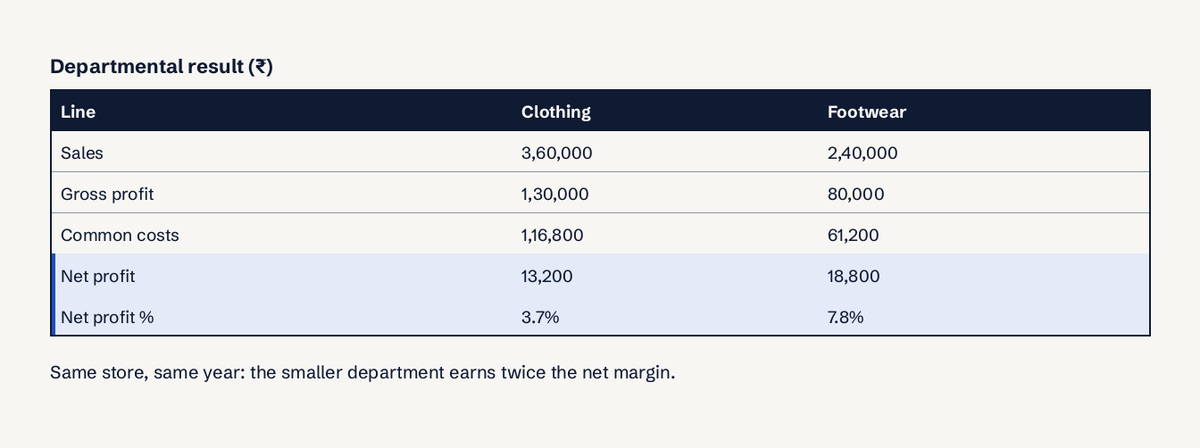
What it tells the owner: Clothing has 60% of sales and a slightly higher gross margin (36.1% against 33.3%), but it uses two-thirds of the floor and staff time. Its net margin is 3.7%; Footwear's is 7.8%. Giving more space to clothing would add rent and salary faster than profit. You can check each margin with the profit margin calculator.
How are inter-department transfers treated?
Goods sent from one department to another are recorded as a transfer: the sending department is credited and the receiving one is debited, usually at cost or at cost plus a margin. If the transfer price includes a margin, the part of it still sitting in the receiving department's closing stock is profit the business has not earned yet.
Example: Clothing transfers bags to Footwear at cost plus 25%. At year end Footwear holds ₹10,000 of these bags. Unrealised profit = 10,000 × 25 / 125 = ₹2,000. That amount is charged to Clothing's profit (or the combined account) and a stock reserve of ₹2,000 is deducted from closing stock in the balance sheet (ICAI chapter summary).
Departmental accounts vs segment reporting
They answer different questions:
| Departmental accounts | Segment reporting | |
|---|---|---|
| Purpose | Internal decisions | External financial statements |
| Who must do it | Optional, any business | Entities under AS 17 or Ind AS 108 |
| Detail | Trading and P&L per department | Revenue, result, assets per reportable segment |
| Format | Columnar, set by management | Set by the standard |
Segment reporting rules are in AS 17 and Ind AS 108 (ICAI). A small shop does not need them; it can still use departmental accounts.
Pitfalls to avoid
- Apportioning every cost by sales. It makes every department's net margin look the same and hides the answer you wanted.
- Changing bases between periods. Pick, document, keep.
- Closing a department on a net loss alone. Some apportioned costs (rent, the owner's salary) stay if the department closes. Check the department's contribution (gross profit minus its own direct costs) before deciding.
- Ignoring stock reserve on transfers. It overstates the receiving department's stock and profit.
Questions
What is departmental accounting in simple words?
It is keeping a separate profit figure for each department of the same business, by recording each department's sales, purchases and stock separately and sharing common costs among them on a fair basis.
What are the advantages of departmental accounting?
Performance evaluation per department, a view of each department's growth, a check on whether capital put into a department pays back, stock turnover per department, and better budgets and control.
How are common expenses apportioned between departments?
On the basis of benefit: rent by floor area, electricity by meter units, selling expenses by sales, carriage inward by purchases, salaries by time, asset costs by asset value, labour welfare by number of employees.
What is the format of departmental accounts?
A columnar trading and profit and loss account with one column per department and a total column, built from a trial balance that already splits sales, purchases and stock by department.
Can small businesses use departmental accounting?
Yes. The columnar method in one set of books suits a small shop. In LuckPanda, keep a sales and expense account per department, let invoices post to the books, and apportion common costs with the table above.
Is departmental accounting the same as branch accounting?
No. Departments share one location and usually one set of books; branches are separate locations that often keep their own books and send returns to the head office.
Ready to see each department's numbers without retyping invoices? Start free with LuckPanda Finance, then use the free balance sheet format at year end.