 luckpanda
Inbound Lead Qualification: A 6-Step Process for Small Teams
Inbound lead qualification sorts website leads by fit and urgency the moment they arrive: set fit rules, ask two questions, score, route and follow up fast.
On this page
- What is inbound lead qualification?
- Which leads count as ready to buy?
- What you need before you start
- The 6 steps, from first message to follow-up
- Step 4 in detail: a scoring sheet you can copy
- Response targets by band
- Which framework works for small businesses?
- How fast should you follow up an inbound lead?
- How LuckPanda Chatbot qualifies website leads
- How to check your process works
- Common mistakes and fixes
- What to do with leads that do not qualify
TL;DR: Inbound lead qualification is deciding, as each enquiry arrives, whether the person fits what you sell and how soon they want it, so the best leads get a reply first. For a small team that means six steps: write down fit rules, ask two questions at the moment of contact, capture five fields, score, route and follow up within the hour. LuckPanda Chatbot does the asking, capturing and summarising on your website, so you open each lead already qualified.
Try LuckPanda Chatbot on your website for free: paste your address, no account needed.
To qualify inbound leads, judge two things for every person who contacts you: fit (can you serve them, and can they pay for it?) and timing (do they want to buy soon?). Get both answers in the first exchange instead of a later discovery call, write them into the same fields every time, and give each lead a score that decides who replies and how fast. Hot leads get a person within minutes, warm leads within a day, and leads that do not fit get a polite, useful no. The rest of this guide shows each step with the exact questions, fields and thresholds to use.
What is inbound lead qualification?
Inbound lead qualification is the check you run on people who came to you first: they filled a form, started a chat, called or emailed. Outbound qualification checks people you contacted; inbound leads have already shown interest, so the question is not "are they interested?" but "can we help them, and how urgent is it?"
The classic framework is BANT: Budget, Authority, Need and Timeline, first used at IBM (Quo). It still works as a checklist, but asking all four as a questionnaire at the first touch feels like an interrogation. Most small businesses only need Need and Timeline asked out loud; Budget and Authority usually show up in what the person says.
Which leads count as ready to buy?
A lead is qualified when three things are true:
- Fit: they want something you actually sell, in a place and at a size you serve.
- Need with a reason: they can say what problem they are solving, not just "send pricing".
- A timeline: they plan to decide within a period you can work with: 7 days, 30 days or 90 days.
Budget matters when your price is a filter (a ₹5 lakh project and a ₹5,000 enquiry are different businesses). Authority matters when you sell to companies. For a café, a clinic or an agency, fit plus timeline is usually enough to decide who gets the first call.
Scoring alone is not qualification. Forrester's waterfall benchmarks put inquiry-to-closed-won conversion in a lead-centric process under 1%, as Spara notes, which is why page-visit points and job titles cannot replace an actual answer from the buyer.
What you need before you start
- A list of what you sell and who you do not serve (locations, minimum order, job types you turn down).
- One place where every lead lands with the same fields: a CRM, or a spreadsheet if you are starting out (see our Google Sheets CRM template).
- A way to ask questions at the moment of contact: a short form, a chat on your website, or a phone script.
- One person who owns follow-up for each hour of the day you sell.
The 6 steps, from first message to follow-up
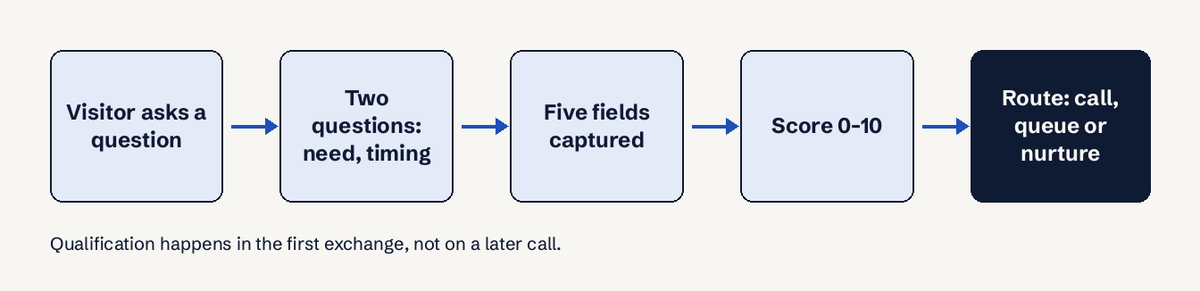
- Write your fit rules. Three to five lines, each one a yes or no. Example for a web design studio: "Business website, not a personal blog", "Based in India, UAE or UK", "Budget ₹60,000 or more", "Launch within 3 months". Anything that fails a hard rule is not qualified, however keen.
- Ask two questions at first contact. One about the need, one about timing: "What are you hoping to get done?" and "When do you need it by?". Two questions get answered; a ten-field form gets abandoned. Add a third only if it is a hard rule (location or size).
- Capture the same five fields every time. Name, contact, need (in their words), timeline, size or budget, plus the page they came from.
- Score with a simple 0-10. Add points for fit and urgency, as in the table below.
- Route by score. Hot to a person now, warm to a same-day queue, cold to a nurture email, no-fit to a polite close.
- Follow up inside the window, then review weekly. Look at which questions buyers asked and which leads you lost, and tune the rules.
Step 4 in detail: a scoring sheet you can copy
| Signal | Points |
|---|---|
| Wants a product or service you sell | 3 |
| Location and size inside your rules | 2 |
| Timeline under 30 days | 3 |
| Timeline 1 to 3 months | 1 |
| Named budget at or above your minimum | 1 |
| Decision maker or says who decides | 1 |
Timeline answers map to points like this: under 30 days scores 3, 30 to 90 days scores 1, over 90 days scores 0.
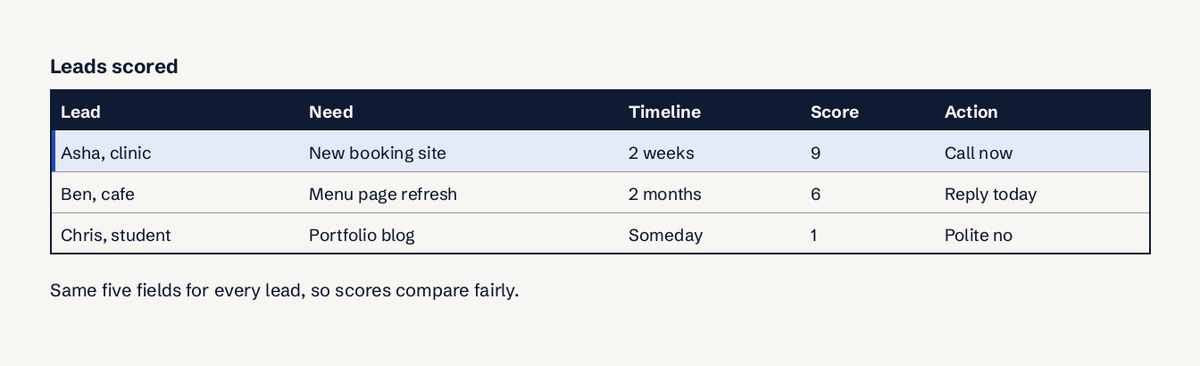
Bands, adapted from the ones Quo suggests for small businesses: 8-10 hot (reply within minutes), 5-7 warm (reply the same working day, at most 24 hours), 2-4 cold (useful email and a check-in later), 0-1 or a failed hard rule: no fit.
Response targets by band
| Band | First reply | Second touch | Give up after |
|---|---|---|---|
| Hot (8-10) | 5 minutes | 24 hours | 14 days |
| Warm (5-7) | 4 hours | 3 days | 30 days |
| Cold (2-4) | 24 hours | 30 days | 90 days |
| No fit (0-1) | 24 hours | none | none |
These are starting points: tighten them once you know how fast your own buyers go cold.
Which framework works for small businesses?
Use a cut-down BANT: Need and Timeline asked directly, Budget and Authority inferred or asked only when they decide the outcome. Bigger frameworks such as MEDDIC (Metrics, Economic buyer, Decision criteria, Decision process, Identify pain, Champion) and CHAMP (Challenges, Authority, Money, Prioritisation) are built for multi-month B2B deals with buying committees. If your typical sale closes in one or two conversations, they add questions without changing who you call first.
| Framework | Best for | Questions at first contact |
|---|---|---|
| Need + Timeline (cut-down BANT) | Local services, agencies, shops, small B2B | 2 |
| BANT | B2B with a fixed price floor | 4 |
| CHAMP | B2B where the problem leads the sale | 4 |
| MEDDIC | Enterprise deals with several buyers | 6+ |
For ready-made wording, see our list of sales qualifying questions.
How fast should you follow up an inbound lead?
Within an hour at the latest, and within minutes for a hot lead. The Harvard Business Review audit "The Short Life of Online Sales Leads" (March 2011) tested 2,241 US companies and found that firms which contacted a web lead within an hour were nearly seven times as likely to qualify it as firms that waited longer (study record). Our guide to speed to lead covers how to set that up with a small team.
Speed is the hard part for a small business: the enquiry that arrives at 11 pm or during a client meeting is the one that goes cold. That is the gap a website chatbot closes, because the qualifying questions get asked while the visitor is still on the page.
How LuckPanda Chatbot qualifies website leads
LuckPanda Chatbot is an AI chatbot for your website that turns visitors into customers. For lead qualification it does steps 2, 3 and 5 for you, at the moment the visitor is interested:
- Answers first. It answers from your own pages, documents and FAQs. When the answer is not there it says so and offers to pass the chat to a person; it does not guess prices or policies.
- Asks at most two or three short questions. It asks for contact details only once a visitor wants something, then suggests one next step that fits what they said.
- Hands you a summary. Leads come with a summary of the need, timeline and size, so the five fields are filled before you open the lead. Leads go into LuckPanda CRM, with email alerts and webhooks.
- Keeps the full chat. Every chat is saved word for word with the page it started on.
- Lets you take over. Chats that need a person are flagged as waiting; you take over, reply as your business and hand back. The bot stays quiet while you have it. See chatbot human handoff.
- Shows what buyers wanted. With request logging on, things visitors asked for that you do not offer yet are grouped on a Requests board, ranked by how many different people asked, with a weekly digest. That is step 6 done for you.
Setup: paste your website address and LuckPanda builds a preview that reads up to 30 pages and answers up to 20 questions, with no account, kept for 7 days. To go live, add one line of script before the closing body tag (WordPress, Shopify, Wix, Webflow or plain HTML; there are no platform plugins yet). The Chatbot plan is $4.99 a month or $44.91 a year, tax included, for up to 10 websites (₹199 or ₹1,791 for a business in India). More on the AI sales agent and the lead generation use case.
What it does not do: it does not score leads with your custom points table, call people, or work inside WhatsApp or Instagram. Use the summary fields to apply the score in step 4 yourself.
How to check your process works
After two weeks, pull every lead and check four numbers:
- Share with all five fields filled. Under 80% means the questions are too many or asked too late.
- Time to first reply for hot leads. Should be under 5 minutes in working hours and under 60 minutes outside them.
- Hot leads that became customers vs warm and cold. If warm leads close as often as hot ones, your timeline points are wrong.
- No-fit leads that later bought. If any did, a hard rule is too strict.
Common mistakes and fixes
- Long forms. A form asking budget, company size, role and needs before a single answer loses people. Ask two questions; infer the rest.
- Scoring page visits instead of answers. Three blog visits is curiosity, not need. Score what they told you.
- One queue for every lead. A hot lead waiting behind twenty cold ones is a lost sale. Route by score.
- No answer for no-fit leads. Send a short, honest reply and, where you can, a referral. It protects your reputation and some come back.
- Never reading the chats. The questions people ask before buying tell you what to put on your pages and what to sell next.
What to do with leads that do not qualify
Decide whether they are "not now" or "not ever". Not-now leads (good fit, no timeline) go on a monthly email with something useful. Not-ever leads (outside your rules) get a polite close the same day. Log the reason either way: if the same reason shows up every week, it may be a market you should serve.
Questions
How do you qualify inbound leads?
Check fit and timing at first contact. Ask what they want to get done and by when, capture five fields (name, contact, need, timeline, size), score 0-10 and route: hot leads get a person within minutes, warm leads the same day.
Which leads count as ready to buy?
A qualified inbound lead wants something you sell, fits your location and size rules, can explain the need, and plans to decide within a timeline you can work with.
Which lead qualification framework is best for a small business?
A cut-down BANT: ask Need and Timeline directly, infer Budget and Authority. MEDDIC and CHAMP are built for long B2B deals with several decision makers.
How fast should I respond to an inbound lead?
Within an hour at most and within minutes for hot leads. The 2011 HBR audit of 2,241 US companies found firms replying within an hour were nearly seven times as likely to qualify the lead.
Can a chatbot qualify leads?
Yes, for the first exchange. LuckPanda Chatbot answers from your content, asks at most two or three short questions, collects contact details once the visitor wants something, and hands you a summary of need, timeline and size. A person still makes the call.
What is the difference between an MQL and an SQL?
A marketing qualified lead (MQL) has shown interest, such as downloading a guide. A sales qualified lead (SQL) has confirmed a need and timeline that sales can act on. Inbound qualification is the step that turns one into the other.
Want every website visitor asked the right two questions, day and night? Build your LuckPanda Chatbot free: paste your website address and see it answer in seconds.