 luckpanda
Sales Qualifying Questions: 40 Examples by Framework
Sales qualifying questions check need, timeline, budget and authority. 40 examples by framework and channel, plus the 3 that work in website chat.
On this page
- What are sales qualifying questions?
- How LuckPanda Chatbot qualifies website visitors
- 1. BANT: budget, authority, need and timeline (10 examples)
- 2. MEDDIC for multi-stakeholder deals (8 examples)
- 3. GPCTBA/C&I for consultative selling (8 examples)
- 4. Inbound form and quote request callbacks (5 examples)
- 5. Cold calls in the first 60 seconds (4 examples)
- 6. Website chat and chatbot conversations (5 examples)
- Which qualifying questions should you use?
- When should you ask for contact details?
- Try it on your own website
TL;DR: Sales qualifying questions are the questions that tell you whether a prospect needs what you sell, can buy it and will buy it soon. Use the full lists below on a discovery call, but in a website chat ask only two or three, which is how LuckPanda Chatbot qualifies visitors before handing you the lead.
Sales qualifying questions (also called lead qualification questions) check four things: the problem the buyer wants solved, when they need it solved, what they can spend and who decides. The classic set is BANT (Budget, Authority, Need, Timeline), developed by IBM sales leaders in the 1950s (Built In). The best single qualifying question is "What made you look for this now?", because the answer gives you need and timeline in one reply. How many you ask depends on the channel: 8 to 15 on a booked call, 3 to 5 on a cold call, and 2 or 3 in a chat.
Want a website chat that asks the right two questions for you? Build a free LuckPanda Chatbot preview from your website address. No account needed.
What are sales qualifying questions?
Sales qualifying questions are questions a seller asks to decide whether a lead is worth more time. They are not discovery for its own sake: each one should change what you do next (book a demo, send a price, refer the buyer elsewhere or stop). A question whose answer would not change your next step is not a qualifying question.
Most question lists come from one of four frameworks:
| Framework | Origin | Checks |
|---|---|---|
| BANT | IBM, 1950s | Budget, Authority, Need, Timeline |
| MEDDIC | PTC, 1996 | Metrics, Economic buyer, Decision criteria, Decision process, Identify pain, Champion |
| GPCTBA/C&I | HubSpot | Goals, Plans, Challenges, Timeline, Budget, Authority, Consequences, Implications |
| CHAMP / ANUM | Variants of BANT | Same checks, need or authority first |
MEDDIC was created in 1996 inside PTC by Dick Dunkel, working under SVP John McMahon with Jack Napoli, by studying why deals were won, lost or slipped (MEDDICC). MEDDICC adds Competition and MEDDPICC adds a Paper Process, for eight checkpoints. GPCTBA/C&I is HubSpot's longer rework of BANT (Weflow).
How LuckPanda Chatbot qualifies website visitors
LuckPanda Chatbot is an AI chatbot for your website that answers from your own pages and documents, then qualifies the visitor in the chat. Its rules are the ones this article recommends for chat:
- It answers the visitor's question first, from your content only.
- It asks at most two or three short questions.
- It asks for contact details only once a visitor wants something.
- It suggests one next step that fits what they said.
- After you keep it, it reads up to 50 pages per website plus documents up to 5 MB each, so answers to pricing and delivery questions come from your own files.
- Leads come with a summary of the need, timeline and size, and every chat is saved word for word with the page it started on.
Setting up and testing are free. Putting it on a website costs $4.99 a month or $44.91 a year for up to 10 websites (₹199 a month in India), tax included (pricing).
1. BANT: budget, authority, need and timeline (10 examples)
Scenario: an outbound or inbound B2B call where you need a quick yes or no.
- Budget: "Have you set aside a budget for this, or would it need approval?"
- Budget: "What are you spending on this problem today, in money or hours?"
- Authority: "Who else will be involved in choosing a supplier?"
- Authority: "How have you bought tools like this before?"
- Need: "What made you look for this now?"
- Need: "What happens if you do nothing this quarter?"
- Need: "What have you already tried?"
- Timeline: "When do you need this working?"
- Timeline: "Is there a date driving that, like a launch or a renewal?"
- Timeline: "What could push the decision back?"
What it shows: fit in under 10 minutes, across 4 checks.
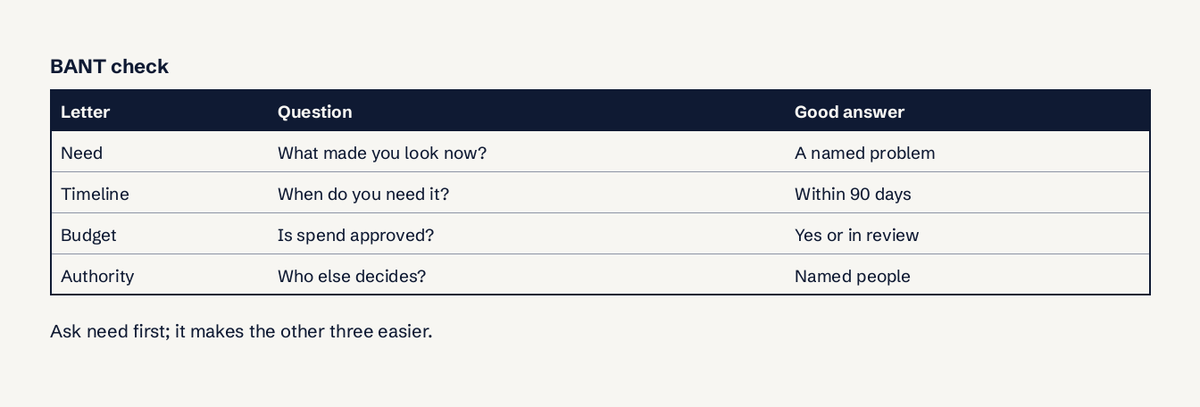
How to adapt: lead with need, not budget. Built In quotes sales leader Ganesh Shenbagaraman warning that BANT used as a checklist makes it "very difficult to build trust" (Built In).
2. MEDDIC for multi-stakeholder deals (8 examples)
Scenario: a larger deal with several stakeholders and a formal buying process.
- Metrics: "How will you measure whether this worked?"
- Economic buyer: "Who signs off on the spend?"
- Decision criteria: "What will you compare suppliers on?"
- Decision process: "What are the steps between today and a signed order?"
- Identify pain: "What does this problem cost you each month?"
- Champion: "Who on your side wants this to happen most?"
- Competition (MEDDICC): "Who else are you looking at?"
- Paper process (MEDDPICC): "Does procurement or legal need to review the contract?"
What it shows: whether a 6-to-8-step buying process can close, and who can block it. How to adapt: spread these over 2 or 3 calls. Asking all eight on a first call feels like an audit.
3. GPCTBA/C&I for consultative selling (8 examples)
Scenario: consultative sales where the buyer's goals matter more than their budget line. HubSpot's version runs to 8 letters, so expect a 30 to 45 minute call.
- Goals: "What are you trying to achieve this year?"
- Plans: "How were you planning to get there?"
- Challenges: "What is getting in the way?"
- Timeline: "When do you want to see results?"
- Budget: "Have you planned spend for this goal?"
- Authority: "Who decides on how the goal gets met?"
- Consequences: "What happens if you miss the goal?"
- Implications: "If it works, what changes for you and your team?"
4. Inbound form and quote request callbacks (5 examples)
Scenario: someone filled in a form or requested a quote and you call back.
- "What did you want to get from the request you sent?"
- "What are you using today?"
- "How many people, sites or orders is this for?"
- "When would you like to start?"
- "Would a short demo or a price first be more useful?"
Call within 5 minutes if you can, and within 1 hour at worst: an HBR study of 1.25 million leads found firms that tried to contact a lead within an hour were nearly 7 times as likely to qualify it as firms that waited longer (HBR, 2011). More in our guide to speed to lead.
5. Cold calls in the first 60 seconds (4 examples)
Scenario: the prospect did not ask to hear from you. You have about 60 seconds before they hang up, so 4 questions is the ceiling.
- "How do you handle <problem> today?"
- "Is that working, or is it on the list to fix?"
- "Who looks after that on your side?"
- "Worth 15 minutes next week to see if we can help?"
6. Website chat and chatbot conversations (5 examples)
Scenario: a visitor asks a question in your website chat. They did not book a call, and every extra question risks losing them.
- "What is it for: home, a business, or a client?" (fit)
- "Roughly how many <units, people, rooms> do you need?" (size)
- "When are you hoping to start?" (timeline)
- "Would you like a quote, a call, or to book directly?" (next step)
- "What is the best email to send it to?" (only after they asked for something)
Pick two or three, never all five, and always answer their question before you ask yours. A visitor who has waited 2 minutes for a reply is already half gone, so keep each question to one line. Budget and authority rarely belong in a chat: the price on your page qualifies budget, and a small business visitor usually is the decision maker.
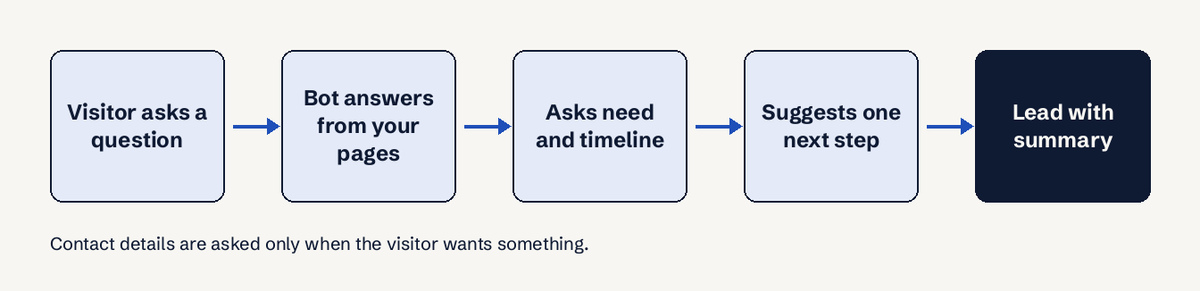
Here is how that reads in a real chat for a cleaning company:
| Turn | Message |
|---|---|
| Visitor | Do you clean offices on weekends? |
| Bot | Yes, Saturdays and Sundays from 7 am. How big is the office, roughly? |
| Visitor | About 2,000 sq ft. |
| Bot | Thanks. When would you like to start? |
| Visitor | In 14 days. |
| Bot | I can ask the team for a quote for a 2,000 sq ft weekend clean starting in 14 days. What email should they send it to? |
The scripts in our chatbot scripts guide follow the same pattern.
Which qualifying questions should you use?
| Channel | Framework | How many | Start with |
|---|---|---|---|
| Website chat | Need + timeline | 2-3 | "What is it for?" |
| Inbound callback | BANT, need first | 4-6 | "What did you want from your request?" |
| Cold call | Need + authority | 3-4 | "How do you handle this today?" |
| Booked discovery call | BANT or GPCTBA/C&I | 8-15 | "What made you look for this now?" |
| Enterprise deal | MEDDICC / MEDDPICC | Over several calls | "How will you measure success?" |
Ask as many as the buyer has given you time for. On a booked 30-minute call, 8 to 15 is normal. On a cold call, 3 or 4 in the first 60 seconds. In a website chat, 2 or 3, because the visitor came for an answer, not an interview. If you need more, move the conversation to a call.
When should you ask for contact details?
Ask for contact details once the visitor wants something you have to send: a quote, a booking, a call back. Asking for an email before answering a question is the fastest way to end a chat. LuckPanda Chatbot follows this rule by default.
Try it on your own website
Paste your website address and LuckPanda builds a chatbot that answers from your own pages and asks the right qualifying questions. The preview reads up to 30 pages, answers up to 20 questions, is kept for 7 days and needs no account. The chat opens after about five pages are read or 30 seconds. Build your free chatbot preview.
Questions
What are the 4 qualifying questions in BANT?
"Do you have a budget for this?", "Who makes the decision?", "What problem are you solving?" and "When do you need it?" Ask need first; it makes the other three easier to answer.
What is the best sales qualifying question?
"What made you look for this now?" It surfaces both the need and the urgency, and buyers answer it freely because it is about them.
Which qualifying questions work in live chat or a chatbot?
Fit, size and timeline questions work in chat: "What is it for?", "How many do you need?" and "When do you want to start?" Skip budget and authority in chat. See our live chat best practices.
Is BANT still useful?
Yes, as a list of things to learn, not a script to read. Newer frameworks such as MEDDIC and GPCTBA/C&I add goals, pain and the buying process for larger deals.
Can a chatbot qualify leads on its own?
It can collect the answers and summarise them. LuckPanda Chatbot asks up to two or three questions, suggests one next step and passes the lead to your team with a summary of the need, timeline and size; a person still decides.